A new study in PLOS Biology reports the first experimental evidence that non-human primates can experience the uncanny valley—an effect long discussed in humans—when viewing artificially generated body animations. The work centers on rhesus macaques, animals whose social lives depend on rich visual signals from both faces and full-body movement.
Researchers built a specialized animation pipeline, dubbed “MacAction,” designed for macaques rather than humans. Conventional motion-capture approaches rely on reflective markers, but applying them to monkeys is impractical. MacAction instead uses deep learning to generate realistic 3D body avatars from multi-camera video footage, producing motion that matches real animals closely enough to support controlled experiments.
To validate realism, the team presented eight male rhesus macaques with paired stimuli: recordings of real monkeys performing specific movements, and an animated avatar executing the same actions. By tracking where the macaques looked, how often they fixated, and for how long, the researchers found no meaningful differences in attention patterns between real and animated targets. In other words, the avatars were believable to the monkeys.
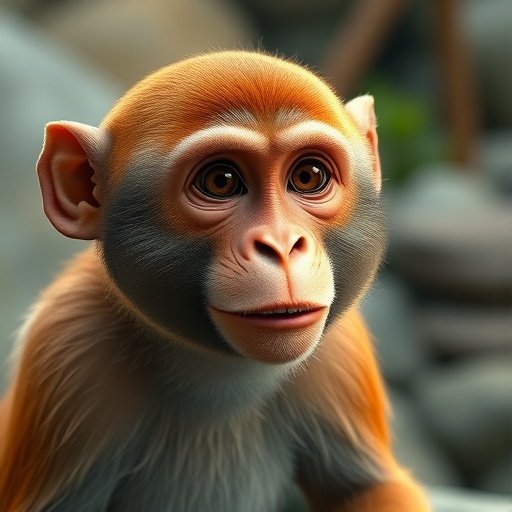
Having established that the system can generate highly convincing motion, the researchers then asked a sharper question: does “almost real” look worse than “not quite real”? They systematically altered the avatar’s appearance in stages, sequentially removing fur, color, and texture to create different realism levels, from uncanny to highly naturalistic.
The results showed a U-shaped relationship between realism and attention. Macaques spent less time looking at avatars with intermediate realism than they did at both extremes—very unrealistic animations and the most lifelike version. This pattern matches the classic uncanny valley signature, suggesting that macaques are sensitive to subtle deviations in body appearance.
Importantly, the uncanny valley effect here is not about faces alone. The study highlights body perception and the motion-and-structure cues primates use to interpret social signals, extending uncanny valley research beyond human-like facial rendering.
Beyond behavioral insight, the tool itself opens new experimental possibilities. By enabling realistic full-body animations with limited resources and marker-less tracking, MacAction offers a practical way to manipulate pose and social dynamics in controlled neurobehavioral studies.
The paper’s findings argue that social perception in macaques and humans shares striking parallels: both systems treat nearly realistic artificial bodies as potentially unsettling, even when the movement is accurate.
The study is open access and can be read here: https://plos.io/3QfoqJe
Subject of Research: Animals; primates (rhesus macaques)
Article Title: Realistic monkey body animation reveals an uncanny valley in macaque body perception.
News Publication Date: 14-Jul-2026
Web References: https://plos.io/3QfoqJe
References: Martini LM, Bognár A, Vogels R, Giese MA (2026) Realistic monkey body animation reveals an uncanny valley in macaque body perception. PLoS Biol 24(7): e3003880. DOI: 10.1371/journal.pbio.3003880
Image Credits: Lucas Martini et al. (CC-BY 4.0)
Keywords: uncanny valley; macaques; 3D avatars; deep learning; markerless tracking; primate social perception; PLOS Biology
Tags: 3D animated monkey avatarsanimation pipeline for non-human primatesartificial body animation in non-human primatesdeep learning for primate motion captureeffects of near-realistic avatars on primatesexperimental evidence of uncanny valley in animalsmacaque gaze and attention trackingprimate response to artificial stimulirealistic primate motion generationrhesus macaque social perceptionuncanny valley in primatesvalidation of animated primate realism