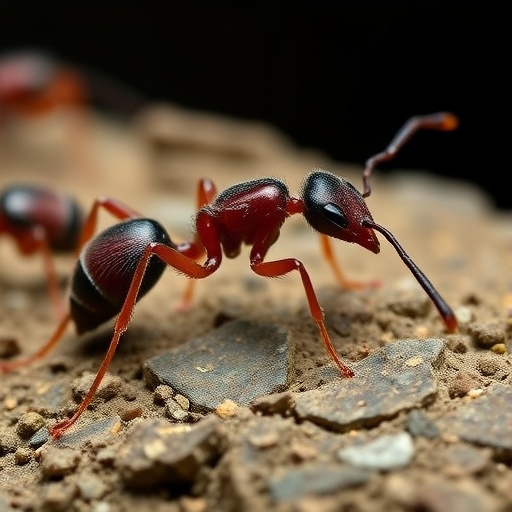
Ancient Neuropeptides Link Nutrition to Alloparental Care in Ants
A groundbreaking study has unveiled how ancient neuropeptides, originally involved in feeding regulation, have been co-opted to govern parental care behaviors in ants. This scientific advance sheds light on the intricate molecular mechanisms that underpin social behavior evolution, with implications for understanding complex neurobiological circuits conserved across species.
Researchers focused on two highly conserved neuropeptides: neuropeptide F (NPF) and allatostatin A (AstA). These molecules have long been implicated in the modulation of feeding behaviors, typically exerting opposing effects—NPF promotes feeding during hunger, whereas AstA suppresses feeding during satiety. The team investigated whether these ancestral neuromodulators also regulate brood-care behavior in the clonal raider ant, Ooceraea biroi.
Using an experimental design where cohorts of young ants were subjected to either prolonged starvation or feeding, the scientists measured both behavioral interactions with larvae and neuropeptide levels in specific brain regions. Starved ants displayed significantly increased brood-care behavior, engaging more with larvae compared to their well-fed counterparts. Crucially, no larval cannibalism occurred, suggesting that starvation selectively enhanced caregiving rather than aggressive or foraging behaviors.
This counterintuitive finding contrasts with patterns observed in many solitary and social insects, where hunger typically drives increased foraging rather than parental care. The authors propose this reversal reflects the species’ unique phasic life cycle, characterized by alternating reproductive and foraging phases, during which the neuroendocrine regulation of behavior undergoes pronounced shifts.
Immunohistochemical analyses revealed that in starved ants, NPF levels rose significantly in the antennal lobe and anterior dorsoposterior protocerebrum (adPC), key neural centers involved in sensory processing and behavioral regulation. Conversely, AstA levels increased in the antennal lobe and protocerebrum of fed ants, aligning with their reduced brood-care activity. These region-specific neuromodulatory changes parallel shifts in behavior, indicating a direct biochemical mechanism linking nutritional state to alloparental care.
The study highlights an ancient neurochemical framework that transitions an animal’s behavioral priorities—from feeding to nurturing—through the modulation of conserved neuropeptide pathways. Moreover, the co-option of feeding-related circuitry for social function demonstrates a remarkable example of evolutionary innovation in the neural control of complex social behaviors.
By elucidating how age and nutritional status influence NPF and AstA expression in ant brains, this work provides unprecedented insight into the neuromodulatory basis of division of labor and social interactions in eusocial insects. It opens avenues for further exploration into how ancient molecular systems have been adapted to shape the dynamics of cooperative brood care, a hallmark of insect sociality.
This discovery has broader implications, offering a model for understanding the neurogenetic foundations of caregiving behaviors not only in insects but potentially across diverse animal taxa where feeding circuits may underlie parental and alloparental care strategies.
Subject of Research:
The regulation of alloparental care in ants through conserved feeding-related neuropeptides.
Article Title:
Ancient feeding-related neuropeptides regulate alloparenting in ants.
Article References:
Paul, A., Kay, T., Lacroix, I. et al. Ancient feeding-related neuropeptides regulate alloparenting in ants. Nature (2026). https://doi.org/10.1038/s41586-026-10747-6
Image Credits: AI Generated
DOI:
https://doi.org/10.1038/s41586-026-10747-6
Tags: ant neuropeptides NPF and AstA modulate alloparental behavior in response to nutritional statelinking feeding regulation pathways to social caregiving behaviorsrevealing conserved neurobiological mechanisms across species.