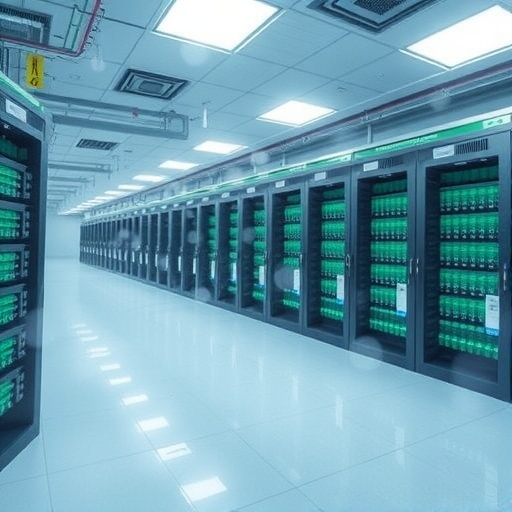
As the digital era continues to expand at an unprecedented pace, the vast infrastructures supporting our global data exchange have become pivotal to everyday life. Among these infrastructures, data centers stand out due to their critical role in cloud computing, internet services, and the storage of immense amounts of information. However, they face a growing challenge that threatens their operational efficiency and sustainability: the escalating heat and humidity driven by climate change. The latest research conducted by Karamperidou, Casselman, Cleveland, and colleagues highlights a pressing issue within the realm of data center cooling technologies. Their study, published in Scientific Reports in 2026, meticulously investigates the limitations of air free cooling systems in data centers confronted with rising thermal and moisture loads.
To understand the significance of their findings, it is essential to first grasp the fundamental concept behind air free cooling in data centers. Traditionally, these facilities rely heavily on mechanical cooling methods, such as chillers and compressors, which consume substantial amounts of energy and contribute significantly to greenhouse gas emissions. Air free cooling is an alternative approach that leverages ambient outdoor air to dissipate heat generated by servers, thereby reducing reliance on energy-intensive cooling equipment. By pulling in cooler external air when conditions allow, data centers can lower operational costs and minimize their environmental footprint.
However, the viability of air free cooling is inherently sensitive to the climate conditions surrounding the data center’s location. While it works efficiently in cooler and drier environments, the researchers emphasize that rising global temperatures and increasing humidity levels pose formidable obstacles. High humidity impairs the effectiveness of heat exchange processes and also risks introducing moisture-related hazards such as condensation and corrosion within electronic equipment. The study’s simulations suggest that in certain regions, the window of opportunity for utilizing air free cooling is steadily shrinking as warming trends accelerate.
The research team employed a multifaceted approach, combining climate modeling, thermal system analysis, and empirical data from operational data centers around the world. This comprehensive methodology allowed them to quantify the degradation in performance of air free cooling systems under various projected climate futures. Intriguingly, the models reveal a non-linear relationship between temperature, humidity, and cooling capacity, indicating that incremental increases in temperature can drastically reduce the time periods during which air free cooling remains viable. This compounding effect challenges the assumption that minor climate variations can be managed with straightforward system adjustments.
In addition to diminished operational windows, the study highlights the risks posed by humidity’s impact on hardware reliability. Moist environments can accelerate corrosion of metal components and promote accumulation of moisture on circuit boards, both of which increase the likelihood of equipment failure. Given the critical importance of uptime and data integrity in modern data centers, these findings raise significant concerns. The authors argue that climate-driven limitations may force a reevaluation of air free cooling strategy in favor of more robust—and potentially more energy-consuming—cooling methodologies.
The implications of this research stretch beyond the engineering domain to encompass economic and environmental considerations. Data centers consume an estimated 1% of global electricity, a figure poised to rise with expanding digitalization. Transitioning away from energy-efficient cooling solutions like air free cooling could exacerbate this trend, leading to increased carbon emissions. The study calls attention to this precarious trade-off, urging innovation in adaptive cooling technologies that balance performance, sustainability, and resilience to climate variability.
Furthermore, the findings underscore the necessity for site-specific strategies when designing or retrofitting data centers. Uniform cooling solutions may no longer suffice in a world where local climate conditions are rapidly evolving. Future facilities might require integrated systems that dynamically switch between air free cooling and mechanical methods depending on real-time atmospheric parameters. Advances in sensor technologies and automated control systems could play a crucial role in optimizing such hybrid cooling approaches.
Another dimension explored by the authors relates to the role of architectural and urban planning in mitigating the thermal challenges faced by data centers. The positioning of facilities with respect to prevailing winds, green buffer zones, and reflective building materials can influence local microclimates and improve passive cooling performance. Thus, interdisciplinary collaboration between climatologists, engineers, and urban planners becomes essential to develop sustainable data infrastructure in the face of climate change.
The study also invites reflection on the broader systemic vulnerabilities introduced by climate change in critical infrastructure networks. As heatwaves become more frequent and severe, data centers might experience concurrent environmental stresses such as power grid instability and water scarcity, complicating the management of cooling systems. The researchers advocate for comprehensive risk assessments that integrate climate projections with infrastructure resilience planning to ensure uninterrupted digital service delivery.
Intriguingly, the work challenges the prevailing optimism surrounding air free cooling as a universal solution for sustainable data center operation. While the approach remains valuable in suitable climates, the paper clarifies that its limitations must be acknowledged and addressed proactively. The research team proposes expanded exploration into alternative cooling paradigms, such as liquid cooling technologies and novel refrigerants with lower environmental impact, as complementary strategies for achieving carbon-neutral data centers.
One of the key contributions of this study is the development of a predictive framework for assessing air free cooling viability under dynamic climate scenarios. This tool enables stakeholders to make informed decisions regarding data center location selection, design specifications, and operational protocols. By quantifying the influence of temperature and humidity trends, the model supports adaptive management practices that optimize energy use and reliability.
The authors also emphasize the importance of collaborative data sharing across the data center industry to enrich the empirical basis of cooling system performance assessments. Real-world operational data from diverse climates can refine predictive models and uncover context-specific challenges. Such cooperative initiatives hold promise for accelerating innovation in energy-efficient cooling technologies tailored to emerging climate realities.
In acknowledging the complexity of the challenges ahead, the research advocates for a multi-pronged approach combining technological innovation, policy incentives, and climate mitigation efforts. Regulatory frameworks encouraging energy efficiency and emissions reduction, alongside investments in renewable energy integration for data centers, could help alleviate the pressure on cooling systems while promoting sustainability.
Ultimately, the findings illuminate the intertwined destinies of digital infrastructure and the natural environment. As society’s dependency on data centers deepens, ensuring their resilience to a warming, more humid world is imperative. The paper by Karamperidou and colleagues acts as a clarion call for the scientific community, industry actors, and policymakers to engage urgently with the emerging constraints of air free cooling and to pioneer solutions that harmonize technological advancement with ecological stewardship.
This transformative research not only maps out the limitations of current cooling strategies in the shadow of climate change, but also charts a pathway toward resilient and sustainable data center operation. Addressing these challenges head-on will be critical to sustaining the digital ecosystems that underpin modern society—protecting not only data integrity but the planet itself.
Subject of Research: Limitations and challenges of air free cooling systems in data centers under increasing heat and humidity due to climate change.
Article Title: Limitations to air free cooling in data centers under rising heat and humidity
Article References:
Karamperidou, C., Casselman, J.W., Cleveland, S.B., et al. Limitations to air free cooling in data centers under rising heat and humidity. Sci Rep (2026). https://doi.org/10.1038/s41598-026-56926-3
Image Credits: AI Generated
Tags: air free cooling in data centersalternative cooling technologies for data centerschallenges of data center coolingcooling data centers in hot humid climatesenergy-efficient data center coolingenvironmental challenges in cloud computing infrastructureimpact of climate change on data centerslimitations of air free cooling systemsmoisture control in data centersreducing greenhouse gas emissions in IT infrastructuresustainability in data center operationsthermal management in data centers