In the relentless pursuit of practical quantum computing, one of the most daunting challenges scientists face is reducing error rates to levels that allow large-scale, fault-tolerant quantum algorithms to operate reliably. Quantum computers hold the promise to revolutionize fields ranging from physics to chemistry by solving problems that are currently intractable for classical machines. However, current physical quantum processors suffer from error rates that are too high to directly perform the sophisticated computations required for these breakthrough tasks. Addressing this critical obstacle, researchers have now demonstrated a groundbreaking advancement that significantly lowers logical error rates through innovative quantum error correction strategies implemented on a cutting-edge trapped-ion quantum charge-coupled device (QCCD).
Quantum error correction, the process of detecting and correcting errors that inevitably occur during quantum computations, is fundamental to scaling quantum computers. For years, theorists and experimentalists have known that these techniques can only succeed if the physical error rates of quantum gates and qubits dip below a rigorous threshold. Crossing this threshold unlocks the possibility of fault-tolerant quantum computing, where logical qubits – built atop multiple entangled physical qubits – maintain coherence long enough to solve meaningful problems. Yet the journey from theoretical thresholds to experimental reality has proven formidable. The latest study, published in Nature, marks a pivotal leap forward by successfully implementing two highly optimized error-correcting codes on a programmable ion-trap platform, achieving improvements in logical error rates that dwarf previous benchmarks.
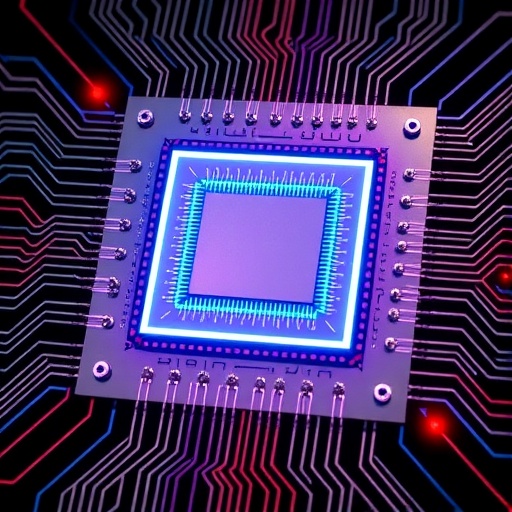
The experimental setup centers around a trapped-ion QCCD system, an architecture famed for exquisite qubit coherence times and high-fidelity gate operations. This platform allows the precise manipulation and measurement of multiple qubits, making it ideal for exploring advanced error-correction schemes. The team employed two specialized quantum codes tailored for this hardware: a 12-qubit code inspired by Knill’s design that encodes two logical qubits, and an intricate 16-qubit tesseract colour code encoding four logical qubits. By carefully calibrating these codes to the unique error profiles of the ion-trap processor, the researchers achieved substantial suppression of logical errors beyond that possible with physical qubits alone.
An essential factor underlying this performance leap was a novel approach to error detection combined with post-selection techniques. Rather than attempting to correct every detected error directly in real time, the method selectively discards experimental outcomes flagged with potential errors, dramatically increasing the fidelity of the remaining data. This post-selection process complements the inherent error correction capabilities of the code constructions, pushing the effective logical error rates down by factors ranging from 11-fold to a staggering 800-fold compared to baseline physical error rates observed in various quantum circuits.
The implications of this work resonate deeply within the quantum information community. Demonstrating that state-of-the-art quantum devices can implement fault-tolerant protocols to dramatically improve logical qubit performance is a milestone that signals a transition from proof-of-concept experiments toward scalable quantum processors capable of addressing complex scientific problems. The approach also underscores the importance of hardware-aware code design, where error-correcting codes are meticulously optimized to both the quantum hardware and dominant noise mechanisms, yielding error suppression gains that far exceed generic implementations.
Crucially, the ability to encode multiple logical qubits within manageable physical qubit arrays illustrates how near-term quantum processors can be structured to handle meaningful quantum algorithm workloads. The 12-qubit and 16-qubit codes implemented represent some of the most complex quantum error-correcting codes realized experimentally to date, highlighting significant strides in engineering capabilities and control methodologies for multi-qubit quantum systems. This progress lays foundational building blocks for future devices with hundreds or thousands of qubits that will demand even more sophisticated error management.
From a broader perspective, this breakthrough offers tangible proof that the decades-old theoretical frameworks surrounding quantum fault tolerance are entering an era of practical realization. The threshold theorems set out by pioneers like Aharonov, Kitaev, and Knill gave the community mathematical confidence that scalable quantum computing is possible, but experimental demonstrations such as this one provide vital empirical validation. They bring us closer to the long-anticipated vision of reliable quantum computation that can tackle physically and chemically important problems unreachable by classical means.
Moreover, the research demonstrates the synergistic power of combining cutting-edge hardware platforms with innovative software-level error correction protocols. By bridging the gap between physical qubit imperfections and logical qubit resilience, the findings inject new momentum into efforts to architect next-generation quantum processors that can robustly maintain quantum coherence over extended computations. Importantly, the ion-trap QCCD system’s inherent scalability combined with the efficient error detection schemes opens promising pathways toward large-scale fault-tolerant quantum architectures.
While the ultimate goal remains the realization of fully error-corrected universal quantum computers operative in real-world conditions, the current achievements meaningfully lower the barriers toward this milestone. They also provide a versatile experimental testbed for further refining error correction techniques, benchmarking quantum processors, and developing schemes that may be adapted across diverse quantum computing modalities beyond trapped ions, including superconducting circuits or photonic platforms.
Looking forward, the roadmap inspired by these findings naturally involves integrating real-time error correction with feedback mechanisms to replace post-selection, reducing overhead and enabling continuous operation. Additionally, extending the demonstrated codes to support more complex logical operations and to withstand broader classes of noise will be crucial. The impressive improvements in logical error rates already achieved herald a future where quantum advantage – the ability of quantum processors to outperform classical counterparts decisively – is within tangible reach.
In summary, the compelling evidence supplied by this study reveals that sophisticated quantum error correcting codes, when cleverly tailored and implemented on high-performance trapped-ion hardware combined with strategic post-selection, can transform the error landscape of quantum processors. This collective advance represents a critical step toward unlocking the immense potential of quantum computing to explore the frontiers of science and technology.
Subject of Research: Quantum error correction and logical error rate reduction on trapped-ion quantum processors
Article Title: Improved quantum processor logical error rates via correction and detection
Article References:
Paetznick, A., Reichardt, B.W., Silva, M.P.d. et al. Improved quantum processor logical error rates via correction and detection. Nature 654, 349–355 (2026). https://doi.org/10.1038/s41586-026-10628-y
DOI: 10.1038/s41586-026-10628-y
Tags: breakthrough quantum error mitigationentangled qubit error correctionfault-tolerant quantum algorithmslarge-scale quantum computationlogical qubit coherencephysical qubit error reductionquantum computing reliabilityquantum error correction techniquesquantum gate error thresholdsquantum processor error ratesscalable quantum computingtrapped-ion quantum charge-coupled device