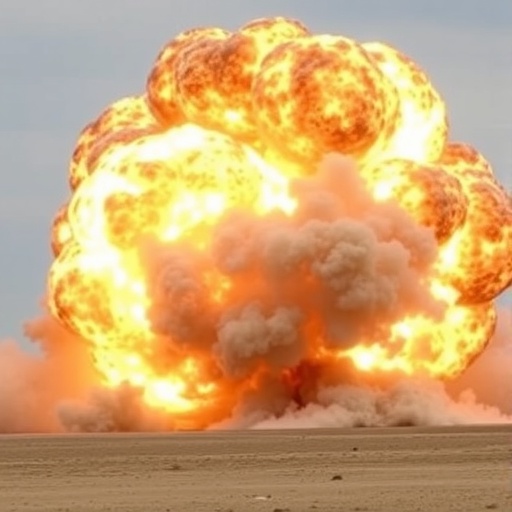
In a groundbreaking leap for explosive science and engineering, Texas A&M University has unveiled the Detonation Research Test Facility (DRTF), now the largest academic lab in the world devoted specifically to controlled explosions. This colossal facility, spanning nearly two football fields in length, is a marvel of steel and concrete situated within the Texas A&M-RELLIS innovation campus. With unparalleled capacity and instrumentation, the DRTF offers researchers an unprecedented window into the fleeting instants of detonations, turning raw explosive energy into transformative breakthroughs with far-reaching impact.
Capturing the physics of explosions has historically been an elusive endeavor, as these violent phenomena erupt and resolve in mere fractions of a second. What appears to the naked eye as a brief flash is underpinned by complex shock wave dynamics, flame accelerations, and chemical kinetics that determine the explosion’s nature and consequences. At DRTF, scientists do far more than observe blasts—they dissect them with precise instruments tracing subtle spatial and temporal scales. Researchers illuminate the processes by which flames destabilize and accelerate, mapping the transition from deflagration to full detonation, insight essential for both improving industrial safety and advancing propulsion technologies.
Under the leadership of renowned aerospace experts Dr. Elaine Oran and Dr. Scott Jackson, the facility pushes the limits of experimental detonation science. Supported by the Texas Governor’s University Research Initiative and the Texas A&M University System Chancellor’s Research Initiative, the project has rallied a formidable coalition of academia, industry, and government labs. Together, they aim to demystify detonation physics that influence everything from chemical plant safety to the future of hypersonic flight, bringing theory and simulation into concrete contact with empirical data at scales never before achievable.
The DRTF’s operation is a symphony of coordinated precision. Igniting a methane-air mixture inside a 500-foot steel tube, researchers initiate controlled detonations that produce shock waves traveling at hypersonic velocities, around Mach 5. The facility’s engineering cleverly includes a noise-mitigating earth-covered muffler to reduce the blast’s decibel level from a deafening 220 dB down to a rock concert-like 120 dB, balancing scientific rigor with environmental stewardship. This blend of scale and instrumentation bridges a crucial gap, permitting direct observation of physical phenomena that have until now only been explored computationally or through smaller-scale experiments.
Beyond pushing physical understanding, the DRTF addresses pressing industrial challenges. Incidents like the 2005 Buncefield fuel depot explosion demonstrate how rapid pressure increases and shock wave propagation can culminate in catastrophes. By scrutinizing flame stability thresholds and detonation escalation mechanisms, researchers strive to develop superior safety systems, such as enhanced detonation arrestors that can preemptively halt dangerous flame transitions. These innovations hold promise for safeguarding pipelines, chemical plants, and energy infrastructure vital to modern society’s backbone.
Yet, the implications of controlled detonations extend far beyond risk mitigation. Hypersonic flight—a longstanding technological frontier destined to redefine commercial and defense aviation—relies fundamentally on rapid, repetitive explosions to generate thrust exceeding five times the speed of sound. The DRTF enables empirical study of rotating detonation engines, a propulsion concept that harnesses continuous detonation waves for efficient high-speed travel. Generating detonations that reach Mach 5 within seconds, the facility’s research could catalyze the advent of hypersonic aircraft, shrinking transcontinental journeys from hours to minutes and reshaping aerospace design paradigms.
Interestingly, the physics explored at DRTF transcend terrestrial applications, finding analogues in astrophysical phenomena. The detonation waves studied mirror processes occurring during supernovae, monumental stellar explosions whose mechanics remain partly enigmatic. By reproducing scaled-down equivalents under controlled laboratory conditions, researchers gain insights into energy transfer, shock propagation, and reactive flows fundamental to cosmic events. This fusion of astrophysics and experimental physics connects the infinitesimal to the immense, from nanodiamonds forged in blasts to the cataclysmic death throes of stars.
In line with this cosmic-to-atomic continuum, the lab also investigates nanodiamonds formed during detonations. These microscopic carbon allotropes, billions of times smaller than a human hair, crystallize under extreme pressure and temperature conditions created by explosive shock waves. Nanodiamonds exhibit extraordinary hardness and unique quantum properties, making them candidates for revolutionary applications in quantum computing, biomedicine, and aerospace materials. By understanding their formation pathways, the DRTF could unlock new frontiers in material science, designing ultra-hard nanostructures with functionalities previously unattainable.
The interdisciplinary nature of the DRTF distinguishes it further; aerospace engineers, chemists, physicists, and materials scientists congregate here, breaking traditional research silos. Collaboration transcends domains, blending fundamental physical chemistry, combustion kinetics, fluid dynamics, and structural engineering. This convergence of expertise accelerates innovation and education simultaneously, providing students with immersive experiences where theoretical curricula meet hands-on experimentation within a world-class research infrastructure. As graduate researcher Zachary Weidman highlights, students are active contributors, shaping the evolving knowledge base around detonation phenomena.
Ultimately, the Detonation Research Test Facility epitomizes a bold reinvention of how explosive science can be studied and applied. Beyond the raw power of detonations themselves, the lab’s greatest force may well be the generation of ideas, experimentation, and technological advances it ignites. From enabling safer industrial practices and powering hypersonic engines to unraveling stellar physics and creating next-generation materials, the DRTF stands at the nexus of discovery where science turns transient violence into enduring progress.
Subject of Research: Controlled explosive physics, detonation dynamics, hypersonic propulsion, industrial safety, astrophysical detonation analogues, nanodiamond synthesis
Article Title: Texas A&M Opens World’s Largest Academic Controlled Explosions Laboratory
News Publication Date: 2024
Web References:
Detonation Research Test Facility: https://detonationresearchtestfacility.engr.tamu.edu/
Texas A&M-RELLIS Campus: https://rellis.tamus.edu/
Texas Governor’s University Research Initiative: https://gov.texas.gov/business/page/guri
Buncefield Fire Incident: https://www.hse.gov.uk/comah/buncefield/index.htm
Emerson Technologies: https://www.emerson.com/en-us/about-us
Image Credits: Texas A&M University College of Engineering
Keywords
Controlled explosions, detonation physics, hypersonic flight, industrial safety, flame stability, shock waves, rotating detonation engines, nanodiamonds, supernovae, experimental physics, aerospace engineering, materials science, chemical kinetics, energy infrastructure
Tags: academic detonation laboratoryaerospace explosive sciencechemical kinetics of explosionscontrolled explosion researchdeflagration to detonation transitionflame acceleration analysishigh-speed explosion instrumentationindustrial safety advancementslarge-scale experimental facilitypropulsion technology developmentshock wave dynamics studyTexas A&M RELLIS innovation campus