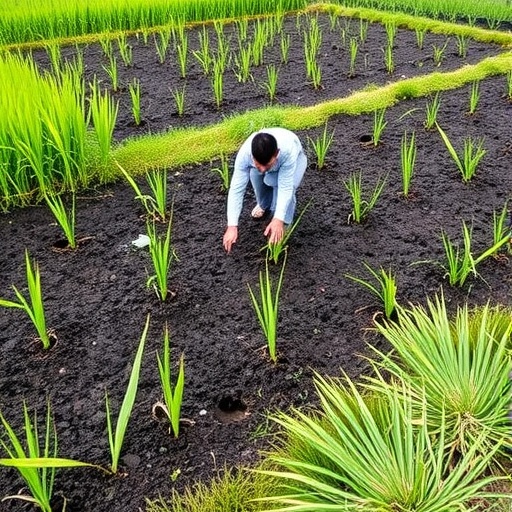
A groundbreaking five-year field experiment has unveiled critical insights into the long-term mitigation of methane emissions from rice paddies—a leading source of agricultural greenhouse gases worldwide. Conducted from 2018 to 2022, the study reveals that not only the presence of biochar, a carbon-rich soil amendment, but the frequency and method of its application profoundly influence the sustainability of methane reduction efforts in these ecosystems. The research underscores the synergy between continuous biochar amendments and water-saving irrigation techniques in delivering durable climate benefits without compromising rice production.
Methane (CH4) poses a significant climate challenge, possessing a global warming potential approximately 28 times greater than carbon dioxide over a century. Rice paddies contribute substantially to atmospheric methane due to anaerobic conditions that foster methanogenic microbes. Historically, biochar has been championed as a promising amendment capable of sequestering carbon and altering soil properties to reduce methane release. Yet, much of the extant research has focused on short-term trials, leaving a knowledge gap regarding the persistence of biochar’s effects over multiple growing seasons.
This extended investigation addressed this limitation by systematically comparing a high-dose, one-time biochar application with smaller, continuous annual additions across two irrigation regimens: traditional flooding and water-saving irrigation. Findings illustrated a temporal divergence in performance; while the single initial application yielded a methane emission reduction close to 36 percent in year one, its efficacy notably diminished in subsequent years. Conversely, continuous annual biochar additions sustained and even enhanced methane mitigation across the full five-year span.
The mechanism underpinning these trends lies in the dynamic interactions between biochar and soil chemistry. Repeated biochar inputs maintained elevated soil redox potential, a critical factor inhibiting the anaerobic conditions favorable to methane production. Additionally, continuous amendment enhanced concentrations of ammonium nitrogen, a nutrient form less conducive to methanogenesis, and curtailed levels of dissolved organic carbon, which serves as substrate for methane-producing microbes. This biochemical shift fostered a microbial milieu more biased toward methane oxidation, effectively tipping the balance toward reduced emissions.
A novel aspect of this study delved into how modern irrigation practices intersect with biochar aging processes in paddy soils. Water-saving irrigation, designed to improve water efficiency by intermittently draining fields, inherently increases soil aeration, thereby decreasing methane emissions independently. However, this increased aeration accelerates the aging and degradation of biochar surfaces, undermining the persistence of benefits from a singular biochar application. By contrast, continual biochar replenishment counters this degradation cycle, ensuring that reactive soil surfaces and associated microbial interactions remain robust.
The practical implications are profound. Farmers and agricultural planners often grapple with reconciling climate goals with yield stability. The research convincingly demonstrated that continuous biochar management under water-saving irrigation maintained, and occasionally enhanced, rice productivity over the duration of the experiment. This intersects crucially with global food security considerations, indicating that environmental sustainability need not come at the expense of agricultural output.
From a climate policy and agricultural technology perspective, these results advocate for a paradigm shift away from traditional, large one-off biochar treatments toward adaptive, consistent soil amendment strategies. This approach aligns with principles of climate-smart agriculture, leveraging iterative inputs to strengthen ecosystem resilience and greenhouse gas mitigation over prolonged timescales. Importantly, the study emphasizes the criticality of long-term field data, highlighting how short-duration trials may mask essential dynamics relevant to real-world application.
The research team’s insights also point toward potential refinements in biochar production and formulation tailored to maximize longevity and functional interaction with soil microbes under varying irrigation regimes. By optimizing material properties and application schedules, the biochar amendment could become a more predictable and scalable tool in the global effort to lower methane emissions from rice cultivation.
Furthermore, this study builds a compelling case for integrating irrigation management and soil amendment practices into holistic mitigation frameworks. The synergistic benefits witnessed suggest that combining water-saving irrigation with continuous biochar amendment produces greenhouse gas reduction outputs exceeding the sum of their individual effects, including scenarios of net-negative emissions at the field scale.
As global rice consumption escalates with population growth and changing diets, the deployment of evidence-based, sustainable practices becomes paramount. This experiment serves as a critical blueprint, demonstrating that agricultural landscapes, often perceived as climate liabilities, can be managed proactively to deliver positive environmental outcomes alongside economic and food production goals.
Ultimately, the research underscores a fundamental tenet in environmental management: sustained, adaptive interventions outperform isolated, static measures in confronting complex, evolving challenges. The robustness of methane mitigation through continuous biochar amendment allied with improved water use efficiency presents a scalable pathway toward climate-resilient agronomy. This long-term experimental evidence should guide policymakers, agronomists, and farmers alike in crafting integrated strategies that harness soil chemistry, microbial ecology, and water management to secure a sustainable agricultural future.
Subject of Research: Methane mitigation in rice paddies via biochar amendments and irrigation management
Article Title: Continuous biochar amendment to achieve long-term CH4 mitigation in paddy fields under water-saving irrigation: a 5-year experiment
News Publication Date: 6 March 2026
Web References: http://dx.doi.org/10.1007/s42773-026-00578-z
References: Han, Y., Chen, P., Zhang, Z. et al. Biochar 8, 70 (2026). https://link.springer.com/journal/42773
Image Credits: Yu Han, Peng Chen, Zhongxue Zhang, Xiaoyuan Yan, Guangbin Zhang, Zuohe Zhang, Tiecheng Li, Tangzhe Nie & Sicheng Du
Keywords
Methane mitigation, biochar amendment, rice paddies, water-saving irrigation, greenhouse gases, soil redox potential, microbial ecology, climate-smart agriculture, agricultural sustainability, carbon sequestration, field experiment, long-term study
Tags: anaerobic soil conditions and methanebiochar soil amendment frequencycarbon sequestration in paddy soilsclimate-smart rice production techniquescontinuous vs one-time biochar applicationlong-term biochar application effectsmethane emissions reduction in rice paddiesmethane global warming potentialmitigation of agricultural greenhouse gasessustainable agriculture practicessynergy between biochar and irrigation methodswater-saving irrigation in rice farming