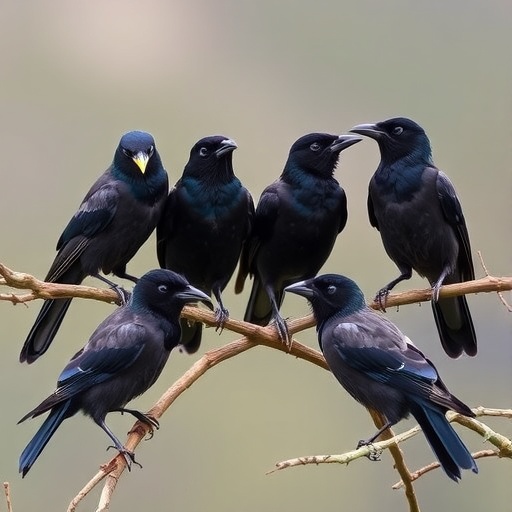
In a groundbreaking study published in “Animal Cognition,” researchers have illuminated the fascinating world of jackdaws, a species within the Corvus family, known for both their intelligence and complex social behavior. The focus of this research is the variability and individuality found in the contact calls of jackdaws, highlighting how these vocalizations are not merely means of communication but also serve as a canvas for expressing unique identities. Conducted by a team led by G. Szipl, A. Baotic, and K. Kotrschal, the findings are set to broaden our understanding of avian communication and individual recognition within species.
Contact calls in birds like jackdaws play a pivotal role in maintaining social bonds and facilitating interactions within their flocks. What sets jackdaws apart from other birds is their ability to produce a varied array of calls that can be distinguished not just between species but also among individuals of the same species. The meticulous research sheds light on how these calls evolve, adapt, and reflect the social dynamics of jackdaw communities. Researchers utilized advanced audio analysis techniques to examine the nuances of these calls, identifying distinct patterns and inconsistencies that provide insights into each bird’s individuality.
One of the key components of this study was the attention to detail in capturing the acoustic properties of the calls. The authors identified specific characteristics such as pitch, duration, and modulation, which contribute to the unique signature of each jackdaw’s call. By analyzing hundreds of recordings from various individuals under natural conditions, the researchers compiled a comprehensive dataset that underpinned their analysis. Through rigorous statistical evaluation, the team discovered that individuality in calls could significantly affect social interactions among jackdaws, influencing mate selection, parenting, and group dynamics.
Furthermore, this research has implications beyond the mere observation of communication; it challenges existing theories surrounding animal cognition. Traditionally, animal communication has been viewed through a simplistic lens of signal and response, but the findings of Szipl and colleagues suggest a much more intricate framework. The ability to recognize individual calls reflects a level of cognitive sophistication in jackdaws that warrants a reevaluation of the cognitive capacities attributed to corvids and their relatives. This study, therefore, not only contributes to avian biology but also enriches the dialogue surrounding animal consciousness and the neurological underpinnings of communication.
Notably, the social structures of jackdaws play a crucial role in shaping these individual calls. In tightly-knit family units, calls can serve as critical identifiers, signaling kinship and social roles within the group. The researchers observed that higher-ranking birds had a different quality to their calls compared to lower-ranking individuals, suggesting that vocal characteristics may correlate with social status. Such findings underline the complexity of social behaviors in avian species and their reliance on auditory cues for maintaining hierarchies and relationships.
The methodologies employed in this investigation are equally noteworthy. Utilizing state-of-the-art recording equipment and sound analysis software, the researchers ensured that each call was recorded in a naturalistic environment, free from human interference. This approach not only enriches the dataset but also increases the ecological validity of the study’s findings. The acoustic analysis was complemented by behavioral observations, facilitating a deeper understanding of the context in which these calls are made and received.
As the research team delves deeper into the implications of their findings, they highlight the potential for future studies to explore the impact of environmental factors on call variability. For instance, changes in habitat, population density, and even seasonal variations could influence how jackdaws modify their calls over time. This paves the way for an exciting avenue of research, extending beyond jackdaws to other social bird species that might exhibit similar patterns of vocal individuality.
Moreover, the study raises questions about the evolutionary advantages of maintaining such call variability. The ability to convey individual identities through vocalizations could lead to improved social cohesion, enhanced reproductive success, and more effective resource acquisition strategies. As ecological pressures change, the flexibility of vocal adaptations might serve as a critical factor in the survival of these intelligent birds.
Interestingly, this research does not move only within the confines of jackdaw social structures; it opens the door to understanding how these insights could apply to other species. For example, species that exhibit similar group dynamics, such as parrots and crows, might also showcase unique vocal signatures that reflect individual identities. Thus, the findings of Szipl and colleagues could offer a broader framework for understanding animal communication across diverse classifications.
The academic community has already begun to engage with these findings, sparking discussions about the potential for further investigations into vocal communication in other avian species. The emphasis on individuality and variance in contact calls could influence the approaches taken by ornithologists and behavioral ecologists worldwide. Understanding the implications of these calls on bird behavior and ecology could lead to more comprehensive conservation strategies tailored to the needs of specific populations.
As conversations continue regarding these groundbreaking findings, the research team emphasizes the importance of interdisciplinary approaches, merging fields such as sociology, ethology, and acoustics. They underscore that enriching scientific discourse often emerges from collaborative efforts that traverse traditional academic boundaries. Encouraging future researchers to adopt such a holistic perspective could lead to novel insights, not just about jackdaws but also about the complex web of life in which they exist.
The potential for public engagement through these revelations is significant. With increasing interest in birdwatching and citizen science initiatives, the research team’s findings could resonate with a wider audience. By highlighting the cognitive and communicative complexities of jackdaws, scholars hope to pique public interest in avian conservation efforts and foster a greater appreciation for the intelligence of these remarkable creatures. Raising awareness about their social structures and individual identifiers has the potential to galvanize community support for habitat preservation and responsible wildlife encounters.
In summary, the research conducted by Szipl, Baotic, and Kotrschal represents a pivotal contribution to our understanding of avian communication. By honing in on the individuality and variability of jackdaw contact calls, the team unravels a rich tapestry of social interactions that deepen our appreciation of these birds as not just intelligent beings but as individuals with distinct personalities. This landmark study promises to inspire further inquiry and exploration, with the possibility of uncovering more about how our world’s diverse species communicate and thrive within their ecosystems. The journey to fully understand the depths of avian cognition and communication is far from over, and researchers are only beginning to scratch the surface.
Subject of Research: Contact calls and individuality in jackdaws
Article Title: Variability and individuality in the contact calls of jackdaws (Corvus monedula).
Article References:
Szipl, G., Baotic, A. & Kotrschal, K. Variability and individuality in the contact calls of jackdaws (Corvus monedula).
Anim Cogn 29, 2 (2026). https://doi.org/10.1007/s10071-025-02022-4
Image Credits: AI Generated
DOI: 16 December 2025
Keywords: jackdaws, contact calls, individuality, avian communication, animal cognition, social behavior, eco-acoustics.
Tags: advanced audio analysis techniquesanimal cognition studiesavian communicationbird vocalization analysiscontact calls in birdsCorvus family researchindividual recognition in birdsintelligence in jackdawsjackdaw individualitysocial behavior of jackdawssocial dynamics in avian communitiesvariability in bird calls