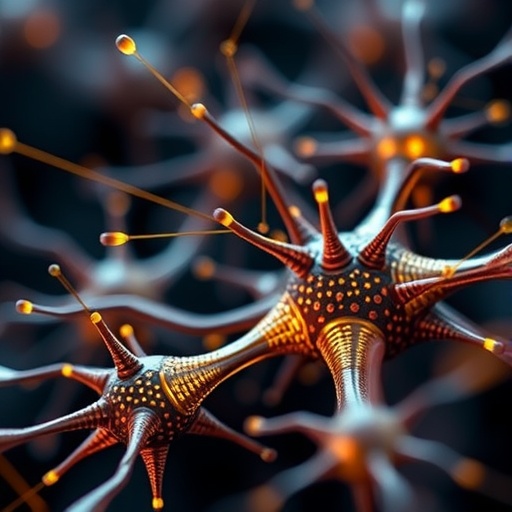
In a groundbreaking advancement at the intersection of materials science and neuromorphic computing, researchers have unveiled an innovative organic spiking artificial neuron characterized by both excitatory and inhibitory synapses. This pioneering development, heralded in the upcoming issue of npj Flexible Electronics, marks a significant stride towards realizing fully soft, flexible, and biologically inspired neuromorphic processing platforms, potentially revolutionizing the future landscape of brain-inspired computing technologies.
Traditional silicon-based neuromorphic chips, although immensely powerful, are often hampered by rigid architectures and substantial energy consumption. The advent of an organic counterpart, fabricated from pliable and lightweight materials, opens new avenues for wearable, implantable, and flexible technologies that seamlessly integrate with human physiology. The new artificial neuron mimics fundamental neuronal spiking behavior—rapid electrical pulses that encode and transmit critical information—through organic electronic components capable of supporting complex signal processing akin to biological neural networks.
At the core of this breakthrough lies the meticulous engineering of both excitatory and inhibitory synapses within a single organic neuron device. Excitatory synapses amplify signal transmission, while inhibitory synapses suppress electrical activity, collectively enabling a balanced and dynamic interplay mirroring the natural equilibrium observed in biological neurons. This dual functionality, rarely achieved in artificial systems, allows for advanced computational capabilities such as selective signal filtering, adaptive learning, and real-time decision-making.
The organic materials utilized in constructing these neurons derive from a combination of semiconducting polymers and specially designed electrolytes that facilitate ion transport—key to replicating the ionic dynamics present in living neurons. By harnessing ionic-electronic hybrid conduction mechanisms, these devices circumvent the limitations of purely electronic counterparts, offering richer and more nuanced emulation of neural activity patterns including temporal spike timing and synaptic plasticity.
Central to the device operation is a complex interplay between charge injection at the electrodes and ion migration within the organic channel, which modulates the neuron’s membrane potential analogously to biological excitable membranes. These bio-mimetic features enable precise control over the timing and frequency of output spikes, essential for encoding information and enabling sophisticated neuromorphic computations such as pattern recognition, sensory integration, and learning algorithms.
This innovation also capitalizes on the intrinsic flexibility and mechanical resilience of organic materials, which grant the neuron extraordinary conformability and durability suitable for integration into flexible substrates. Such mechanical properties promise transformative applications in soft robotics, wearable health monitors, and neuroprosthetic devices, where seamless interfacing with organic tissue and mechanical compliance are paramount.
A seminal aspect of the study includes the demonstration of controlled synaptic plasticity within the artificial neuron. By varying the ionic environment and electrical stimulation conditions, the researchers could dynamically tune the strength of synaptic connections, simulating long-term potentiation and depression mechanisms—fundamental to learning and memory in living brains. This capability could serve as a foundation for adaptive and self-learning neuromorphic systems, drastically reducing reliance on traditional digital reprogramming.
The research team employed a series of rigorous electrical characterizations and computational modeling to elucidate the operational principles of the organic spiking neuron. Through cyclic voltammetry, impedance spectroscopy, and transient response analyses, they mapped the device’s ionic-electronic coupling and synaptic transmission characteristics in exquisite detail, thereby validating its fidelity in replicating neuronal spiking and synaptic modulation.
Moreover, the novel neuron design exhibited remarkable energy efficiency, consuming significantly lower power levels compared to conventional silicon-based neuromorphic circuits. This sustainable operational profile stems from the bio-inspired ion transport mechanisms and the intrinsic material properties of organic semiconductors, highlighting the potential for large-scale deployment in low-power, portable neuromorphic computing architectures.
From an architectural standpoint, the integration of excitatory and inhibitory synapses within a monolithic organic device circumvents the complexity and scalability issues associated with multiple discrete components. The compact and simplified device layout not only facilitates miniaturization but also paves the way for constructing dense, large-scale neuromorphic networks on flexible substrates—a critical step toward practical implementations.
Beyond the device itself, the study emphasizes the broader implications of soft neuromorphic systems, which could fundamentally reshape human-computer interfaces by enabling more naturalistic sensory processing, adaptive control, and context-aware computing. The soft organic neuron’s compatibility with biological tissues opens prospects for seamless brain-machine interfaces, neurorehabilitation technologies, and advanced prosthetics capable of more intuitive and responsive function.
Furthermore, this research underscores the vital importance of interdisciplinary collaboration, blending expertise from organic chemistry, solid-state physics, electrical engineering, and neuroscience to bridge gaps between material innovation and computational functionality. This convergence fuels a vibrant frontier in developing neuromorphic devices that transcend conventional limitations and embody principles derived from biological intelligence.
Looking ahead, the researchers envisage scaling up these devices into arrays capable of complex neural network architectures, exploring device-to-device variability, long-term stability, and integration with sensory inputs and output effectors. Such next-generation systems could herald a paradigm shift in artificial intelligence hardware, delivering unprecedented adaptability and efficiency beyond digital processing constraints.
In conclusion, the creation of an organic spiking artificial neuron integrating both excitatory and inhibitory synapses represents a landmark achievement with far-reaching implications for flexible electronics and neuromorphic engineering. By coupling biological inspiration with cutting-edge material science, this innovation offers a blueprint for next-level soft, flexible, and energy-efficient neuromorphic processors that promise to redefine the future of intelligent systems.
Subject of Research: Organic spiking artificial neurons with excitatory and inhibitory synapses for flexible neuromorphic processing.
Article Title: An organic spiking artificial neuron with excitatory and inhibitory synapses: towards soft and flexible organic neuromorphic processing.
Article References: Mirshojaeian Hosseini, M.J., Yang, Y., Bamford, S. et al. An organic spiking artificial neuron with excitatory and inhibitory synapses: towards soft and flexible organic neuromorphic processing. npj Flex Electron (2026). https://doi.org/10.1038/s41528-025-00512-6
Image Credits: AI Generated
Tags: biologically inspired processingbrain-inspired computing advancementsdynamic neural network simulationenergy-efficient artificial neuronsexcitatory and inhibitory synapsesflexible neuromorphic computingimplantable neuroelectronicsinnovative materials science in neuromorphicsorganic spiking neuronssignal processing in organic electronicssoft and flexible materials in electronicswearable neuromorphic technologies