Researchers at MIT and the Scripps Research Institute have unveiled a groundbreaking vaccine approach that may revolutionize the way we combat persistent infectious diseases such as HIV and SARS-CoV-2. By harnessing a synergistic combination of two powerful adjuvants within a single vaccine dose, this method elicits a dramatically enhanced immune response, notably broadening the diversity and potency of antibodies produced. This innovative strategy not only challenges traditional multi-dose vaccine protocols but also opens the door to long-lasting protection with minimal administrations.
The cornerstone of this breakthrough lies in the strategic pairing of aluminum hydroxide — commonly known as alum and widely used in existing vaccines — with an advanced saponin-based adjuvant nanoparticle, referred to as SMNP. Alum is renowned for triggering innate immune responses and facilitating antigen retention, while SMNP, derived from the bark of the Chilean soapbark tree, initiates robust inflammatory signaling pathways. Their combined effect profoundly amplifies the quality and longevity of the immune activation, especially within the germinal centers located in lymph nodes.
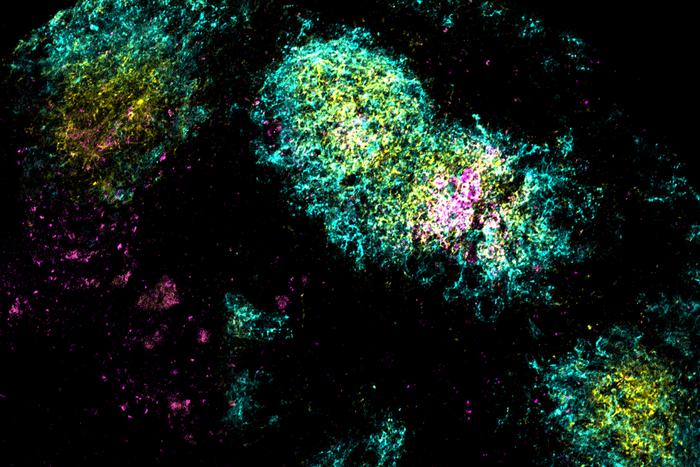
Within these germinal centers, B cells undergo an intricate process of selection and mutation, refining their antibody affinity and breadth. The study, conducted in mice, demonstrated that vaccines crafted with both alum and SMNP not only penetrate lymph node barriers effectively but also maintain the integrity of the HIV antigen—specifically the engineered MD39 protein—for extended periods, up to 28 days. This prolonged antigen presence mimics natural infection dynamics, allowing B cells repeated exposure and continuous affinity maturation.
.adsslot_qCO3zmou0V{ width:728px !important; height:90px !important; }
@media (max-width:1199px) { .adsslot_qCO3zmou0V{ width:468px !important; height:60px !important; } }
@media (max-width:767px) { .adsslot_qCO3zmou0V{ width:320px !important; height:50px !important; } }
ADVERTISEMENT
This dual-adjuvant formulation significantly expands the diversity of the B cell repertoire. Leveraging single-cell RNA sequencing techniques, the researchers uncovered that mice receiving the combined vaccine exhibited two-to-three times the number of unique B cell clones than those vaccinated with a single adjuvant. Such clonal expansion is critical for producing broadly neutralizing antibodies capable of targeting diverse and evolving viral strains, a milestone especially vital for combating viruses like HIV, known for their high mutation rates.
Importantly, the study outlines that combining these adjuvants exerts an additive or even synergistic effect without necessitating novel or untested components. Both alum and saponin-based adjuvants have established safety profiles and regulatory acceptance, which potentially accelerates regulatory approvals for vaccines employing this method. Furthermore, the platform’s adaptability makes it applicable to a wide range of protein-based immunogens, suggesting its utility beyond HIV to encompass influenza, SARS-CoV-2, and emerging pandemic threats.
The implications of this research extend into the realm of vaccine logistics and global health. By enabling potent immune responses with a single administration, the approach surmounts challenges associated with multi-dose schedules, which often hinder vaccine coverage in resource-limited environments. Simplifying vaccination regimens increases compliance and facilitates rapid mass immunization, a critical component in epidemic and pandemic preparedness.
Moreover, the molecular design of anchoring multiple copies of the HIV MD39 antigen onto alum particles ensures a concentrated presentation of the antigen within lymph nodes. This dense display optimizes B cell receptor engagement and cross-linking, a prerequisite for initiating potent germinal center reactions. The Scripps and MIT teams’ choice of the MD39 antigen, known for its stabilized trimeric structure mimicking the native HIV envelope, further enhances immune recognition.
Another novel aspect lies in the ability of the adjuvants to facilitate antigen translocation across the lymph node subcapsular sinus without fragmentation, a biological barrier that typically limits antigen availability. By circumventing this obstacle, the vaccine ensures that native-like antigens are presented to B cells as intact conformations, crucial for generating high-affinity antibodies that recognize the virus authentically.
The dual-adjuvant vaccine’s capacity to sustain antigen release equates to a form of controlled, slow-release delivery, extending immune system stimulation over weeks rather than hours or days. This persistent stimulation is well-aligned with natural infection kinetics, wherein continuous antigenic presence drives robust long-term immunity and immune memory—a phenomenon difficult to replicate with conventional vaccine formulations.
With these promising preclinical findings, the vaccine formulation is poised for further assessment in clinical trials. The SMNP adjuvant is already under evaluation in HIV vaccine trials, which may provide essential safety and immunogenicity data supporting eventual human application of the combined adjuvant strategy. Such translational steps will be pivotal in confirming the approach’s effectiveness in humans and guiding its deployment.
Ultimately, this research embodies a significant leap forward in vaccine science by integrating foundational immunological principles with cutting-edge nanotechnology and biochemical engineering. The ability to engineer slow-release, follicle-targeted vaccines that magnify germinal center B cell diversity and expansion holds transformative potential for controlling infectious diseases that have so far eluded effective immunization.
Subject of Research: Animals
Article Title: Vaccines combining slow release and follicle targeting of antigens increase germinal center B cell diversity and clonal expansion
News Publication Date: 18-Jun-2025
Web References: http://dx.doi.org/10.1126/scitranslmed.adw7499
Image Credits: MIT
Keywords
Health and medicine, Vaccine research, Vaccine development, Life sciences, Human immunodeficiency virus, Chemical engineering
Tags: adjuvant combinations in vaccinesaluminum hydroxide in immunologyenhanced immune response mechanismsgerminal centers and B cell activationHIV vaccine development innovationslong-lasting vaccine protection strategiesMIT vaccine research breakthroughsnanoparticle vaccine delivery systemssaponin-based adjuvants in vaccinesSARS-CoV-2 vaccine advancementssingle-dose vaccines for infectious diseasessupercharged vaccine technology