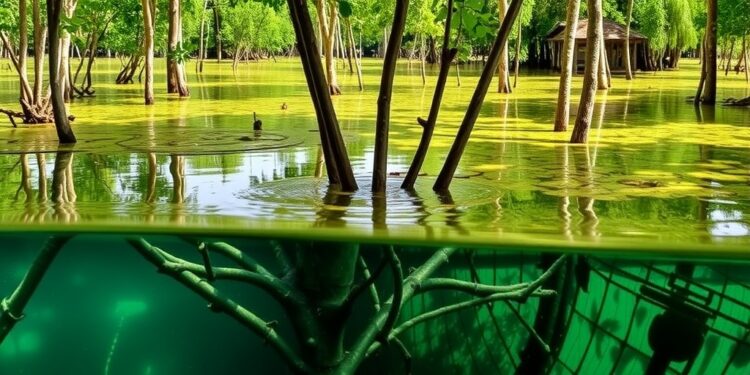
Mangrove forests, often overlooked in discussions about global ecosystems, are beginning to gain recognition for their significant contributions to marine and terrestrial environments. These unique ecosystems serve as crucial carbon sinks, help to maintain biodiversity, and actively participate in the global cycling of trace elements. A recent study conducted by the GEOMAR Helmholtz Centre for Ocean Research Kiel, Germany, highlights the critical role of mangrove systems in supplying essential trace elements like neodymium to ocean waters. This revelation not only elevates the ecological significance of mangroves but also calls attention to the urgency of their conservation.
The research revealed that mangrove systems along the Amazon coastline release approximately 8.4 million grams of dissolved neodymium into the ocean annually. This staggering figure accounts for 64 percent of the total neodymium input observed in this region. Such a high contribution points to the importance of mangroves in the ocean’s biogeochemical cycles, suggesting that similar dynamics likely apply to other crucial trace elements such as iron and manganese. These metals play pivotal roles in marine ecosystems, influencing processes like phytoplankton growth and the overall health of the oceanic carbon cycle.
The researchers conducted extensive examinations of water samples across various coastal waters, estuaries, and mangrove sediments along the Amazonian coast. They identified distinct isotopic patterns of neodymium and hafnium, unlocking the secrets of their origin and tracing their complex interactions within these ecosystems. Professor Martin Frank, co-author of the study and the head of the research division encompassing Ocean Circulation and Climate Dynamics at GEOMAR, articulates the duality of mangroves. He notes that while they act as buffer zones retaining nutrients and materials from land, they also serve as critical catalysts for processing and selectively releasing these substances into the ocean. Such processes are vital for coastal food chains, highlighting the interconnectedness of ecosystem functions.
As global awareness of climate change and environmental degradation rises, these findings bring to light the urgent need for concerted efforts aimed at conserving mangrove ecosystems situated at the delicate interface between land and sea. Dr. Xu’s assertion that mangroves provide invaluable services for biodiversity and climate regulation resonates deeply in contemporary environmental discussions. The potential loss of these unique ecosystems could have cascading effects not only on local environments but also on global marine health.
The implications of this study demand a reevaluation of our conservation strategies and resource management practices. Protecting mangrove forests transcends the immediate desire to preserve biodiversity; it is a matter of maintaining the ecological integrity that supports marine life. By prioritizing the conservation of mangroves, we not only safeguard local species but also uphold the broader health of oceanic ecosystems, which are fundamental in climate regulation and carbon cycling.
Moreover, the critical role that mangroves play in sequestering carbon further underscores their importance in combating climate change. These ecosystems are capable of capturing more carbon dioxide per unit area than many terrestrial forests, thereby playing a vital role in mitigating the impacts of global warming. The safeguarding of mangroves should, therefore, be integrated into larger climate action plans, ensuring that their ecological functions are recognized and supported.
The research is not only a testament to the invaluable services that mangroves provide but also a clarion call for further study into the myriad ways these ecosystems can be leveraged to support marine conservation and climate initiatives. As we deepen our understanding of the complexities of mangrove ecosystems, it becomes increasingly clear that protecting these forests is inextricably linked to the health of our oceans and, by extension, the planet.
Furthermore, efforts to engage local communities in the conservation of mangroves can yield significant benefits, both ecologically and socially. By educating and involving communities in the management of these critical habitats, we can promote sustainable practices that enhance the resilience of mangrove ecosystems. The integration of scientific research with local knowledge can foster a holistic approach to ecosystem management, ensuring that both people and nature thrive.
In conclusion, the study of mangrove forests and their role as nutrient pumps in oceanic systems offers profound insights into the interconnectedness of terrestrial and marine ecosystems. As we advance toward a more sustainable future, the necessity of protecting mangroves becomes undeniably apparent. These natural treasures, which supply essential trace elements to the ocean and support diverse life forms, represent a critical component of our planet’s ecological fabric. The time for decisive action to preserve and enhance mangrove ecosystems is now.
In understanding the depths of their significance, we pave the way for a more sustainable cohabitation with nature, ensuring that future generations can also benefit from the invaluable services that mangroves provide. Let us amplify these research findings in discussions of biodiversity conservation, climate change mitigation, and global environmental policies. The voices advocating for mangrove protection must grow louder, inspiring collective action towards preserving these vital ecosystems.
Subject of Research: Not applicable
Article Title: The Amazonian mangrove systems accumulate and release dissolved neodymium and hafnium to the oceans
News Publication Date: 8-Jan-2025
Web References: Not applicable
References: Not applicable
Image Credits: Not applicable
Keywords
Tags: Amazon mangrove forestsbiodiversity in coastal ecosystemsbiogeochemical cycles of trace elementscarbon sinks in mangrove forestsconservation of mangrove ecosystemsecological significance of mangrovesimportance of coastal biodiversitymangrove research and conservation effortsmarine ecosystem nutrient sourcesneodymium contribution from mangrovesphytoplankton growth and trace metalstrace elements cycling in oceans