• HOME
  • NEWS
  • EXPLORE
    • CAREER
      • Companies
      • Jobs
    • EVENTS
    • iGEM
      • News
      • Team
    • PHOTOS
    • VIDEO
    • WIKI
  • BLOG
  • COMMUNITY
    • FACEBOOK
    • INSTAGRAM
    • TWITTER
Wednesday, June 24, 2026
BIOENGINEER.ORG
No Result
View All Result
  • Login
  • HOME
  • NEWS
  • EXPLORE
    • CAREER
      • Companies
      • Jobs
        • Lecturer
        • PhD Studentship
        • Postdoc
        • Research Assistant
    • EVENTS
    • iGEM
      • News
      • Team
    • PHOTOS
    • VIDEO
    • WIKI
  • BLOG
  • COMMUNITY
    • FACEBOOK
    • INSTAGRAM
    • TWITTER
  • HOME
  • NEWS
  • EXPLORE
    • CAREER
      • Companies
      • Jobs
        • Lecturer
        • PhD Studentship
        • Postdoc
        • Research Assistant
    • EVENTS
    • iGEM
      • News
      • Team
    • PHOTOS
    • VIDEO
    • WIKI
  • BLOG
  • COMMUNITY
    • FACEBOOK
    • INSTAGRAM
    • TWITTER
No Result
View All Result
Bioengineer.org
No Result
View All Result
Home NEWS Science News Health

AI can speed up drug development

by
September 6, 2025
in Health
Reading Time: 2 mins read
0
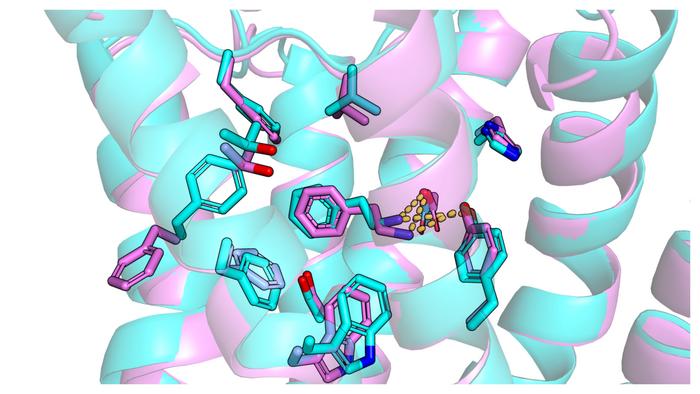
Comparison of the AI model of TAAR1 (turquoise) and a structure of the receptor determined by experiment (purple).
Share on FacebookShare on TwitterShare on LinkedinShare on RedditShare on Telegram

Artificial intelligence (AI) can help identify molecules that could serve as new drugs for mental health disorders. AI can be used to predict the three-dimensional structures of important receptors and thereby speed up the development of potential drugs. This is the result of a new study from Uppsala University published in Science Advances.

Artificial intelligence (AI) can help identify molecules that could serve as new drugs for mental health disorders. AI can be used to predict the three-dimensional structures of important receptors and thereby speed up the development of potential drugs. This is the result of a new study from Uppsala University published in Science Advances.

In drug development, experimental methods are often used to determine the three-dimensional structures of target proteins and to understand how molecules bind to them. This information is needed to design drug molecules efficiently. However, the process to determine structures can be demanding, meaning this strategy cannot always be used.

Thanks to the development of AI methods, the structures of proteins can now be predicted with higher accuracy than previously.

In the study, researchers at Uppsala University used AI to create a model of the unknown three-dimensional structure of a receptor. In this case the TAAR1 receptor, which is an interesting target protein for the development of drugs for mental health disorders. Drug molecules that activate TAAR1 have shown promising results in the treatment of schizophrenia and depression.

Using supercomputers, the researchers then searched chemical libraries containing millions of molecules to find those that best fitted the model. Molecules predicted to bind to the receptor were then tested in experiments by research colleagues at Karolinska Institutet. An unexpectedly large number of the molecules activated TAAR1, and one of the most potent also showed promising effects in animal experiments.

During the final stage of the study, experimental structures for TAAR1 suddenly became available and the researchers were able to compare them with the AI models.

“The accuracy of the structures generated with AI was astonishing – I couldn’t believe it. The results also show that modelling with AI is significantly better than traditional methods. We can now use the same strategy for receptors that we previously could only dream of working with,” explains Jens Carlsson, who led Uppsala University’s part of the study.


Journal

Science Advances

DOI

10.1126/sciadv.adn1524

Method of Research

Computational simulation/modeling

Subject of Research

Not applicable

Article Title

AlphaFold accelerated discovery of psychotropic agonists targeting the trace amine–associated receptor 1

Article Publication Date

7-Aug-2024
Tags: Artificial intelligence in drug developmentMental health disorders treatmentProtein structure predictionScience Advances studyTAAR1 receptor research
Share12Tweet8Share2ShareShareShare2

Related Posts

Acute Psychedelic Effects on Brain Entropy Revealed

June 24, 2026

Global Drop in Intimate Partner Violence Linked to Shifts in Attitudes and Behavior

June 24, 2026

Epiblast Diversification Fuels Early Blood Formation

June 24, 2026

Neutrophil S100A8/A9 Hinders Megakaryocyte Maturation

June 24, 2026

POPULAR NEWS

  • Saying Goodbye to PGY-6: Pediatric Fellowship Realities

    103 shares
    Share 41 Tweet 26
  • Multi-Hospital Study Reveals Long Covid Burden Is Twice as High as Current Estimates

    92 shares
    Share 36 Tweet 23
  • Detection of EDCs in Breast Milk and Infant Urine Up to Six Months Highlights Early Exposure Risks

    77 shares
    Share 31 Tweet 19
  • New Drug Candidate Developed at McMaster Shows Potential for Treating Brain Cancer

    58 shares
    Share 23 Tweet 15

About

We bring you the latest biotechnology news from best research centers and universities around the world. Check our website.

Follow us

Recent News

Decades of Data Reveal Which Orcas Call Puget Sound Home

Introducing a Revolutionary Pixel Technology

Plasma Technology Extends Catalyst Lifespan in Hydrogen Production

Subscribe to Blog via Email

Enter your email address to subscribe to this blog and receive notifications of new posts by email.

Join 82 other subscribers
  • Contact Us

Bioengineer.org © Copyright 2023 All Rights Reserved.

Welcome Back!

Login to your account below

Forgotten Password?

Retrieve your password

Please enter your username or email address to reset your password.

Log In
No Result
View All Result
  • Homepages
    • Home Page 1
    • Home Page 2
  • News
  • National
  • Business
  • Health
  • Lifestyle
  • Science

Bioengineer.org © Copyright 2023 All Rights Reserved.