In today’s medical landscape, antibiotics are pivotal in combatting bacterial infections. These potent compounds, produced by bacteria and fungi, act as natural defenses against microbial attacks. A team of researchers delved into the intricate world of glycopeptide antibiotics – a vital resource in countering drug-resistant pathogens – to uncover their evolutionary origins. Dr. Demi Iftime and Dr. Martina Adamek headed this interdisciplinary project, guided by Professors Evi Stegmann and Nadine Ziemert from the “Controlling Microbes to Fight Infections” Cluster of Excellence at the University of Tübingen, with support from Professor Max Cryle and Dr. Mathias Hansen from Monash University in Australia.
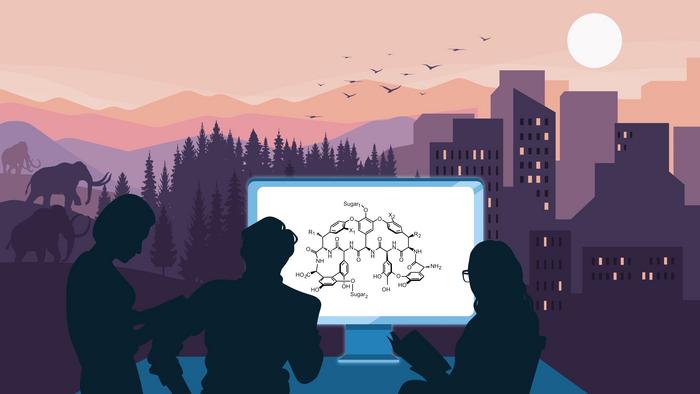
Credit: © Universität Tübingen / CMFI
In today’s medical landscape, antibiotics are pivotal in combatting bacterial infections. These potent compounds, produced by bacteria and fungi, act as natural defenses against microbial attacks. A team of researchers delved into the intricate world of glycopeptide antibiotics – a vital resource in countering drug-resistant pathogens – to uncover their evolutionary origins. Dr. Demi Iftime and Dr. Martina Adamek headed this interdisciplinary project, guided by Professors Evi Stegmann and Nadine Ziemert from the “Controlling Microbes to Fight Infections” Cluster of Excellence at the University of Tübingen, with support from Professor Max Cryle and Dr. Mathias Hansen from Monash University in Australia.
Using advanced bioinformatics, the team sought to decipher the chemical blueprint of ancient glycopeptide antibiotics. By understanding their evolutionary trajectory, the researchers were looking for insights that could steer the development of future antibiotics for medical applications. The team’s study has been published in the latest edition of Nature Communications.
Tracing an Evolutionary Path
“Antibiotics emerge from an ongoing evolutionary tug-of-war between different organisms, each striving to outmaneuver or curtail the spread of their adversaries,” explains Evi Stegmann. To explore this, the researchers utilized the glycopeptide antibiotics teicoplanin and vancomycin, along with related compounds sourced from specific bacterial strains. These compounds, built from amino acids and sugars, disrupt bacterial cell wall construction, ultimately leading to bacterial death. Notably, teicoplanin and vancomycin exhibit this potency against numerous human pathogens.
In simplified terms, scientists often organize species into an evolutionary tree structure to illustrate their relationships. Similarly, the research team constructed a family tree of known glycopeptide antibiotics, linking their chemical structures via gene clusters that encode their blueprints. Employing bioinformatics algorithms, they deduced a putative ancestral form of these antibiotics – which they dubbed “paleomycin.” By reconstructing the genetic pathways they believed to produce paleomycin, the team successfully synthesized the compound, which displayed antibiotic properties in tests. “Recreating such an ancient molecule was exhilarating, akin to bringing dinosaurs or wooly mammoths back to life,” remarks Ziemert.
Connecting Evolution to Practicality
“One intriguing finding is that all glycopeptide antibiotics stem from a common precursor,” Stegmann says. “Moreover, the core structure of paleomycin mirrors the complexity seen in teicoplanin, while vancomycin exhibits a simpler core. We speculate that recent evolution streamlined the latter’s structure, yet its antibiotic function remained unchanged,” Ziemert adds. This family of antibiotics – though beneficial for bacteria producing them – demand substantial energy due to their complex chemical composition. Streamlining this complexity while retaining efficacy could confer an evolutionary advantage.
The researchers meticulously traced the evolution of these antibiotics and their underlying genetic sequences, investigating pivotal steps required for creating functional molecules. In collaboration with Australian scientists, some of these steps were replicated in laboratory settings. “This journey through time revealed profound insights into the evolution of bacterial antibiotic pathways and nature’s optimization strategies, leading to modern glycopeptide antibiotics,” says Ziemert. “This provides us with a solid foundation for advancing this crucial antibiotic group using biotechnology.”
Publication:
Mathias Hansen, Martina Adamek, Dumitrita Iftime, Daniel Petras, Frauke Schuseil, Stephanie Grond, Evi Stegmann, Max Cryle and Nadine Ziemert: Resurrecting Ancestral Antibiotics: Unveiling the Origins of Modern Lipid II Targeting Glycopeptides. Nature Communications, https://doi.org/10.1038/s41467-023-43451-4
Journal
Nature Communications
DOI
10.1038/s41467-023-43451-4
Method of Research
Computational simulation/modeling
Subject of Research
Not applicable
Article Title
Resurrecting ancestral antibiotics: unveiling the origins of modern lipid II targeting glycopeptides
Article Publication Date
29-Nov-2023