• HOME
  • NEWS
  • EXPLORE
    • CAREER
      • Companies
      • Jobs
    • EVENTS
    • iGEM
      • News
      • Team
    • PHOTOS
    • VIDEO
    • WIKI
  • BLOG
  • COMMUNITY
    • FACEBOOK
    • INSTAGRAM
    • TWITTER
Wednesday, April 1, 2026
BIOENGINEER.ORG
No Result
View All Result
  • Login
  • HOME
  • NEWS
  • EXPLORE
    • CAREER
      • Companies
      • Jobs
        • Lecturer
        • PhD Studentship
        • Postdoc
        • Research Assistant
    • EVENTS
    • iGEM
      • News
      • Team
    • PHOTOS
    • VIDEO
    • WIKI
  • BLOG
  • COMMUNITY
    • FACEBOOK
    • INSTAGRAM
    • TWITTER
  • HOME
  • NEWS
  • EXPLORE
    • CAREER
      • Companies
      • Jobs
        • Lecturer
        • PhD Studentship
        • Postdoc
        • Research Assistant
    • EVENTS
    • iGEM
      • News
      • Team
    • PHOTOS
    • VIDEO
    • WIKI
  • BLOG
  • COMMUNITY
    • FACEBOOK
    • INSTAGRAM
    • TWITTER
No Result
View All Result
Bioengineer.org
No Result
View All Result
Home NEWS Science News Chemistry

Surpassing the human eye: machine learning image analysis rapidly determines chemical mixture composition

Bioengineer by Bioengineer
August 30, 2023
in Chemistry
Reading Time: 3 mins read
0
Artistic depiction of machine learning analysis of chemical mixture ratios
Share on FacebookShare on TwitterShare on LinkedinShare on RedditShare on Telegram

Machine learning model provides quick method for determining the composition of solid chemical mixtures using only photographs of the sample.
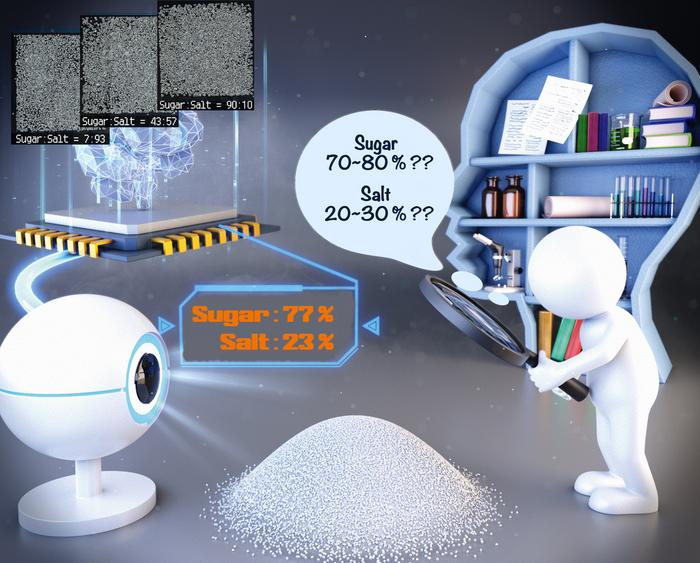
Artistic depiction of machine learning analysis of chemical mixture ratios

Credit: Yasuhide Inokuma

Machine learning model provides quick method for determining the composition of solid chemical mixtures using only photographs of the sample.

Have you ever accidentally ruined a recipe in the kitchen by adding salt instead of sugar? Due to their similar appearance, it’s an easy mistake to make. Similarly, checking with the naked eye is also used in chemistry labs to provide quick, initial assessments of reactions; however, just like in the kitchen, the human eye has its limitations and can be unreliable. 

To address this, researchers at the Institute of Chemical Reaction Design and Discovery (WPI-ICReDD), Hokkaido University led by Professor Yasuhide Inokuma have developed a machine learning model that can distinguish the composition ratio of solid mixtures of chemical compounds using only photographs of the samples. 

The model was designed and developed using mixtures of sugar and salt as a test case. The team employed a combination of random cropping, flipping and rotating of the original photographs in order to create a larger number of sub images for training and testing. This enabled the model to be developed using only 300 original images for training. The trained model was roughly twice as accurate as the naked eye of even the most expert member of the team.

“I think it’s fascinating that with machine learning we have been able to reproduce and even exceed the accuracy of the eyes of experienced chemists,” commented Inokuma. “This tool should be able to help new chemists achieve an experienced eye more quickly.”

After the successful test case, researchers applied this model to the evaluation of different chemical mixtures.  The model successfully distinguished different polymorphs and enantiomers, both of which are extremely similar versions of the same molecule with subtle differences in atomic or molecular arrangement. Distinguishing these subtle differences is important in the pharmaceutical industry and normally requires a more time-consuming process.

The model was even able to handle more complex mixtures, accurately assessing the percentage of a target molecule in a four-component mixture. Reaction yield was also analyzed, determining the progress of a thermal decarboxylation reaction. 

The team further demonstrated the versatility of their model, showing that it could accurately analyze images taken with a mobile phone, after supplemental training was performed. The researchers anticipate a wide variety of applications, both in the research lab and in industry.

“We see this as being applicable in situations where constant, rapid evaluation is required, such as monitoring reactions at a chemical plant or as an analysis step in an automated process using a synthesis robot,” explained Specially Appointed Assistant Professor Yuki Ide. “Additionally, this could act as an observation tool for those who have impaired vision.”


Journal

Industrial & Engineering Chemistry Research

DOI

10.1021/acs.iecr.3c01882

Method of Research

Experimental study

Subject of Research

Not applicable

Article Title

Machine Learning-Based Analysis of Molar and Enantiomeric Ratios and Reaction Yields Using Images of Solid Mixtures

Article Publication Date

23-Aug-2023

Share12Tweet8Share2ShareShareShare2

Related Posts

Creating Desktop Particle Accelerators to Open New Frontiers in Scientific Research

Creating Desktop Particle Accelerators to Open New Frontiers in Scientific Research

April 1, 2026
Photochargeable Semiconductor Powers Efficient Amine Coupling

Photochargeable Semiconductor Powers Efficient Amine Coupling

April 1, 2026

From Cells to Smart Gels: Advancing Frontiers in Motion Science

March 31, 2026

Tides Amplify Biochar’s Carbon Capture Efficiency in Coastal Wetlands

March 31, 2026

POPULAR NEWS

  • blank

    Revolutionary AI Model Enhances Precision in Detecting Food Contamination

    96 shares
    Share 38 Tweet 24
  • Imagine a Social Media Feed That Challenges Your Views Instead of Reinforcing Them

    1006 shares
    Share 398 Tweet 249
  • Promising Outcomes from First Clinical Trials of Gene Regulation in Epilepsy

    51 shares
    Share 20 Tweet 13
  • Popular Anti-Aging Compound Linked to Damage in Corpus Callosum, Study Finds

    43 shares
    Share 17 Tweet 11

About

We bring you the latest biotechnology news from best research centers and universities around the world. Check our website.

Follow us

Recent News

FGFR2b Links to Biomarkers, Tumor Diversity, Survival

Frailty, Malnutrition Link Falls to Daily Functioning

Dactylides D, E: Novel 22-Membered Polyol Macrolides

Subscribe to Blog via Email

Enter your email address to subscribe to this blog and receive notifications of new posts by email.

Join 78 other subscribers
  • Contact Us

Bioengineer.org © Copyright 2023 All Rights Reserved.

Welcome Back!

Login to your account below

Forgotten Password?

Retrieve your password

Please enter your username or email address to reset your password.

Log In
No Result
View All Result
  • Homepages
    • Home Page 1
    • Home Page 2
  • News
  • National
  • Business
  • Health
  • Lifestyle
  • Science

Bioengineer.org © Copyright 2023 All Rights Reserved.