The importance of magnesium in plants and animals has long been known, but the details of its uptake and transport in plants are largely unexplored. The recent results from an international collaboration led by Cornelia Spetea (University of Gothenburg), published in Frontiers in Plant Science, provide new knowledge about the role of magnesium uptake by plants in photosynthesis and in the function of chloroplasts. The data show that the activity of magnesium transport proteins is essential for plant metabolism and chloroplast functioning, impacting growth and agricultural yield.
Credit: Photo: Emilija Dukic
The importance of magnesium in plants and animals has long been known, but the details of its uptake and transport in plants are largely unexplored. The recent results from an international collaboration led by Cornelia Spetea (University of Gothenburg), published in Frontiers in Plant Science, provide new knowledge about the role of magnesium uptake by plants in photosynthesis and in the function of chloroplasts. The data show that the activity of magnesium transport proteins is essential for plant metabolism and chloroplast functioning, impacting growth and agricultural yield.
Magnesium deficiency in humans is often associated with unpleasant symptoms, perhaps the best known of which is muscle cramps in the legs. This is because magnesium is essential for the function of more than 300 enzymes that are responsible for the proper activity of the nervous system and muscles, the synthesis of proteins, DNA and RNA, and the regulation of blood sugar and blood pressure.
Magnesium is also an essential mineral for plants, where it is required for the function of many proteins, including the enzymes involved in photosynthetic carbon fixation in chloroplasts. Additional roles for this ion in photosynthesis are incorporation into the porphyrin skeleton of the green pigment, chlorophyll, and involvement in the organization of photosynthetic (thylakoid) membranes. It is therefore not surprising that 15-35% of the total magnesium content of plants is found in chloroplasts.
Despite its importance, relatively little is known about how magnesium is taken up and transported by plants through their bodies and cells. For the proper growth and healthy development of our crops,
it is important to understand how essential nutrients present in the soil are transported from the roots to the place where they are used in the plants, for example into the chloroplast for photosynthesis.
The ions can only pass through membranes by means of special ion channels and transporters. Led by Cornelia Spetea, a team of researchers from Sweden, Japan, Hungary, Denmark, and USA investigated how magnesium enters the plant’s photosynthetic organelle, the chloroplast.
The work recently published in Frontiers in Plant Science, characterized the function of three proteins from two distinct families previously identified in the model plant Arabidopsis thaliana. These are called magnesium release 8 and 9 (MGR8, MGR9) and magnesium transporter 10 (MGT10). All three studied proteins are located in the envelope of the chloroplast and are involved in the transport of magnesium across this membrane. They have also been shown to play important roles in the regulation of different processes during photosynthesis. The work also identified and characterized for the first time a protein from the unicellular green alga Chlamydomonas reinhardtii, MRS4, which has a similar function as the MGT10 described in Arabidopsis.
The analyses suggest that MGT10 protein is a magnesium ion channel, while MGR8 and MGR9 are magnesium transporters that may require the presence of sodium ions. This phenomenon is of interest for several reasons: firstly, because sodium is not an essential nutrient for plants, so little is known about its transport mechanisms within the plant cell, and secondly, because the presence of this ion has a negative effect on photosynthesis, among other things, in plants growing in saline or high-salinity soils.
‘We observed evident decrease in the photosynthetic performance of the mutant plants lacking one or two of these magnesium transport proteins, which underlines the importance of this element in plant metabolism’
– summarizes Professor Cornelia Spetea from the University of Gothenburg the major findings of the work.
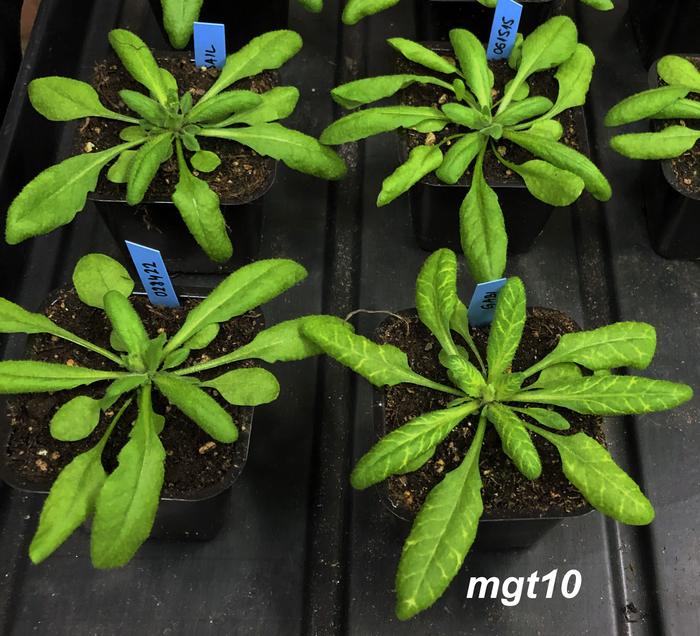
The importance of the uptake of magnesium by the chloroplast, and the role of MGT10 in this process, is also demonstrated by the fact that mutant plants that are completely lacking this protein (knock-out) are not viable. Therefore, only so-called knock-down mutant plants could be analyzed in the studies, in which the expression of this gene is lower and thus have a smaller amount of the protein. These mutant plants had yellow leaf veins instead of the green veins observed in wild-type plants. The yellow leaf veins indicates that chlorophyll formation is inhibited in these regions.
‘Moreover, a particular thylakoid organization was observed in the cells near the leaf veins. Even within the same cell, there were chloroplasts with normal thylakoids as well as some with thylakoids organized in large grana (so-called macro-grana) and small membrane vesicles’ – explains Katalin Solymosi, from Eötvös Loránd University, Hungary, who performed the microscopic analyses.
Further investigation is needed to understand exactly why two differently organized plastid types are present within a single cell.
The yellow discoloration of the leaf veins is also typical of certain viral infections and deficiencies of other essential nutrients such as iron. These studies suggest that similar symptoms may also occur in case of inadequate intracellular transport of magnesium, and that the presence and the proper functioning of the studied proteins is essential for plant metabolism and thus agriculture.
Journal
Frontiers in Plant Science
DOI
10.3389/fpls.2023.1221436
Article Title
Chloroplast magnesium transporters play essential but differential roles in maintaining magnesium homeostasis