WASHINGTON, August 29, 2023 – With their intricate arrangements and dynamic functionalities, proteins perform a plethora of biological tasks by employing unique arrangements of simple building blocks where geometry is key. Translating this nearly limitless library of arrangements into their respective functions could let researchers design custom proteins for specific uses.
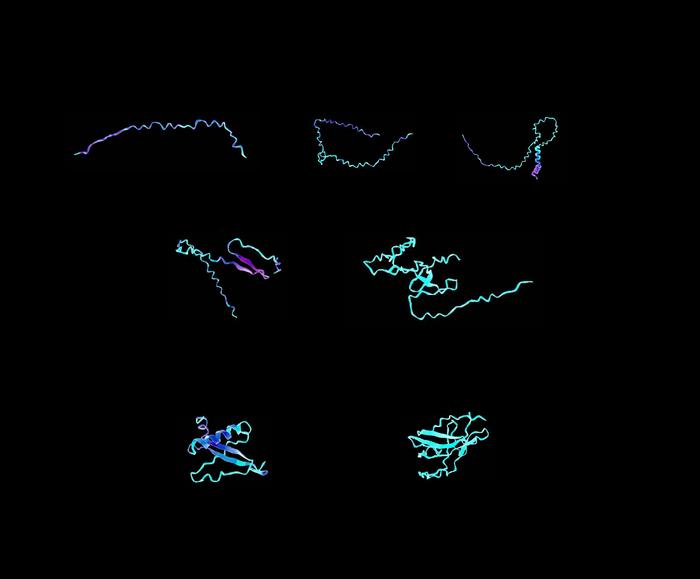
Credit: Markus Buehler
WASHINGTON, August 29, 2023 – With their intricate arrangements and dynamic functionalities, proteins perform a plethora of biological tasks by employing unique arrangements of simple building blocks where geometry is key. Translating this nearly limitless library of arrangements into their respective functions could let researchers design custom proteins for specific uses.
In Journal of Applied Physics, from AIP Publishing, Markus Buehler of the Massachusetts Institute of Technology combined attention neural networks, often referred to as transformers, with graph neural networks to better understand and design proteins. The approach couples the strengths of geometric deep learning with those of language models not only to predict existing protein properties but also to envision new proteins that nature has not yet devised.
“With this new method, we can utilize all that nature has invented as a knowledge basis by modeling the underlying principles,” Buehler said. “The model recombines these natural building blocks to achieve new functions and solve these types of tasks.”
Owing to their complex structures, ability to multitask, and tendency to change shape when dissolved, proteins have been notoriously difficult to model. Machine learning has demonstrated the ability to translate the nanoscale forces governing protein behavior into working frameworks describing their function. However, going the other way — turning a desired function into a protein structure — remains a challenge.
To overcome this challenge, Buehler’s model turns numbers, descriptions, tasks, and other elements into symbols for his neural networks to use.
He first trained his model to predict the sequencing, solubility, and amino acid building blocks of different proteins from their functions. He then taught it to get creative and generate brand new structures after receiving initial parameters for a new protein’s function.
The approach allowed him to create solid versions of antimicrobial proteins that previously had to be dissolved in water. In another example, his team took a naturally occurring silk protein and evolved it into various new forms, including giving it a helix shape for more elasticity or a pleated structure for additional toughness.
The model performed many of the central tasks of designing new proteins, but Buehler said the approach can incorporate even more inputs for more tasks, potentially making it even more powerful.
“A big surprise element was that the model performed exceptionally well even though it was developed to be able to solve multiple tasks. This is likely because the model learns more by considering diverse tasks,” he said. “This change means that rather than creating specialized models for specific tasks, researchers can now think broadly in terms of multitask and multimodal models.”
The broad nature of this approach means this model can be applied to many areas outside protein design.
“While our current focus is proteins, this method has vast potential in materials science,” Buehler said. “We’re especially keen on exploring material failure behaviors, aiming to design materials with specific failure patterns.”
###
The article “Generative pretrained autoregressive transformer graph neural network applied to the analysis and discovery of novel proteins” is authored by Markus Buehler. It will appear in Journal of Applied Physics on Aug. 29, 2023 (DOI: 10.1063/5.0157367). After that date, it can be accessed at https://doi.org/10.1063/5.0157367.
ABOUT THE JOURNAL
The Journal of Applied Physics is an influential international journal publishing significant new experimental and theoretical results in all areas of applied physics. See https://aip.scitation.org/journal/jap.
###
Journal
Journal of Applied Physics
DOI
10.1063/5.0157367
Article Title
Generative pretrained autoregressive transformer graph neural network applied to the analysis and discovery of novel proteins
Article Publication Date
29-Aug-2023