WASHINGTON, Aug. 1, 2023 – Since ancient times, gemstones have been mined and traded across the globe, sometimes traveling continents from their origin. Gems are geologically defined as minerals celebrated for beauty, strength, and rarity. Their unique elemental composition and atomic orientation act as a fingerprint, enabling researchers to uncover the stones’ past, and with it, historical trade routes.
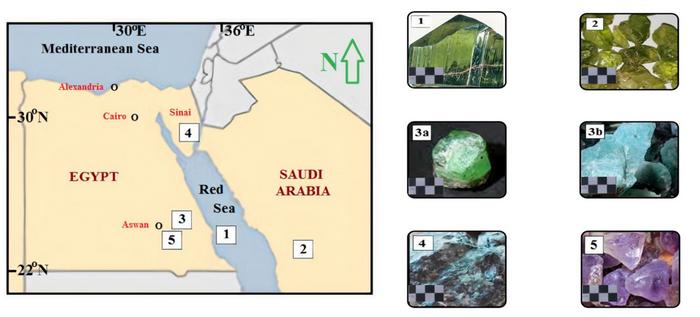
Credit: Khedr et al.
WASHINGTON, Aug. 1, 2023 – Since ancient times, gemstones have been mined and traded across the globe, sometimes traveling continents from their origin. Gems are geologically defined as minerals celebrated for beauty, strength, and rarity. Their unique elemental composition and atomic orientation act as a fingerprint, enabling researchers to uncover the stones’ past, and with it, historical trade routes.
In AIP Advances, from AIP Publishing, Khedr et al. employed three modern spectroscopic techniques to rapidly analyze gems found in the Arabian-Nubian Shield and compare them with similar gems from around the world. Using laser-induced breakdown spectroscopy (LIBS), Fourier transform infrared (FTIR) spectroscopy, and Raman spectroscopy, the authors identified elements that influence gems’ color, differentiated stones found within and outside the region, and distinguished natural from synthetic.
The Arabian-Nubian Shield is an exposure of mineral deposits that sandwiches the Red Sea in current-day Egypt and Saudi Arabia. The deposits date back to the Earth’s earliest geological age, and the precious metals and gemstones have been harvested for thousands of years.
“We showed the main spectroscopic characteristics of gemstones from these Middle East localities to distinguish them from their counterparts in other world localities,” said author Adel Surour. “This includes a variety of silicate gems such as emerald from the ancient Cleopatra’s mines in Egypt, in addition to amethyst, peridot, and amazonite from other historical sites, which mostly date to the Roman times.”
The various spectroscopic techniques they employed revealed different information about the stones. LIBS quickly characterizes chemical composition, while FTIR determines functional groups connected to the structure and indicates the presence of water and other hydrocarbons. Even for chemically identical materials, Raman spectroscopy shows the unique crystalline structure of the gems’ atoms.
The authors identified that iron content correlates to amethysts’ signature purple hue, and other elements such as copper, chromium, and vanadium are also responsible for colorization. A signature water peak exposes lab-grown synthetic gems, which are useful for scientific purposes and identical to natural gems but are less expensive.
Crystalline structure differentiated amazonite beads from Mexico, Jordan, and Egypt.
“Gemstones such as emerald and peridot have been mined since antiquity,” Surour said. “Sometimes, some gemstones were brought by sailors and traders to their homelands. For example, royal crowns in Europe are decorated with peculiar gemstones that originate from either Africa or Asia. We need to have precise methods to distinguish the source of a gemstone and trace ancient trade routes in order to have correct information about the original place from which it was mined.”
###
The article “Characterization and discrimination of some gem silicate minerals adopting LIBS, FTIR and Raman spectroscopic techniques” is authored by Amal Abdelfattah Khedr, Adel A. Surour, Ahmed El-Hussein, and Mahmoud Abdelhamid. The article will appear in AIP Advances on Aug. 1, 2023 (DOI: 10.1063/5.0157623). After that date, it can be accessed at https://doi.org/10.1063/5.0157623.
ABOUT THE JOURNAL
AIP Advances is an open access journal publishing in all areas of physical sciences—applied, theoretical, and experimental. The inclusive scope of AIP Advances makes it an essential outlet for scientists across the physical sciences. See https://pubs.aip.org/aip/adv.
###
Journal
AIP Advances
DOI
10.1063/5.0157623
Article Title
Characterization and discrimination of some gem silicate minerals adopting LIBS, FTIR and Raman spectroscopic techniques
Article Publication Date
1-Aug-2023