Tsukuba, Japan—Many people may not realize that the humble sea urchin is a titan when it comes to the study of biology. Now, researchers from Japan have discovered that sea urchins could help biological studies go further than ever before.
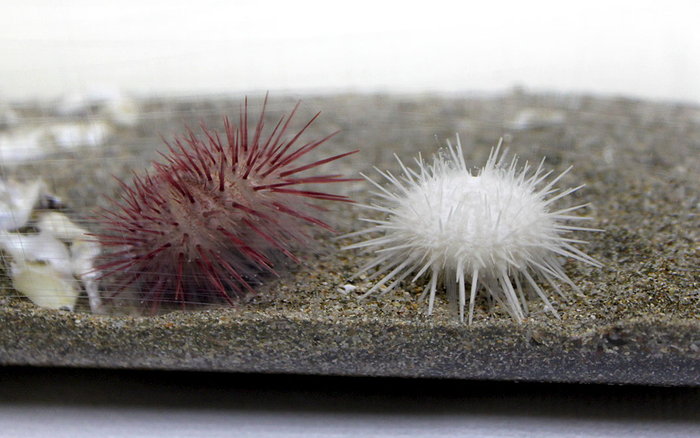
Credit: University of Tsukuba
Tsukuba, Japan—Many people may not realize that the humble sea urchin is a titan when it comes to the study of biology. Now, researchers from Japan have discovered that sea urchins could help biological studies go further than ever before.
In a study published in this month in Development, Growth and Differentiation, researchers from the University of Tsukuba have revealed that a particular species of sea urchin may be a game changer, opening up new avenues for genetic research.
Sea urchins have been used for over a hundred year as a model for understanding how biological systems work. These organisms have enabled the identification of mechanisms underlying biological phenomena, ranging from gene regulatory networks to the proteins involved in cell cycles. However, there is a catch—the model species used so far take 2 years to reach reproductive maturity, making them unsuitable for genetic studies.
“To be able to study genetics in sea urchins, we need to find species with short breeding cycles, or to speed up the cycles of the current model species,” says senior author of the study, Professor Shunsuke Yaguchi. “In our study, we looked for a species with a short reproductive cycle.”
The researchers identified Temnopleurus reevesii as a candidate species because it only takes 6 months to produce the next generation, and eggs and sperm can be collected continuously throughout the year when kept at a temperature over 20°C. Most other model sea urchins don’t have these features, which make this species useful for culturing in a lab.
The team assembled a draft genome of T. reevesii and constructed two genome databases, TrBase and the Western Pacific Sea Urchin Genome Database (WestPac-SUGDB), the latter containing genomic information on T. reevesii and another model urchin species, Hemicentrotus pulcherrimus. The aim of creating these databases was to provide genetic information and establish a portal site for West Pacific sea urchin genetic data. WestPac-SUGDB also has search programs for comparing the two datasets.
“We predict that these databases will contribute not only to sea urchin genetic research, but also to evolutionary research and comparative genomics,” says Professor Yaguchi.
The results of this study have opened up the possibility of using T. reevesii as a new model species for research in a number of fields, including cell, developmental, experimental, and evolutionary biology. Additionally, the researchers suggest that investigations in the near future will identify another sea urchin species as an improved model organism for medicine and the life sciences.
Original Paper:
The article, “TrBase: A genome and transcriptome database of Temnopleurus reevesii,” was published in Development, Growth and Differentiation at DOI: 10.1111/dgd.12780
Correspondence:
Associate Professor YAGUCHI Shunsuke
Faculty of Life and Environmental Sciences, University of Tsukuba
Related Link:
Faculty of Life and Environmental Sciences
Shimoda Marine Research Center
TrBase: https://cell-innovation.nig.ac.jp/Tree/
WestPac-SUGDB: https://cell-innovation.nig.ac.jp/WPAC/
DOI
10.1111/dgd.12780
Article Title
TrBase: A genome and transcriptome database of Temnopleurus reevesii
Article Publication Date
22-Apr-2022