• HOME
  • NEWS
  • EXPLORE
    • CAREER
      • Companies
      • Jobs
    • EVENTS
    • iGEM
      • News
      • Team
    • PHOTOS
    • VIDEO
    • WIKI
  • BLOG
  • COMMUNITY
    • FACEBOOK
    • INSTAGRAM
    • TWITTER
Friday, November 27, 2026
BIOENGINEER.ORG
No Result
View All Result
  • Login
  • HOME
  • NEWS
  • EXPLORE
    • CAREER
      • Companies
      • Jobs
        • Lecturer
        • PhD Studentship
        • Postdoc
        • Research Assistant
    • EVENTS
    • iGEM
      • News
      • Team
    • PHOTOS
    • VIDEO
    • WIKI
  • BLOG
  • COMMUNITY
    • FACEBOOK
    • INSTAGRAM
    • TWITTER
No Result
View All Result
Bioengineer.org
No Result
View All Result
Home NEWS Science News Chemistry

Capturing electrons in space

Bioengineer by Bioengineer
July 20, 2021
in Chemistry
Reading Time: 3 mins read
0
IMAGE
Share on FacebookShare on TwitterShare on LinkedinShare on RedditShare on Telegram

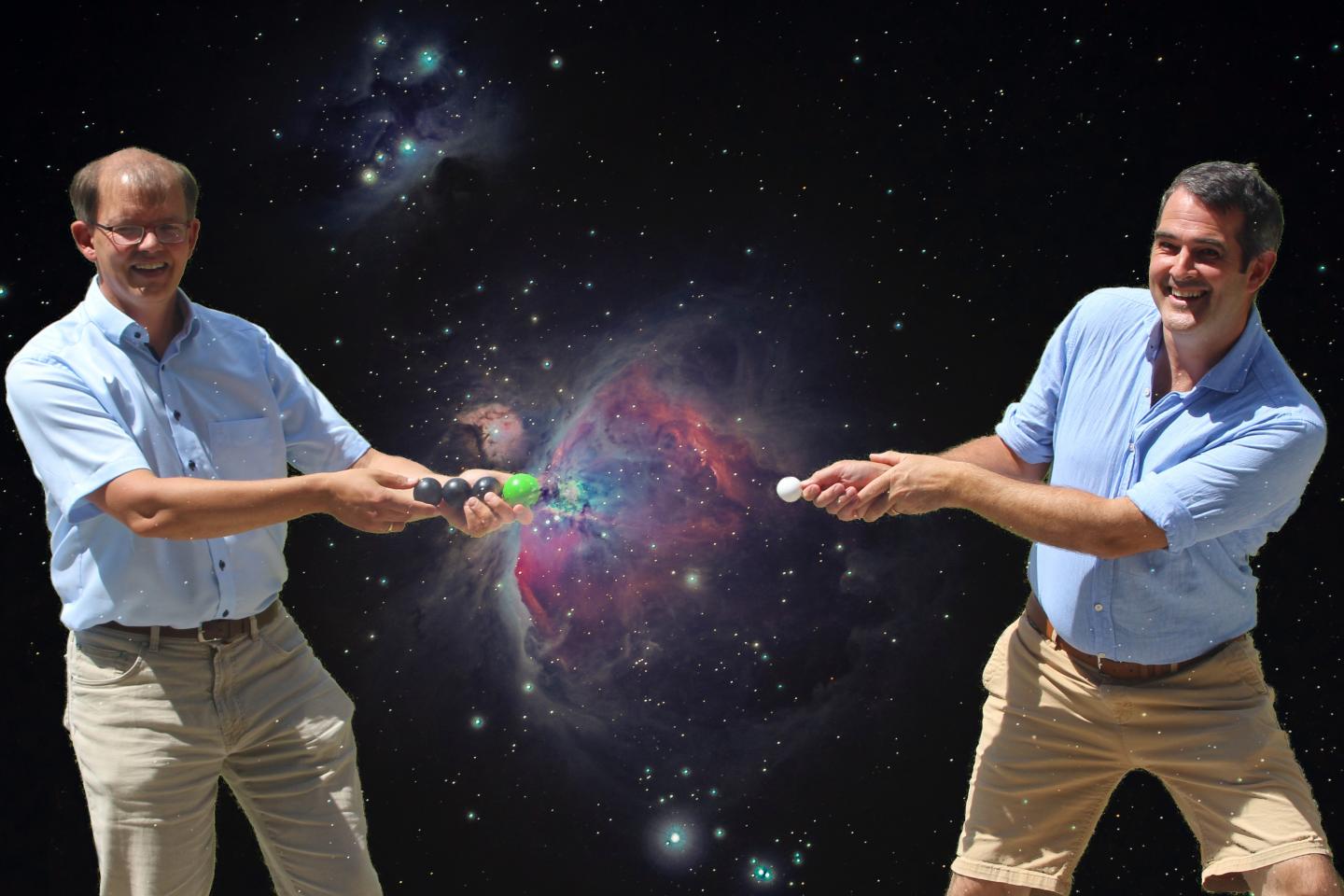
How negatively charged molecules are created in interstellar environments?
IMAGE

Credit: Bryan Goff on Unsplash / AG Wester

Interstellar clouds are the birthplaces of new stars, but they also play an important role in the origins of life in the Universe through regions of dust and gas in which chemical compounds form. The research group, molecular systems, led by ERC prize winner Roland Wester at the Institute for ion physics and applied physics at the University of Innsbruck, has set itself the task of better understanding the development of elementary molecules in space. “Put simply, our ion trap allows us to recreate the conditions in space in our laboratory,” explains Roland Wester. “This apparatus allows us to study the formation of chemical compounds in detail.” The scientists working with Roland Wester have now found an explanation for how negatively charged molecules form in space.

An idea built on theoretical foundations

Before the discovery of the first negatively charged carbon molecules in space in 2006, it was assumed that interstellar clouds only contained positively charged ions. Since then, it has been an open question how negatively charged ions are formed. The Italian theorist Franco A. Gianturco, who has been working as a scientist at the University of Innsbruck for eight years, developed a theoretical framework a few years ago that could provide a possible explanation. The existence of weakly bound states, so-called dipole-bound states, should enhance the attachment of free electrons to linear molecules. Such molecules have a permanent dipole moment which strengthens the interaction at a relatively great distance from the neutral nucleus and boosts the capture rate of free electrons.

Observing dipole-bound states in the laboratory

In their experiment, the Innsbruck physicists created molecules consisting of three carbon atoms and one nitrogen atom, ionized them, and bombarded them with laser light in the ion trap at extremely low temperatures. They continuously changed the frequency of the light until the energy was large enough to eject an electron from the molecule. Albert Einstein described this so-called photoelectric effect 100 years ago. An in-depth analysis of the measurement data by the early-stage researcher Malcolm Simpson from the doctoral training programme, atoms, light and molecules at the University of Innsbruck finally shed light on this difficult-to-observe phenomenon. A comparison of the data with a theoretical model finally provided clear evidence of the existence of dipole-bound states. “Our interpretation is that these dipole-bound states represent a kind of door opener for the binding of free electrons to molecules, thus contributing to the creation of negative ions in space,” says Roland Wester. “Without this intermediate step, it would be very unlikely that electrons would actually bind to the molecules.”

###

The work was supported by the Austrian Science Fund FWF, which also finances the PhD program Atoms, Light and Molecules (ALM) at the University of Innsbruck.

Publication: Influence of a supercritical electric dipole moment on the photodetachment of C3N-. Malcolm Simpson, Markus Nötzold, Tim Michaelsen, Robert Wild, Franco A. Gianturco, and Roland Wester. Phys. Rev. Lett. 127, 043001, https://journals.aps.org/prl/abstract/10.1103/PhysRevLett.127.043001

Media Contact
Roland Wester
roland.wester@uibk.ac.at

Related Journal Article

http://dx.doi.org/10.1103/PhysRevLett.127.043001

Tags: Chemistry/Physics/Materials Sciences
Share12Tweet8Share2ShareShareShare2

Related Posts

Biodegradable Nanocomposite Films Preserve Caspian White Fish and Visually Track Spoilage

Biodegradable Nanocomposite Films Preserve Caspian White Fish and Visually Track Spoilage

November 27, 2026
MAP9 Staples Microtubule Protofilaments to Prevent Depolymerization and Guide Neuronal Growth

MAP9 Staples Microtubule Protofilaments to Prevent Depolymerization and Guide Neuronal Growth

November 27, 2026

Amphistegina lobifera Dominates Moderately Acidified Mediterranean Seeps but Declines at Low pH

November 27, 2026

Indian Urban Heat Islands Reveal Seasonal Hotspot Shifting Driven by Surrounding Farmland

November 27, 2026
Please login to join discussion

POPULAR NEWS

  • Severe Burnout Prevalence Did Not Differ by Parental Status in Chinese Female Nurses

    Severe Burnout Prevalence Did Not Differ by Parental Status in Chinese Female Nurses

    29 shares
    Share 12 Tweet 7
  • Amphistegina lobifera Dominates Moderately Acidified Mediterranean Seeps but Declines at Low pH

    29 shares
    Share 12 Tweet 7
  • Brain Metabolic Signature Predicts Clinical Decline Across Progressive Supranuclear Palsy Spectrum

    29 shares
    Share 12 Tweet 7
  • Hippocampal Replay in Mice Promotes a Slow-Breathing Post-Stress Recovery State

    29 shares
    Share 12 Tweet 7

About

We bring you the latest biotechnology news from best research centers and universities around the world. Check our website.

Follow us

Recent News

Dual Biomarker Panel Detects Vascular Invasion in Hepatic Alveolar Echinococcosis

Review Finds Digital Tools Aid Tropical Disease Surveillance Feasibility and Reporting

Combined Peripheral Nerve Blocks Associated With Lower Vasopressor Use in Knee Replacement

Subscribe to Blog via Email

Enter your email address to subscribe to this blog and receive notifications of new posts by email.

Join 89 other subscribers
  • Contact Us

Bioengineer.org © Copyright 2023 All Rights Reserved.

Welcome Back!

Login to your account below

Forgotten Password?

Retrieve your password

Please enter your username or email address to reset your password.

Log In
No Result
View All Result
  • Homepages
    • Home Page 1
    • Home Page 2
  • News
  • National
  • Business
  • Health
  • Lifestyle
  • Science

Bioengineer.org © Copyright 2023 All Rights Reserved.