• HOME
  • NEWS
  • EXPLORE
    • CAREER
      • Companies
      • Jobs
    • EVENTS
    • iGEM
      • News
      • Team
    • PHOTOS
    • VIDEO
    • WIKI
  • BLOG
  • COMMUNITY
    • FACEBOOK
    • INSTAGRAM
    • TWITTER
Saturday, February 7, 2026
BIOENGINEER.ORG
No Result
View All Result
  • Login
  • HOME
  • NEWS
  • EXPLORE
    • CAREER
      • Companies
      • Jobs
        • Lecturer
        • PhD Studentship
        • Postdoc
        • Research Assistant
    • EVENTS
    • iGEM
      • News
      • Team
    • PHOTOS
    • VIDEO
    • WIKI
  • BLOG
  • COMMUNITY
    • FACEBOOK
    • INSTAGRAM
    • TWITTER
  • HOME
  • NEWS
  • EXPLORE
    • CAREER
      • Companies
      • Jobs
        • Lecturer
        • PhD Studentship
        • Postdoc
        • Research Assistant
    • EVENTS
    • iGEM
      • News
      • Team
    • PHOTOS
    • VIDEO
    • WIKI
  • BLOG
  • COMMUNITY
    • FACEBOOK
    • INSTAGRAM
    • TWITTER
No Result
View All Result
Bioengineer.org
No Result
View All Result
Home NEWS Science News Chemistry

Multi-material multi-photon 3D laser micro- and nanoprinting

Bioengineer by Bioengineer
September 6, 2025
in Chemistry
Reading Time: 2 mins read
0
IMAGE
Share on FacebookShare on TwitterShare on LinkedinShare on RedditShare on Telegram

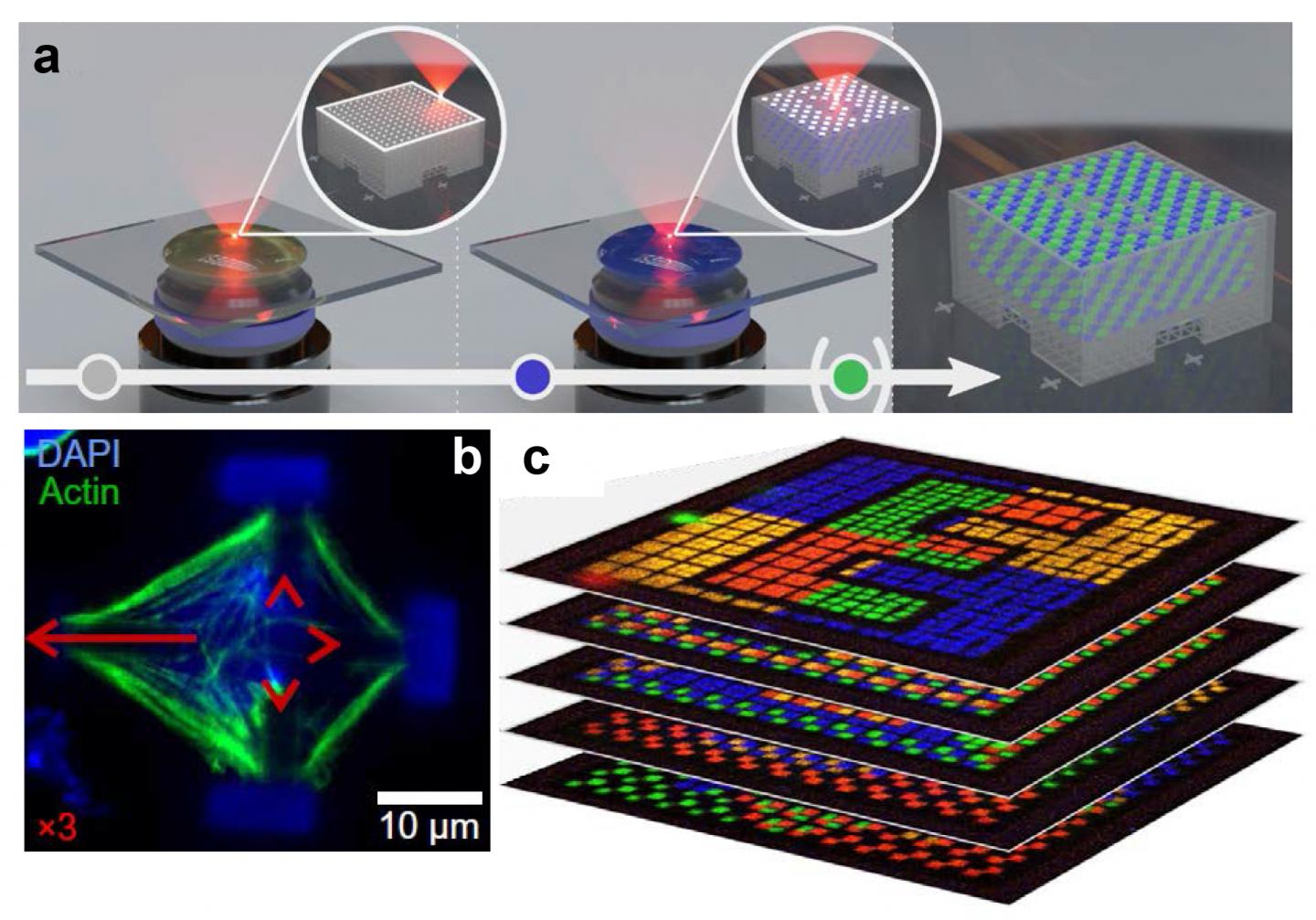
Multi-photon approaches provide printing rates of up to about ten million voxels per second. And, multi-photon-based 3D approaches structure matter with a resolution approaching sub-micrometer and nanometer feature sizes. Such spatial resolution is crucial for many applications in photonics and electronics and is inaccessible to most other 3D additive manufacturing approaches. However, the vast majority of 3D printed objects and devices made along these lines has been composed of only a single polymeric material. Multi-material architectures are much less investigated than single-material architectures, yet, most real-life systems (microscopic and macroscopic, biological and artificial) contain a large number of different materials with vastly dissimilar optical, mechanical, thermal, and electronic properties.

In a new paper published in Light: Advanced Manufacturing, a team of scientists, led by Professor Martin Wegener from Institute of Applied Physics, Karlsruhe Institute of Technology, Germany and co-workers have reviewed approaches and achievements on multi-material multi-photon micro/nano-printing. Existing materials that might serve as a working set of “primary materials” are concluded first. In the second step, processing dissimilar primary materials within 3D printed structures using a single machine tool is discussed. Corresponding literature are divided into two avenues.

In the first avenue, different photoresists – the counterparts of the colored inks – are combined to manufacture a targeted multi-material 3D structure. So far, this combination has been accomplished by intermediate manual processing steps, but automated multi-photon multi-material 3D printing systems are rapidly developing.

In the second avenue, a single photoresist delivers 3D printed material with different properties. There is no direct analogue in graphical 2D printing. The underlying idea is to impose a stimulus during the 3D printing process of each voxel, influencing the photo-reaction of the ink, such, that the emerging material properties can be varied locally and deterministically in 3D.

“Nature proceeds quite similarly. It achieves a vast variety of different effective material properties in animals and plants by architecting on a micrometer and nanometer scale by using only a limited number of building blocks, based on polysaccharides, proteins, and minerals.16 Printing tailored 3D microstructures results in artificial composites, with effective optical, mechanical, thermal, and electronic properties that can be qualitatively dramatically distinct from those of the constituents. As for dithering in 2D, it is key that the characteristic feature sizes are sufficiently small such that the observer does not notice them and rather experiences an effective homogeneous continuum” they added.

“Concerning primary materials, the field still shows shortcomings concerning electrically conductive, semiconducting, metallic, and stimuli-responsive ingredients. ” the scientists forecast.

###

Media Contact
Liang Yang
[email protected]

Related Journal Article

http://dx.doi.org/10.37188/lam.2021.017

Tags: Chemistry/Physics/Materials SciencesOptics
Share12Tweet8Share2ShareShareShare2

Related Posts

blank

Breakthrough in Environmental Cleanup: Scientists Develop Solar-Activated Biochar for Faster Remediation

February 7, 2026
blank

Cutting Costs: Making Hydrogen Fuel Cells More Affordable

February 6, 2026

Scientists Develop Hand-Held “Levitating” Time Crystals

February 6, 2026

Observing a Key Green-Energy Catalyst Dissolve Atom by Atom

February 6, 2026
Please login to join discussion

POPULAR NEWS

  • Robotic Ureteral Reconstruction: A Novel Approach

    Robotic Ureteral Reconstruction: A Novel Approach

    82 shares
    Share 33 Tweet 21
  • Digital Privacy: Health Data Control in Incarceration

    63 shares
    Share 25 Tweet 16
  • Study Reveals Lipid Accumulation in ME/CFS Cells

    57 shares
    Share 23 Tweet 14
  • Breakthrough in RNA Research Accelerates Medical Innovations Timeline

    53 shares
    Share 21 Tweet 13

About

We bring you the latest biotechnology news from best research centers and universities around the world. Check our website.

Follow us

Recent News

Personalized Guide to Understanding and Reducing Chemicals

Inflammasome Protein ASC Drives Pancreatic Cancer Metabolism

Phage-Antibiotic Combo Beats Resistant Peritoneal Infection

Subscribe to Blog via Email

Enter your email address to subscribe to this blog and receive notifications of new posts by email.

Join 73 other subscribers
  • Contact Us

Bioengineer.org © Copyright 2023 All Rights Reserved.

Welcome Back!

Login to your account below

Forgotten Password?

Retrieve your password

Please enter your username or email address to reset your password.

Log In
No Result
View All Result
  • Homepages
    • Home Page 1
    • Home Page 2
  • News
  • National
  • Business
  • Health
  • Lifestyle
  • Science

Bioengineer.org © Copyright 2023 All Rights Reserved.