• HOME
  • NEWS
  • EXPLORE
    • CAREER
      • Companies
      • Jobs
    • EVENTS
    • iGEM
      • News
      • Team
    • PHOTOS
    • VIDEO
    • WIKI
  • BLOG
  • COMMUNITY
    • FACEBOOK
    • INSTAGRAM
    • TWITTER
Thursday, September 24, 2026
BIOENGINEER.ORG
No Result
View All Result
  • Login
  • HOME
  • NEWS
  • EXPLORE
    • CAREER
      • Companies
      • Jobs
        • Lecturer
        • PhD Studentship
        • Postdoc
        • Research Assistant
    • EVENTS
    • iGEM
      • News
      • Team
    • PHOTOS
    • VIDEO
    • WIKI
  • BLOG
  • COMMUNITY
    • FACEBOOK
    • INSTAGRAM
    • TWITTER
  • HOME
  • NEWS
  • EXPLORE
    • CAREER
      • Companies
      • Jobs
        • Lecturer
        • PhD Studentship
        • Postdoc
        • Research Assistant
    • EVENTS
    • iGEM
      • News
      • Team
    • PHOTOS
    • VIDEO
    • WIKI
  • BLOG
  • COMMUNITY
    • FACEBOOK
    • INSTAGRAM
    • TWITTER
No Result
View All Result
Bioengineer.org
No Result
View All Result
Home NEWS Science News Chemistry

How to retard time for cells

Bioengineer by Bioengineer
September 6, 2025
in Chemistry
Reading Time: 2 mins read
0
IMAGE
Share on FacebookShare on TwitterShare on LinkedinShare on RedditShare on Telegram

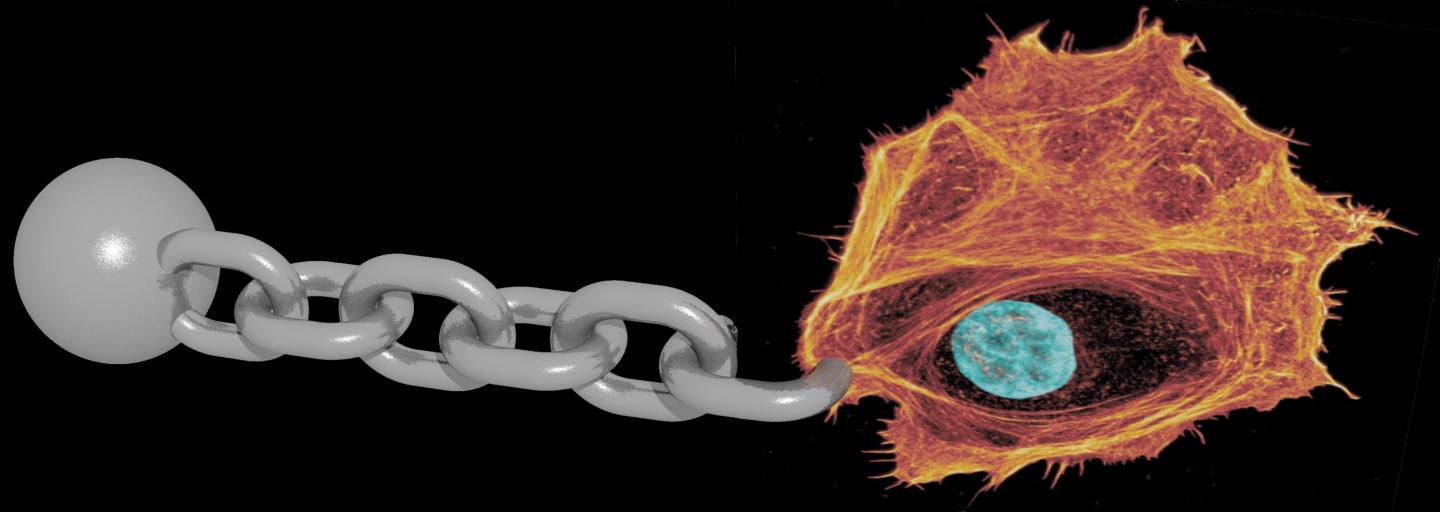
Heavy water makes biological clocks tick more slowly

They recently published their findings in the renowned journal “Advanced Materials“. Cells are not only our biological building blocks, but also highly dynamic, active systems. The research group led by Professor Käs has succeeded in significantly reducing these dynamics with heavy water, without damaging the cells.

“Generally, a lot of people know heavy water for its important technical use in nuclear power plants. We took a different approach here and were able to show that for cells, time – or, more specifically, their dynamics – can be significantly slowed down in the presence of heavy water,” said Käs, who has devoted himself to researching the physical properties of cells and tissue. The research showed on various biological levels that the movement of cells and their dynamics was only taking place in slow motion. “It is very intriguing that cellular dynamics can be slowed down at the same temperature. So far, only the theory of relativity has offered such possibilities in the physical context,” explained Käs. He added that the results form the basis of a method to offer cells and organs longer-lasting protection against degeneration.

The researchers confirmed this effect with a variety of complementary methods and attributed the observations to an increased interaction between the structural proteins. “Heavy water also forms hydrogen bonds, but these are stronger than in normal aqueous environments. As a result, structural proteins such as actin seem to interact more strongly with one another and briefly stick together. What is spectacular here is that the effects are reversible, with cells showing their native properties again as soon as they are transferred into a normal aqueous medium,” said Dr Jörg Schnauß. “What is even more astonishing is that these changes show the fingerprint of a passive material. However, cells are highly active and far from thermodynamic equilibrium. If they behave like a passive material, they are usually dead,” added Käs.

However, as the researchers were able to show, this was not the case in their experiments. They now hope to be able to use the knowledge gained to keep cells or even tissue vital for longer. If this approach is confirmed, heavy water could be used for longer storage times, for example during organ transplants.

###

Original title of the publication in Advanced Materials:
“Cells in Slow Motion: Apparent Undercooling Increases Glassy Behavior at Physiological Temperatures”

Media Contact
Dr. Jörg Schnauß
[email protected]

Original Source

https://www.uni-leipzig.de/en/newsdetail/artikel/wie-sich-zeit-fuer-zellen-aufhalten-laesst-2021-06-04/

Related Journal Article

http://dx.doi.org/10.1002/adma.202101840

Tags: BiochemistryBiomechanics/BiophysicsCell BiologyChemistry/Physics/Materials Sciences
Share12Tweet8Share2ShareShareShare2

Related Posts

Nanoparticle-Coated Fabrics Promise Antibacterial, Self-Cleaning and Conductive Clothing

Nanoparticle-Coated Fabrics Promise Antibacterial, Self-Cleaning and Conductive Clothing

September 24, 2026
Bismuth Tungstate Wrapped in Conductive Polymer Yields Supercapacitor Electrode That Barely Fades Over 1,000 Cycles

Bismuth Tungstate Wrapped in Conductive Polymer Yields Supercapacitor Electrode That Barely Fades Over 1,000 Cycles

September 24, 2026

New Sum-Connectivity Descriptors Give Molecular Graphs a Sharper Predictive Edge

September 24, 2026

Ball-Milled and CVD Silicon Anodes Face Off in All-Solid-State Batteries

September 24, 2026
Please login to join discussion

POPULAR NEWS

  • Weasel Bite Linked to Deadly Tick-Borne Virus in Rare Chinese Case

    29 shares
    Share 12 Tweet 7
  • Brain’s Waste-Clearance System Emerges as New Alzheimer’s Treatment Frontier

    29 shares
    Share 12 Tweet 7
  • New Risk Model Predicts Kidney Disease Years Before It Strikes People With Prediabetes

    29 shares
    Share 12 Tweet 7
  • Heart Cells Have a 24-Hour Molecular Switch That Turns Sleep Apnea Damage On

    29 shares
    Share 12 Tweet 7

About

We bring you the latest biotechnology news from best research centers and universities around the world. Check our website.

Follow us

Recent News

Weasel Bite Linked to Deadly Tick-Borne Virus in Rare Chinese Case

Brain’s Waste-Clearance System Emerges as New Alzheimer’s Treatment Frontier

New Risk Model Predicts Kidney Disease Years Before It Strikes People With Prediabetes

Subscribe to Blog via Email

Enter your email address to subscribe to this blog and receive notifications of new posts by email.

Join 85 other subscribers
  • Contact Us

Bioengineer.org © Copyright 2023 All Rights Reserved.

Welcome Back!

Login to your account below

Forgotten Password?

Retrieve your password

Please enter your username or email address to reset your password.

Log In
No Result
View All Result
  • Homepages
    • Home Page 1
    • Home Page 2
  • News
  • National
  • Business
  • Health
  • Lifestyle
  • Science

Bioengineer.org © Copyright 2023 All Rights Reserved.