• HOME
  • NEWS
  • EXPLORE
    • CAREER
      • Companies
      • Jobs
    • EVENTS
    • iGEM
      • News
      • Team
    • PHOTOS
    • VIDEO
    • WIKI
  • BLOG
  • COMMUNITY
    • FACEBOOK
    • INSTAGRAM
    • TWITTER
Sunday, December 21, 2025
BIOENGINEER.ORG
No Result
View All Result
  • Login
  • HOME
  • NEWS
  • EXPLORE
    • CAREER
      • Companies
      • Jobs
        • Lecturer
        • PhD Studentship
        • Postdoc
        • Research Assistant
    • EVENTS
    • iGEM
      • News
      • Team
    • PHOTOS
    • VIDEO
    • WIKI
  • BLOG
  • COMMUNITY
    • FACEBOOK
    • INSTAGRAM
    • TWITTER
  • HOME
  • NEWS
  • EXPLORE
    • CAREER
      • Companies
      • Jobs
        • Lecturer
        • PhD Studentship
        • Postdoc
        • Research Assistant
    • EVENTS
    • iGEM
      • News
      • Team
    • PHOTOS
    • VIDEO
    • WIKI
  • BLOG
  • COMMUNITY
    • FACEBOOK
    • INSTAGRAM
    • TWITTER
No Result
View All Result
Bioengineer.org
No Result
View All Result
Home NEWS Science News

Land can retain about 1/4 monthly precipitation

Bioengineer by Bioengineer
May 18, 2021
in Science News
Reading Time: 2 mins read
0
IMAGE
Share on FacebookShare on TwitterShare on LinkedinShare on RedditShare on Telegram

IMAGE

Credit: Enda Zhu

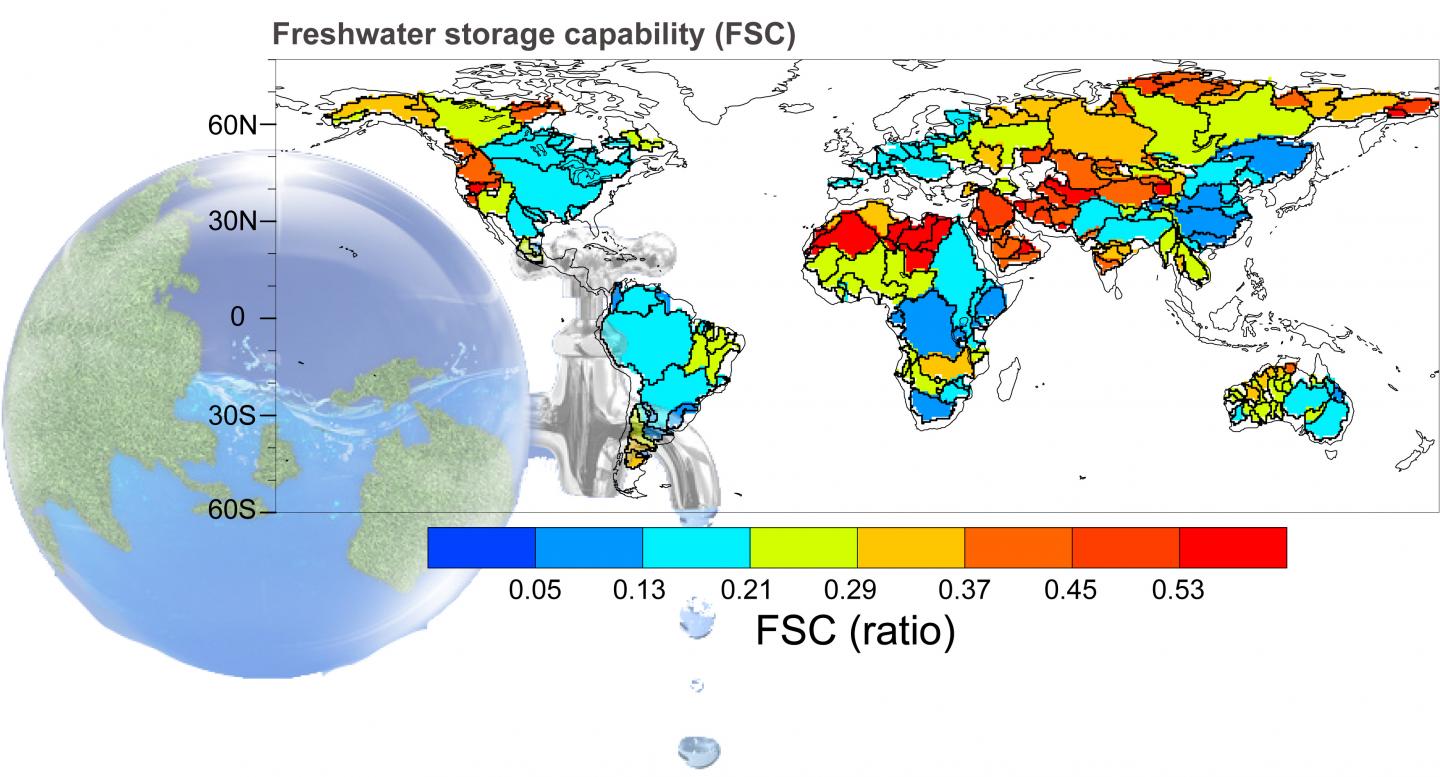
To support growing human and animal life, freshwater sources must continuously supply water. Freshwater from lakes, rivers, and underground is mainly recharged by rainfall. Ground reservoirs can store rainwater over time, depending on that location’s storage capability. However, estimating freshwater storage capability (FSC) is still a challenge due to few observation opportunities and methods to measure and quantify FSC.

Prof. Xing Yuan and his Ph.D. student Enda Zhu, from the Institute of Atmospheric Physics at the Chinese Academy of Sciences, developed and applied a new metric that characterizes the “inertia” of water after rainfall. This method allows better FSC analysis based on satellite data from the Gravity Recovery and Climate Experiment (GRACE). Researchers simulated their new algorithm using the Community Land Model version 5 (CLM5) for 194 major river basins around the world. Advances in Atmospheric Sciences has accepted the study, its results, and supporting data.

“The FSC of river basins which displays the proportion of precipitation that can be retained in land is closely related with the hydrological memory.” said Prof. Yuan. “Larger FSC means longer hydrological memory, which will have an impact on local and regional weather and climate through the land-atmosphere couple.”

Results show that, on average, global land surfaces can retain over one quarter of monthly precipitation based on GRACE observation. The CLM5 simulation represents a similar global distribution. Using this new metric, Small FSC areas have wetter conditions and a higher vegetation density, whereas large FSC areas have drier climates.

This metric observes evaporation using satellite observations. Compared with the monthly FSC, the amount of water retained within land is higher at a shorter time scale due to less evaporation in low FSC areas. Across multiple time scales, the root zone contributes to about 40% of the global land FSC.

While this study, published in Advances in Atmospheric Sciences, primarily focuses on rainfall, precipitation that falls as snow is important, despite most frozen water content sitting above the ground surface. Snow contributes to more than 20% of land FSC, especially in high latitudes.

“This work is worthy of further attentions for water resources management and hydrological prediction,” explained Prof. Yuan.

###

Media Contact
Ms. Zheng Lin
[email protected]

Original Source

http://english.iap.cas.cn/home/News/202105/t20210518_269800.html

Related Journal Article

http://dx.doi.org/10.1007/s00376-021-0222-z

Tags: AgricultureAtmospheric ScienceEarth ScienceHydrology/Water Resources
Share12Tweet8Share2ShareShareShare2

Related Posts

Male Nurses in East Africa: Striving for Recognition

December 21, 2025

Evaluating BioPMovQ’s Effectiveness in Elderly Pain Patients

December 21, 2025

Anopheles gambiae Habitat and Public Health in Osun

December 21, 2025

Advancing Health Equity Through Learning Health Systems

December 21, 2025
Please login to join discussion

POPULAR NEWS

  • Nurses’ Views on Online Learning: Effects on Performance

    Nurses’ Views on Online Learning: Effects on Performance

    70 shares
    Share 28 Tweet 18
  • NSF funds machine-learning research at UNO and UNL to study energy requirements of walking in older adults

    71 shares
    Share 28 Tweet 18
  • Unraveling Levofloxacin’s Impact on Brain Function

    53 shares
    Share 21 Tweet 13
  • Exploring Audiology Accessibility in Johannesburg, South Africa

    51 shares
    Share 20 Tweet 13

About

We bring you the latest biotechnology news from best research centers and universities around the world. Check our website.

Follow us

Recent News

Male Nurses in East Africa: Striving for Recognition

Evaluating BioPMovQ’s Effectiveness in Elderly Pain Patients

Anopheles gambiae Habitat and Public Health in Osun

Subscribe to Blog via Email

Enter your email address to subscribe to this blog and receive notifications of new posts by email.

Join 70 other subscribers
  • Contact Us

Bioengineer.org © Copyright 2023 All Rights Reserved.

Welcome Back!

Login to your account below

Forgotten Password?

Retrieve your password

Please enter your username or email address to reset your password.

Log In
No Result
View All Result
  • Homepages
    • Home Page 1
    • Home Page 2
  • News
  • National
  • Business
  • Health
  • Lifestyle
  • Science

Bioengineer.org © Copyright 2023 All Rights Reserved.