Struggle for dominance leaves a mark on genes and speeds up aging
Credit: Elizabeth Archie
DURHAM, N.C. — Some guys have it all: the muscle, the power, the high social status, the accelerated aging.
But wait. Faster aging? Who wants that? For male baboons, it’s the price they pay to be at the top.
New research appearing April 6 in eLife by Jenny Tung, associate professor of evolutionary anthropology and biology at Duke University, and her colleagues shows that male baboons that climb the social ladder age faster than males with lower social standing. If a male drops in social status, his estimated rate of aging drops as well.
Using blood samples from 245 wild baboons in the Amboseli ecosystem in Kenya, the team analyzed chemical modifications to DNA known as DNA methylation marks.
“These marks change with age in a clock-like fashion,” Tung said. “However, environmental stressors can make the clock tick faster.” This would make an individual appear older than they really are, and, research in humans suggests, can put them at a higher risk of aging-related disease.
Since this cohort of baboons is one of the most intensively studied wild mammal populations in the world, the researchers already knew not only each baboon’s age, but also the environment in which they grew up, their exposure to early life adversity, and a great deal about their adult environment, especially the aspects that predict how long they live and how many offspring they leave behind.
“We used DNA methylation to compare the baboons known ages to their ‘biological ages,'” said Jordan Anderson, a graduate student in the Tung lab who co-led the work. These methylation markers are found across the genome, so the team first needed to measure a large number of these sites – about 400,000 of them – and then, through statistical methods and models, whittle the number of sites down to about 500 that best predicted age.
Interestingly, for males, early life adversity didn’t affect how fast their biological clocks tick.
Adult social status was the strongest factor that affected aging. “Male baboons who compete successfully for high social status appear to age faster,” Tung said. “We repeatedly sampled some of these males and were able to show that the clock can speed up or slow down as males move up or down the social ladder.”
This is contrary to what we see in humans. Typically, high social status in humans predicts better health, not worse. The most wealthy and powerful humans have access to and can afford the best houses, schools, healthcare and more. Those who live in poverty and have lower socioeconomic status are at increased risk and have higher rates of disease, cancer and all-cause mortality.
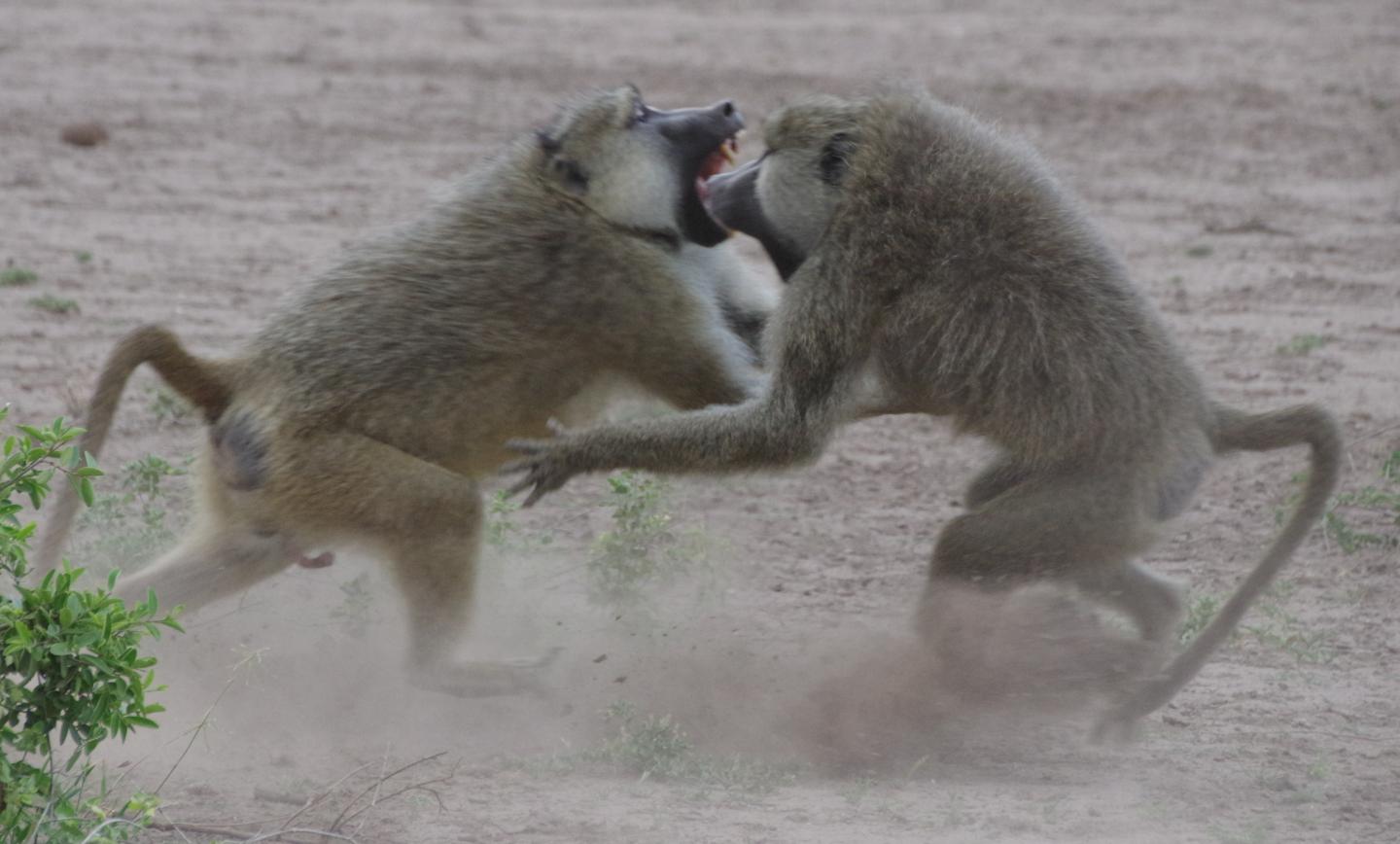
Male baboons, though, have to fight for their social status. Because of this, it’s common to see male-male competition on a regular basis, where baboon observers can see a clear winner and a clear loser.
To maintain their social status, males at the top regularly have to hold their ground and defend themselves physically. Because of this, male baboons at the top tend to have more muscle mass and better body condition than lower ranking baboons. But as their physicality starts to diminish with age, a new, younger, stronger male may overcome them for the top spot.
High ranking males also spend a lot of time mate-guarding females. Around ovulation, they follow females closely and ward off other males. Mate-guarding constrains a male’s other activities, and Tung and her team think it is likely to be energetically costly — perhaps helping to explain their accelerated aging result.
So why do these males work so hard to achieve a high stress social status? It’s simple: to have offspring.
“If male baboons are going to have babies, they need to achieve high rank,” Tung said. “They will have very little chance to leave offspring if they don’t achieve high rank, which creates a powerful evolutionary motivation.”
This study highlights one way that the social environment can influence aging. “Our research shows that the manner in which social status is attained and maintained is crucial to understanding its consequences,” Tung said.
###
This research was supported by the US National Science Foundation and the US National Institutes of Health, Canadian Institute of Advanced Research, North Carolina Biotechnology Center, and the Center for Population Health and Aging. (2018264636, IOS1456832, R01AG053308, R01AG053330, R01HD088558, P01AG031719, F32HD095616, 2016-IDG-1013, P30AG034424)
CITATION: “High Social Status Males Experience Accelerated Epigenetic Aging in Wild Baboons,” Jordan A. Anderson, Rachel A. Johnston, Amanda J. Lea, Fernando A. Campos, Tawni N. Voyles, Mercy Y. Akinyi, Susan C. Alberts, Elizabeth A. Archie, Jenny Tung. eLife, April 6, 2021. DOI: 10.7554/eLife.66128
Media Contact
Robin Ann Smith
[email protected]
Original Source
http://today.
Related Journal Article
http://dx.