It can help operators optimize the performance of X-ray lasers, electron microscopes, medical accelerators and other devices that depend on high-quality beams
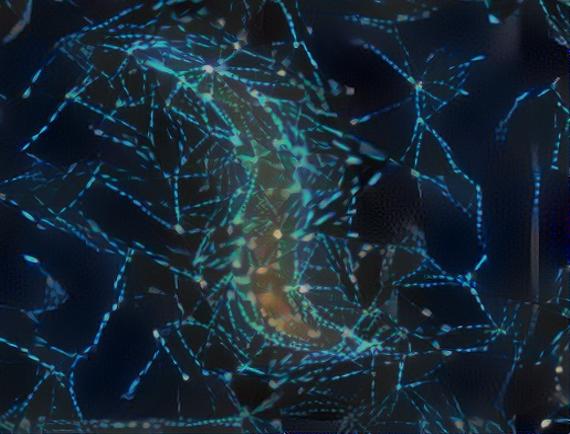
Credit: Adi Hanuka/SLAC National Accelerator Laboratory
Beams of accelerated electrons power electron microscopes, X-ray lasers, medical accelerators and other devices. To optimize the performance of these applications, operators must be able to analyze the quality of the beams and adjust them as needed.
For the past few years, researchers at the Department of Energy’s SLAC National Accelerator Laboratory have been developing “virtual diagnostics” that use machine learning to obtain crucial information about beam quality in an efficient, non-invasive way. Now, a new virtual diagnostic approach, published in Scientific Reports, incorporates additional information about the beam that allows the method to work in situations where conventional diagnostics have failed.
“Our method can be used to diagnose virtually any machine that uses electron beams, whether it’s an electron microscope for imaging of ultrasmall objects or a medical accelerator used in cancer therapy,” said SLAC research associate Adi Hanuka, who led the study.
Conventional beam diagnostics are physical devices that need to interact with the beam to measure its properties, such as intensity and shape. This interaction often destroys or alters the beam or requires its deflection, so it cannot be used at the same time for the actual application. Technical limitations also prevent accurate measurements in some cases, for instance when the beam’s electron pulses are fired at a very high rate or are very intense.
The new method has none of these limitations because it is not a physical device. Instead, it uses a neural network – a machine learning algorithm inspired by the neural network of the brain. Once the SLAC team had trained the neural network on data taken with the lab’s particle accelerators, the algorithm was able to accurately predict beam properties for experimental situations.
The researchers demonstrated the method by comparing its predictions with experimental and simulated data for the electron beams of the Linac Coherent Light Source (LCLS) X-ray laser, its future upgrade LCLS-II, and the recently upgraded Facility for Advanced Accelerator Experimental Tests (FACET-II), three DOE Office of Science user facilities at SLAC.
In particular, the results show that the machine learning approach helps in situations that are beyond the capabilities of conventional tools. In the case of LCLS-II, for example, the neural network can provide detailed information about each of the million electron pulses per second the machine will produce – an unprecedented pulse rate that exceeds the limits of present diagnostic technology. Virtual diagnostics can also provide accurate information about FACET-II’s high-intensity beam, which is challenging to analyze with physical devices.
###
This research was funded by the DOE Office of Science and the Laboratory Directed Research and Development (LDRD) program at SLAC.
SLAC is a vibrant multiprogram laboratory that explores how the universe works at the biggest, smallest and fastest scales and invents powerful tools used by scientists around the globe. With research spanning particle physics, astrophysics and cosmology, materials, chemistry, bio- and energy sciences and scientific computing, we help solve real-world problems and advance the interests of the nation.
SLAC is operated by Stanford University for the U.S. Department of Energy’s Office of Science. The Office of Science is the single largest supporter of basic research in the physical sciences in the United States and is working to address some of the most pressing challenges of our time.
Media Contact
Manuel Gnida
[email protected]
Original Source
https:/
Related Journal Article
http://dx.