Researchers from Osaka University, Nara Institute of Science and Technology, and Kobe University find that plant root tips are constrained to a dome shape, similar to that of an arched bridge, because of one-directional and localized tissue growth
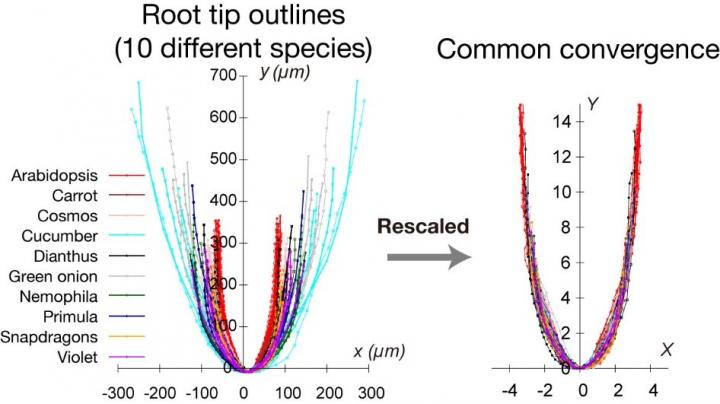
Credit: Osaka University and NAIST
Osaka, Japan – Nature is full of diversity, but underneath the differences are often shared features. Researchers from Japan investigating diversity in plant features have discovered that plant root tips commonly converged to a particular shape because of physical restrictions on their growth.
In a study published in February in Development, researchers from Osaka University, Nara Institute of Science and Technology, and Kobe University have revealed that plant root tips are constrained to a dome-shaped outline because of restrictions on their tissue growth. This study is one of the papers selected as a Research Highlight published in this issue of Development that looked at how the geometric and mechanical properties of plant tissues are regulated during development, and how they contribute to growth.
In plants and animals, the outlines of organs are defined by shape and size. But despite species differences, these outlines retain a basic similarity (e.g., songbird beaks). Plant root tips are no exception, sharing a domed shape. Root tips need to be able to push through soil effectively without disintegrating, and the similarity of their shape between plant species suggests that it may be constrained by evolution.
To investigate how the shape of root tips is defined, the team used morphometric (i.e., measurements of shape and form) analysis and mathematical modeling. They looked at the shape of primary and lateral root tips in Arabidopsis – small flowering plants similar to mustard and cabbage – and other flowering plant species.
“We found that the shape of the root tips in these species commonly converged to a unique curve by rescaling their size,” says lead author of the study Tatsuaki Goh (Figure 1). “This curve can be described as a catenary curve – like that of arch bridges, or of a chain hanging between two points.” (Figure 2)
The team also revealed with simulations that, with this shape, mechanical force is evenly spread over the surface of a root tip, and propose that this may help the tip to efficiently push through the soil. Mechanically, the formation of a curve like this in a growing structure needs a distinct boundary between a growing and non-growing region at the lateral edge of the young root, as well as spatially even, one-directional (oriented) tissue growth in the growing root tip (Figure 3).
“The very young roots of Arabidopsis show both of these characteristics, and mutant strains of these plants that disrupt either of these requirements lead to a departure from the dome shape,” explains senior author Koichi Fujimoto.
Future studies could look at how localized and spatially even occurrence of one-directional tissue growth are shared constraints for the maintenance of the dome shape between different species and classes of roots and have potential applications in plant conservation and plant biotechnology.
###
The article, “Tissue growth constrains root organ outlines into an isometrically scalable shape,” was published in Development at DOI: https:/
About Osaka University
Osaka University was founded in 1931 as one of the seven imperial universities of Japan and is now one of Japan’s leading comprehensive universities with a broad disciplinary spectrum. This strength is coupled with a singular drive for innovation that extends throughout the scientific process, from fundamental research to the creation of applied technology with positive economic impacts. Its commitment to innovation has been recognized in Japan and around the world, being named Japan’s most innovative university in 2015 (Reuters 2015 Top 100) and one of the most innovative institutions in the world in 2017 (Innovative Universities and the Nature Index Innovation 2017). Now, Osaka University is leveraging its role as a Designated National University Corporation selected by the Ministry of Education, Culture, Sports, Science and Technology to contribute to innovation for human welfare, sustainable development of society, and social transformation.
Website: https:/
Media Contact
Saori Obayashi
[email protected]
Original Source
https:/
Related Journal Article
http://dx.