Simple cues reduce cognitive strain and provide a nudge — helping tourists to demonstrate environmentally conscious behavior, such as refusing a plastic bag
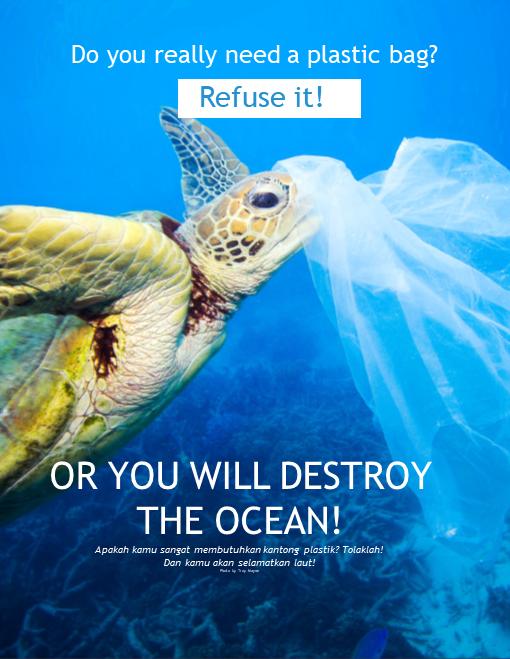
Credit: K. Nelson and coauthors
A new study in Frontiers in Communication has demonstrated the powerful impact that subtle messaging and cues, or ‘nudges’, can provide on encouraging people to show socially desirable behaviors. Travelers who were observed on the Indonesian island of Gili Trawangan, a popular tourist destination, were more likely to demonstrate environmentally conscious actions, such as refusing a plastic bag or avoiding contact with a coral reef, when they were ‘nudged’ towards the desirable action with either a written or face to face interaction. The researchers found that any intervention, whether framed positively or negatively, was enough to lead people to make environmentally conscious decisions, compared to being given no behavioral cues or messaging. The study provides many practical takeaways that can be easily implemented by tourist operators or businesses, at a low cost, to increase environmental stewardship and promote positive behaviors in their customers.
Although many of us feel a responsibility to demonstrate environmentally-conscious behaviors and possess the knowledge we need to take these actions, we are often burdened by numerous obstacles, a phenomenon the researchers describe as the ‘knowledge-action gap’. Dr Katherine Nelson, who led the study in partnership with the Gili Eco Trust, explains:
“The gap between knowledge and action exists because it is much easier to think a certain way than it is to actually consistently behave in that manner — but providing a subtle cue can help us relieve some of the cognitive burden on our brains when we are in a complex environment.”
To try and close this gap, the researchers set up scenarios for tourists in two real life situations — when being offered a plastic bag at a convenience store, and when given a briefing before a snorkeling trip. The researchers observed the differences in people’s behavior based on whether a person was confronted with a written or face to face interaction of either a positive message highlighting good outcomes, or a negative message focusing on the bad outcomes of a specific action.
The study showed that the presence of a ‘nudge’ or cue towards certain behaviors was enough to encourage people to behave in more environmentally conscious ways, whether that was refusing a plastic bag whilst at the convenience store or ensuring they maintained a safe distance from turtles when on a snorkeling trip – whether this message was framed positively or negatively did not matter.
“Our study highlights that an intervention can lead people to making better decisions by just drawing their attention to an issue — by providing a small cue, we can reduce the obstacles that get in the way and make environmental behaviors easy.”
The results offer important insights on the effectiveness of simple messaging as a practical way to nudge people towards environmentally conscious behaviors. The tourist sector in particular has huge potential to utilize these types of approaches and make pro-environmental behaviors a simple choice to reduce local impacts.
###
Media Contact
Mischa Dijkstra
[email protected]
Related Journal Article
http://dx.