• HOME
  • NEWS
  • EXPLORE
    • CAREER
      • Companies
      • Jobs
    • EVENTS
    • iGEM
      • News
      • Team
    • PHOTOS
    • VIDEO
    • WIKI
  • BLOG
  • COMMUNITY
    • FACEBOOK
    • INSTAGRAM
    • TWITTER
Sunday, November 15, 2026
BIOENGINEER.ORG
No Result
View All Result
  • Login
  • HOME
  • NEWS
  • EXPLORE
    • CAREER
      • Companies
      • Jobs
        • Lecturer
        • PhD Studentship
        • Postdoc
        • Research Assistant
    • EVENTS
    • iGEM
      • News
      • Team
    • PHOTOS
    • VIDEO
    • WIKI
  • BLOG
  • COMMUNITY
    • FACEBOOK
    • INSTAGRAM
    • TWITTER
No Result
View All Result
Bioengineer.org
No Result
View All Result
Home NEWS Science News Health

To find the right network model, compare all possible histories

Bioengineer by Bioengineer
January 26, 2021
in Health
Reading Time: 2 mins read
0
IMAGE
Share on FacebookShare on TwitterShare on LinkedinShare on RedditShare on Telegram

IMAGE

Credit: Jean-Gabriel Young

Two family members test positive for COVID-19 — how do we know who infected whom? In a perfect world, network science could provide a probable answer to such questions. It could also tell archaeologists how a shard of Greek pottery came to be found in Egypt, or help evolutionary biologists understand how a long-extinct ancestor metabolized proteins.

As the world is, scientists rarely have the historical data they need to see exactly how nodes in a network became connected. But a new paper published in Physical Review Letters offers hope for reconstructing the missing information, using a new method to evaluate the rules that generate network models.

“Network models are like impressionistic pictures of the data,” says physicist George Cantwell, one of the study’s authors and a postdoctoral researcher at the Santa Fe Institute. “And there have been a number of debates about whether the real networks look enough like these models for the models to be good or useful.”

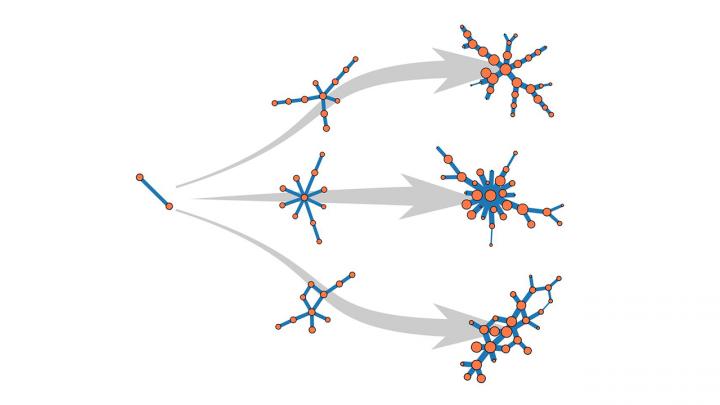
Normally when researchers try to model a growing network — say, a group of individuals infected with a virus — they build up the model network from scratch, following a set of mathematical instructions to add a few nodes at a time. Each node could represent an infected individual, and each edge a connection between those individuals. When the clusters of nodes in the model resemble the data drawn from the real-world cases, the model is considered to be representative — a problematic assumption when the same pattern can result from different sets of instructions.

Cantwell and co-authors Guillaume St-Onge (University Laval, Quebec) and Jean-Gabriel Young (University of Vermont) wanted to bring a shot of statistical rigor to the modeling process. Instead of comparing features from a snapshot of the network model against the features from the real-world data, they developed methods to calculate the probability of each possible history for a growing network. Given competing sets of rules, which could represent real-world processes such as contact, droplet, or airborne transmission, the authors can apply their new tool to determine the probability of specific rules resulting in the observed pattern.

“Instead of just asking ‘does this picture look more like the real thing?'” Cantwell says, “We can now ask material questions like, ‘did it grow by these rules?'” Once the most likely network model is found, it can be rewound to answer questions such as who was infected first.

In their current paper, the authors demonstrate their algorithm on three simple networks that correspond to previously-documented datasets with known histories. They are now working to apply the tool to more complicated networks, which could find applications across any number of complex systems.

###

Media Contact
J Marshall
marshall@santafe.edu

Related Journal Article

http://dx.doi.org/10.1103/PhysRevLett.126.038301

Tags: Algorithms/ModelsArchaeologyEpidemiologyMathematics/StatisticsSystems/Chaos/Pattern Formation/Complexity
Share12Tweet8Share2ShareShareShare2

Related Posts

Automated Synthesis Route Produces High Molar Activity Carbon-11 Phosgene from Carbon Dioxide

Automated Synthesis Route Produces High Molar Activity Carbon-11 Phosgene from Carbon Dioxide

November 15, 2026
Super-Resolution MRI Enhances Preoperative Prediction of Cervical Cancer Vascular Invasion

Super-Resolution MRI Enhances Preoperative Prediction of Cervical Cancer Vascular Invasion

November 15, 2026

Feelings of Disorientation Mediate Income Disparities in Social Engagement in Very Old Age

November 15, 2026

Most Service Users and Staff Favor Retaining Remote Drug and Alcohol Support

November 14, 2026
Please login to join discussion

POPULAR NEWS

  • Betel leaf quantum dots enable rapid fingerprint detection

    Betel leaf quantum dots enable rapid fingerprint detection

    29 shares
    Share 12 Tweet 7
  • New Computational Methods Narrow Price Bounds While Preserving Maximum Business Revenues

    29 shares
    Share 12 Tweet 7
  • Automated Synthesis Route Produces High Molar Activity Carbon-11 Phosgene from Carbon Dioxide

    29 shares
    Share 12 Tweet 7
  • Adaptive Kriging Framework Reduces Structural Reliability Evaluations by Twenty-Five Percent

    29 shares
    Share 12 Tweet 7

About

We bring you the latest biotechnology news from best research centers and universities around the world. Check our website.

Follow us

Recent News

Betel leaf quantum dots enable rapid fingerprint detection

New Computational Methods Narrow Price Bounds While Preserving Maximum Business Revenues

Automated Synthesis Route Produces High Molar Activity Carbon-11 Phosgene from Carbon Dioxide

Subscribe to Blog via Email

Enter your email address to subscribe to this blog and receive notifications of new posts by email.

Join 87 other subscribers
  • Contact Us

Bioengineer.org © Copyright 2023 All Rights Reserved.

Welcome Back!

Login to your account below

Forgotten Password?

Retrieve your password

Please enter your username or email address to reset your password.

Log In
No Result
View All Result
  • Homepages
    • Home Page 1
    • Home Page 2
  • News
  • National
  • Business
  • Health
  • Lifestyle
  • Science

Bioengineer.org © Copyright 2023 All Rights Reserved.