• HOME
  • NEWS
  • EXPLORE
    • CAREER
      • Companies
      • Jobs
    • EVENTS
    • iGEM
      • News
      • Team
    • PHOTOS
    • VIDEO
    • WIKI
  • BLOG
  • COMMUNITY
    • FACEBOOK
    • INSTAGRAM
    • TWITTER
Monday, May 25, 2026
BIOENGINEER.ORG
No Result
View All Result
  • Login
  • HOME
  • NEWS
  • EXPLORE
    • CAREER
      • Companies
      • Jobs
        • Lecturer
        • PhD Studentship
        • Postdoc
        • Research Assistant
    • EVENTS
    • iGEM
      • News
      • Team
    • PHOTOS
    • VIDEO
    • WIKI
  • BLOG
  • COMMUNITY
    • FACEBOOK
    • INSTAGRAM
    • TWITTER
  • HOME
  • NEWS
  • EXPLORE
    • CAREER
      • Companies
      • Jobs
        • Lecturer
        • PhD Studentship
        • Postdoc
        • Research Assistant
    • EVENTS
    • iGEM
      • News
      • Team
    • PHOTOS
    • VIDEO
    • WIKI
  • BLOG
  • COMMUNITY
    • FACEBOOK
    • INSTAGRAM
    • TWITTER
No Result
View All Result
Bioengineer.org
No Result
View All Result
Home NEWS Science News Chemistry

Physicists find ways to control gamma radiation

Bioengineer by Bioengineer
July 21, 2020
in Chemistry
Reading Time: 2 mins read
0
IMAGE
Share on FacebookShare on TwitterShare on LinkedinShare on RedditShare on Telegram

A paper appeared in Physical Review Letters
IMAGE

Credit: Kazan Federal University

Researchers from Kazan Federal University, Texas A&M University and Institute of Applied Physics (Russian Academy of Sciences) found ways to direct high frequency gamma radiation by means of acoustics.

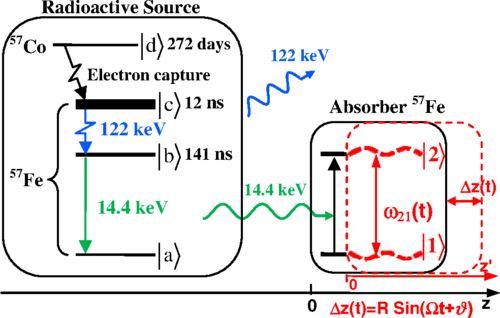
The paper describes an optical “switch” – a device able to let through or stop gamma quanta by switching the acoustic field. Basically, the mechanism makes iron “transparent” for gamma rays when needed.

Mossbauer Spectroscopy Lab of Kazan Federal University showed acoustically induced transparency of a resonant medium for gamma radiation in an experiment. The essence of this phenomenon lies in the transformation of the spectrum of the absorption line into a comb structure consisting of satellite lines spaced from the main line by the frequency of the acoustic field. For the experiment, gamma quanta with an energy of 14.4 keV were used, which are emitted during the decay of the excited state of the iron-57 nucleus.

“By acting on the absorber containing the Fe-57 nuclei with the help of a piezoelectric transducer, it was possible to achieve for the optically dense absorber to become transparent to resonant gamma rays. The absorber was attached to a piezoelectric transducer, which vibrated at a certain frequency and amplitude. At an oscillation amplitude corresponding to a modulation index of 2.4, the absorption of photons with an energy of 14.4 keV was suppressed 148 times,” explains Mossbauer Spectroscopy Lab Head Farit Vagizov. “This effect is analogous to the effect of electromagnetically induced transparency in optics, when radiation in one frequency range is used to control electronic transitions of atoms in another frequency range. As you know, the effect of electromagnetically induced transparency in atomic media has a fairly wide area of potential applications: the creation of controlled delay lines, devices for recording and reproducing quantum information, frequency standards in atomic clocks, and much more.”

This effect showed that with the help of low-frequency (~10-40 MHz) acoustic excitation, it is possible to control the process of transmission of high-frequency electromagnetic radiation with a frequency of more than 1013 MHz through the resonant medium. This effect may turn out to be useful for controlling the generated radiation on modern synchrotron sources and X-ray lasers, as well as for creating promising quantum devices.

###

Media Contact
Yury Nurmeev
[email protected]

Original Source

https://kpfu.ru/eng/news-eng/physicists-find-ways-to-control-gamma-radiation.html

Related Journal Article

http://dx.doi.org/10.1103/PhysRevLett.124.163602

Tags: Atomic/Molecular/Particle PhysicsChemistry/Physics/Materials Sciences
Share12Tweet8Share2ShareShareShare2

Related Posts

Lanthanide Nanocrystals Unlock Room-Temperature Organic Phosphorescence — Chemistry

Lanthanide Nanocrystals Unlock Room-Temperature Organic Phosphorescence

May 25, 2026
Study Reveals How Valproate Affects Early Brain Development: Insights into the Antiepileptic Drug’s Impact — Chemistry

Study Reveals How Valproate Affects Early Brain Development: Insights into the Antiepileptic Drug’s Impact

May 22, 2026

Sustainable Chemistry: Iron Replaces Noble Metals in Catalytic Reactions

May 22, 2026

Advancing Thin-Film Device Manufacturing with Imaging Ellipsometry for Enhanced Process Control

May 22, 2026
Please login to join discussion

POPULAR NEWS

  • ESMO 2025: mRNA COVID Vaccines Enhance Efficacy of Cancer Immunotherapy

    315 shares
    Share 126 Tweet 79
  • New Study Reveals Plants Can Detect the Sound of Rain

    734 shares
    Share 293 Tweet 183
  • Research Indicates Potential Connection Between Prenatal Medication Exposure and Elevated Autism Risk

    847 shares
    Share 339 Tweet 212
  • Common Food Preservatives Associated with Elevated Blood Pressure and Increased Heart Disease Risk

    56 shares
    Share 22 Tweet 14

About

We bring you the latest biotechnology news from best research centers and universities around the world. Check our website.

Follow us

Recent News

ATP2B4 Boosts Chromatin Compaction, Worsens Pancreatic Cancer Radiotherapy Resistance

AI-Guided Ileostomy Use Boosts Rectal Cancer Surgery

Screening Frailty in Elderly Dental Patients: FAST vs. FRAIL

Subscribe to Blog via Email

Enter your email address to subscribe to this blog and receive notifications of new posts by email.

Join 82 other subscribers
  • Contact Us

Bioengineer.org © Copyright 2023 All Rights Reserved.

Welcome Back!

Login to your account below

Forgotten Password?

Retrieve your password

Please enter your username or email address to reset your password.

Log In
No Result
View All Result
  • Homepages
    • Home Page 1
    • Home Page 2
  • News
  • National
  • Business
  • Health
  • Lifestyle
  • Science

Bioengineer.org © Copyright 2023 All Rights Reserved.