Researchers from Osaka University identify the proteins Tet2 and Tet3 as key regulators of B cell activity and autoimmunity
Credit: Osaka University
Osaka, Japan – Our immune system is supposed to protect us from external microbial invaders, but sometimes it turns its efforts inward, potentially resulting in autoimmune diseases. In a new study, researchers from Osaka University discovered how reversible modifications to our DNA by certain proteins protect us from autoimmune diseases and, conversely, how the absence of these proteins paves the way to autoimmunity.
DNA contains all information that cells in our body need to function by providing specific codes to produce specific proteins. Nonetheless, not all parts of DNA are accessible in all cells at all times. The regulated production of proteins ensures that different cells and organs can be developed from the same DNA code. An important regulatory mechanism is the reversible addition (methylation) or removal (demethylation) of chemical bonds, so-called methyl groups, to segments of DNA. This modifies the readout of said DNA segment. Proteins of the ten-eleven translocation (Tet) family are known DNA demethylases that decrease the production of certain proteins in immune cells. How Tet proteins play into the development of autoimmune diseases has remained unknown–until now.
“Epigenetics deals with how reversible changes in DNA affect gene activity and protein expression,” says corresponding author of the study Tomohiro Kurosaki. “Disrupting this machinery can have dramatic effects on cellular function. The goal of our study was to understand how epigenetic control in a specific type of immune cells, called B cells, affects the development of autoimmune diseases.”
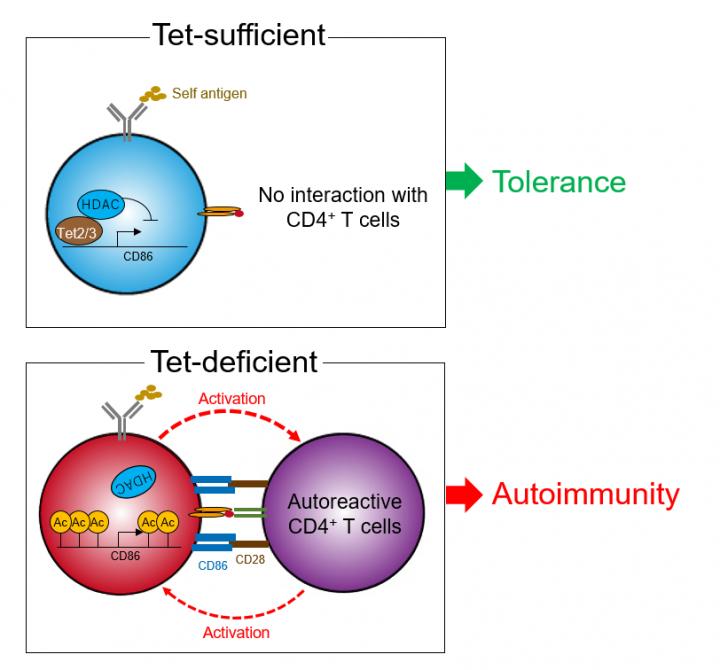
To achieve their goal, the researchers developed a novel mouse line in which B cells did not produce the epigenetic regulator proteins Tet2 and Tet3. They found that these mice developed a mild form of systemic lupus erythematosus, an autoimmune disease that can affect the joints, skin, kidneys and other organs, and for which there is currently no curative treatment. Similar to human patients, the mice showed increased serum levels of autoantibodies and damage to their kidneys, lungs and liver.
“These findings suggest that Tet2 and Tet3, as well as proteins whose expression is regulated by Tet2 and Tet3, might play a fundamental role in the development of systemic lupus erythematosus,” says lead author of the study Shinya Tanaka. “We wanted to gain a deeper molecular understanding of the mechanism behind the effects of Tet2 and Tet3 on the immune system.”
The researchers next investigated a different type of immune cell, called T cells, which often interact with B cells, and found that T cells were excessively activated in the Tet2/Tet3 knockout mice. By examining the molecular interaction between B and T cells closer, the researchers found that the protein CD86 was produced at higher levels in B cells of Tet2/Tet3 knockout mice, leading to aberrant T cell activation and autoimmunity.
“These are striking results that show how Tet proteins suppress autoimmune diseases by inactivating B cells and thus ultimately preventing them from attacking our bodies,” says Kurosaki. “Our findings provide new insights into the contribution of epigenetics to the development of autoimmune disease. Regulating Tet proteins and their downstream effectors could be a novel treatment for autoimmune diseases.”
###
The article, “Tet2 and Tet3 in B cells are required to suppress CD86 and prevent autoimmunity,” was published in Nature Immunology at DOI: https:/
About Osaka University
Osaka University was founded in 1931 as one of the seven imperial universities of Japan and is now one of Japan’s leading comprehensive universities with a broad disciplinary spectrum. This strength is coupled with a singular drive for innovation that extends throughout the scientific process, from fundamental research to the creation of applied technology with positive economic impacts. Its commitment to innovation has been recognized in Japan and around the world, being named Japan’s most innovative university in 2015 (Reuters 2015 Top 100) and one of the most innovative institutions in the world in 2017 (Innovative Universities and the Nature Index Innovation 2017). Now, Osaka University is leveraging its role as a Designated National University Corporation selected by the Ministry of Education, Culture, Sports, Science and Technology to contribute to innovation for human welfare, sustainable development of society, and social transformation.
Website: https:/
Media Contact
Saori Obayashi
[email protected]
Related Journal Article
http://dx.