New findings reveal how ants increase their collective sensing power to help them navigate complex terrains
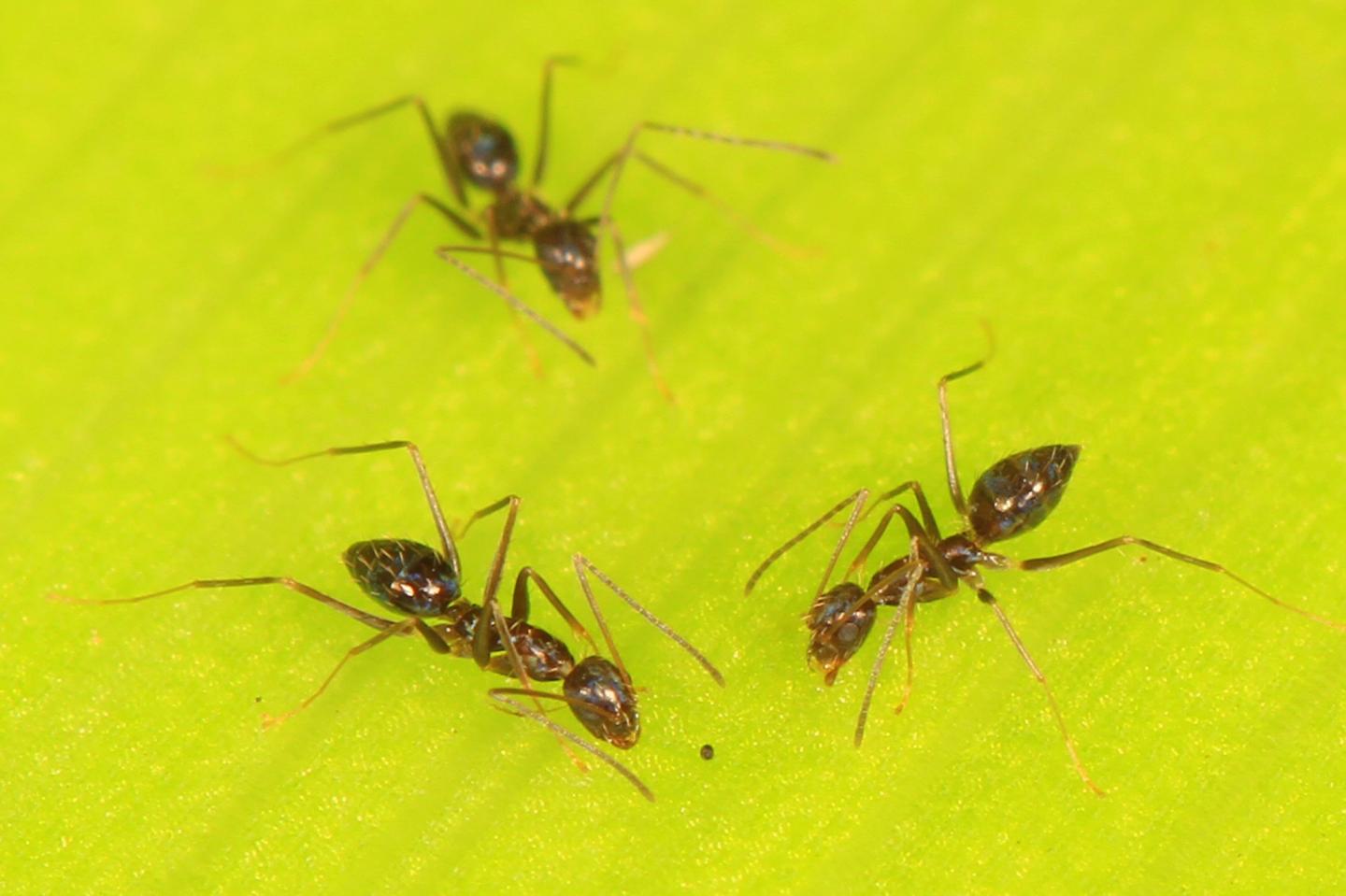
Credit: Judy Gallagher (CC BY 2.0 – https:/
Ants use their numbers to overcome navigational challenges that are too large and disorienting to be tackled by any single individual, reports a new study in the open-access journal eLife.
The results demonstrate the potential advantages of group living and collective cognition in making certain environments habitable for a species.
“Cooperation is a common means by which animals can increase their cognitive capacity, and we were intrigued as to whether this cooperation allows ants to extend the range of environments in which they can efficiently collect food,” says first author Aviram Gelblum, a postdoctoral fellow in senior author Ofer Feinerman’s lab at the Weizmann Institute of Science, Israel. “We addressed this question by studying the cooperative transport of ants as they attempted to transport large loads through semi-natural environments.”
A semi-natural labyrinth was created by randomly spreading cubes of the same size across a surface, to mimic a random stone-riddled terrain. Longhorn crazy ants were then tracked while they carried food to a target – their nest – and the coordinates of the food load, the ants and cubes were extracted using image processing. As the number of cubes increased and the maze became more complex, the ants became slower at solving it. They were still able to solve mazes with up to 55% cube coverage, but at 60% coverage most mazes become physically impassable. Importantly, the challenges imposed by the cubes were practically invisible to individual ants that could easily traverse the maze through paths that were blocked for the much larger load.
The team then compared the ants’ performance to a well-established model of movement – a random walk that is biased towards a certain direction. In this model, direction is changed in response to the physical feedback of hitting a barrier – in this case, a cube surface – so that eventually the way through is discovered. They found that the ants outperformed the computer model on all but the very simplest cube configurations. The higher the number of cubes in the labyrinth, the better the ants were at solving it compared to the computer model.
To work out how the ants outperformed the computer model, they looked at how the ants spent much longer walking away from the target they were trying to reach. This change in movement could not be explained solely by the physical feedback of encountering a cube. However, it is known that collective movement of ants is guided by leader ants who sense information around the group but do not carry the load.
When the team looked more closely at these non-carrying ants, they found they were spread across a circular region from the carrying population with an outer radius of up to 10cm. Although only a few ants were this far out, even a single leader ant was able to steer the group and guide it as far as 10cm to avoid a physical barrier.
They also noticed that when ants carrying a load got stuck, leader ants constantly presented the carrying group with potential crossing routes. Coordinated movement then allowed the entire group to explore the suggested routes, until they found an escape route that bypassed the obstacle. In this way, the ants were able to extend their sensing range beyond the immediate proximity and, potentially, gain a better idea of the obstacles they were facing.
To see whether this extended sensing was key to solving the labyrinth, the team tested whether this ‘sensing’ could improve the computer’s ability to avoid the cubes. As anticipated, setting the sensing range to match that of the ants allowed the computer model to match the ants’ performance in the labyrinth. By contrast, increasing the sensing range to above that of the ants had no effect on the computer’s performance, suggesting the ants had worked out the optimal sensing range for that specific maze.
“We have shown that, in this environment, ants use their numbers to collectively extend how far they can sense,” concludes senior author Ofer Feinerman, the Henry J. Leir Professorial Chair of the Department of Physics of Complex Systems, Weizmann Institute of Science, Israel. “Although this extension is modest, it allows for extremely fast traversal times that are better than known physical movement models for navigating disordered environments.”
###
Reference
The paper ‘Ant collective cognition allows for efficient navigation through disordered environments’ can be freely accessed online at https:/
Media contact
Emily Packer, Senior Press Officer
eLife
[email protected]
01223 855373
About eLife
eLife is a non-profit organisation created by funders and led by researchers. Our mission is to accelerate discovery by operating a platform for research communication that encourages and recognises the most responsible behaviours. We work across three major areas: publishing, technology and research culture. We aim to publish work of the highest standards and importance in all areas of biology and medicine, including Ecology and the Physics of Living Systems, while exploring creative new ways to improve how research is assessed and published. We also invest in open-source technology innovation to modernise the infrastructure for science publishing and improve online tools for sharing, using and interacting with new results. eLife receives financial support and strategic guidance from the Howard Hughes Medical Institute, the Knut and Alice Wallenberg Foundation, the Max Planck Society and Wellcome. Learn more at https:/
To read the latest Ecology research published in eLife, visit https:/
And for the latest in the Physics of Living Systems, see https:/
Media Contact
Emily Packer
[email protected]
Original Source
https:/
Related Journal Article
http://dx.