• HOME
  • NEWS
  • EXPLORE
    • CAREER
      • Companies
      • Jobs
    • EVENTS
    • iGEM
      • News
      • Team
    • PHOTOS
    • VIDEO
    • WIKI
  • BLOG
  • COMMUNITY
    • FACEBOOK
    • INSTAGRAM
    • TWITTER
Monday, February 2, 2026
BIOENGINEER.ORG
No Result
View All Result
  • Login
  • HOME
  • NEWS
  • EXPLORE
    • CAREER
      • Companies
      • Jobs
        • Lecturer
        • PhD Studentship
        • Postdoc
        • Research Assistant
    • EVENTS
    • iGEM
      • News
      • Team
    • PHOTOS
    • VIDEO
    • WIKI
  • BLOG
  • COMMUNITY
    • FACEBOOK
    • INSTAGRAM
    • TWITTER
  • HOME
  • NEWS
  • EXPLORE
    • CAREER
      • Companies
      • Jobs
        • Lecturer
        • PhD Studentship
        • Postdoc
        • Research Assistant
    • EVENTS
    • iGEM
      • News
      • Team
    • PHOTOS
    • VIDEO
    • WIKI
  • BLOG
  • COMMUNITY
    • FACEBOOK
    • INSTAGRAM
    • TWITTER
No Result
View All Result
Bioengineer.org
No Result
View All Result
Home NEWS Science News Chemistry

‘Whiskey webs’ are the new ‘coffee ring effect’

Bioengineer by Bioengineer
March 25, 2020
in Chemistry
Reading Time: 2 mins read
0
IMAGE
Share on FacebookShare on TwitterShare on LinkedinShare on RedditShare on Telegram

IMAGE

Credit: Adapted from ACS Nano 2020, DOI: 10.1021/acsnano.9b08984

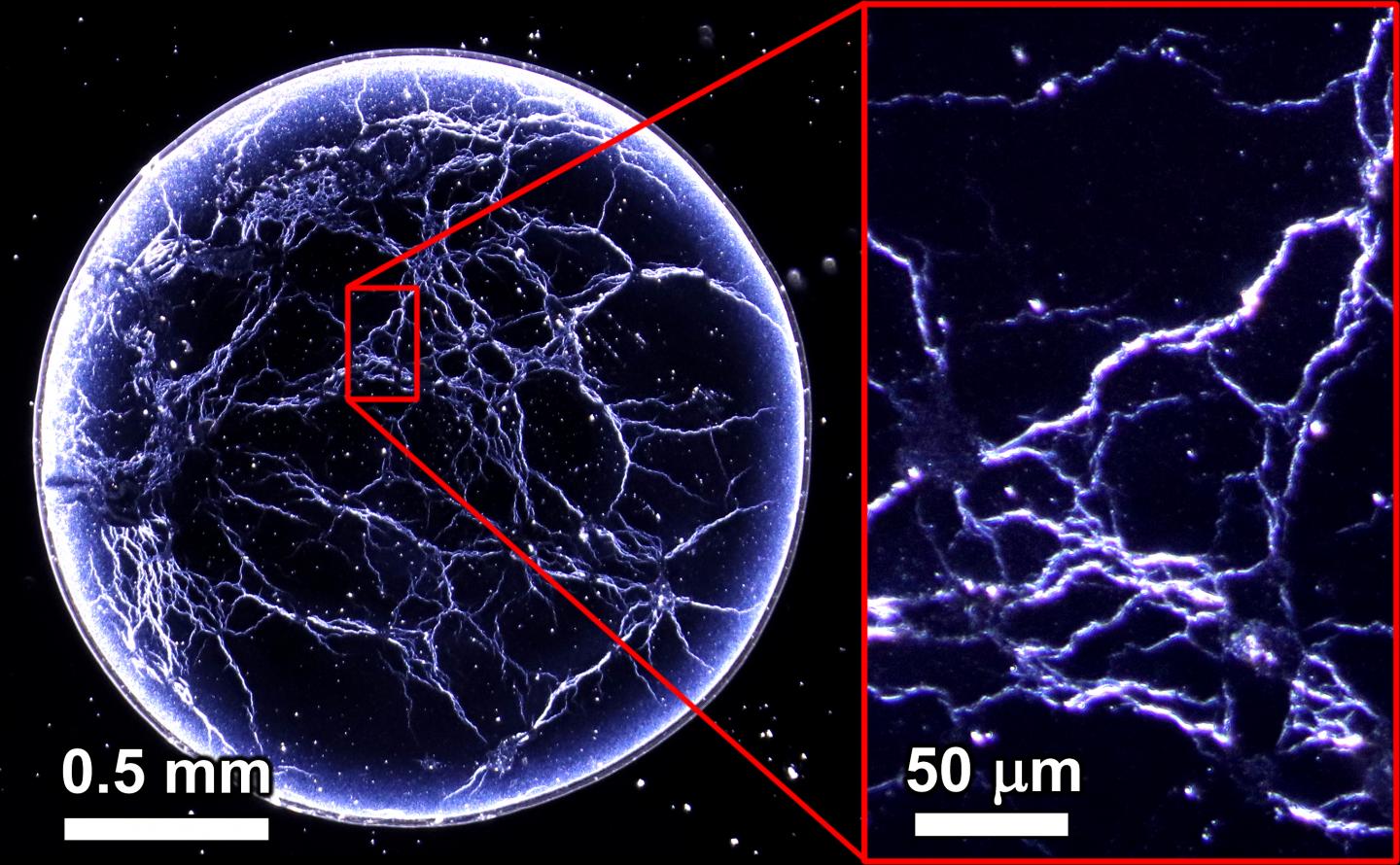
Spilled coffee forms a ring as the liquid evaporates, depositing solids along the edge of the puddle. This “coffee ring effect” has fascinated scientists for decades, but now a team says they have uncovered the mechanism behind an even more striking, web-like pattern that forms when drops of American whiskey dry up. The results, reported in ACS Nano, suggest that these distinctive ‘whiskey webs’ could someday be used to identify counterfeit spirits.

When a drop of liquid evaporates, solids are left behind in a pattern that depends on what the liquid is, what solids are in it and the environmental conditions. Stuart Williams and colleagues previously found that drops of diluted American whiskeys — but not their Scotch or Canadian counterparts — formed webbed patterns when dried on a glass surface, and there were hints that the pattern was distinctive for different brands of whiskey. In the current study, the researchers wanted to see how the whiskey webs form in more detail, and whether they could serve as fingerprints of the spirits.

The team used time-lapse microscopy to examine droplets of diluted American whiskey as the liquid evaporated. Non-volatile organic compounds, such as phenols, aromatics and esters, clustered together and were driven to the surface of the droplet, where they formed monolayers. As the surface area of the droplet decreased, the monolayers collapsed, creating strands of the web. The researchers showed that different American whiskeys showed unique web patterns that could be correctly matched to unknown samples more than 90% of the time. The distinctive webs arise from the unique combination of solutes in each whiskey, the researchers say.

###

The authors do not acknowledge any funding sources for this paper.

The paper’s abstract will be available on March 25 at 8 a.m. Eastern time here: http://pubs.acs.org/doi/abs/10.1021/acsnano.9b08984

The American Chemical Society (ACS) is a nonprofit organization chartered by the U.S. Congress. ACS’ mission is to advance the broader chemistry enterprise and its practitioners for the benefit of Earth and its people. The Society is a global leader in providing access to chemistry-related information and research through its multiple research solutions, peer-reviewed journals, scientific conferences, eBooks and weekly news periodical Chemical & Engineering News. ACS journals are among the most cited, most trusted and most read within the scientific literature; however, ACS itself does not conduct chemical research. As a specialist in scientific information solutions (including SciFinder® and STN®), its CAS division powers global research, discovery and innovation. ACS’ main offices are in Washington, D.C., and Columbus, Ohio.

To automatically receive news releases from the American Chemical Society, contact [email protected].

Follow us: Twitter | Facebook

Media Contact
Katie Cottingham
[email protected]
301-775-8455

Related Journal Article

http://dx.doi.org/10.1021/acsnano.9b08984

Tags: AlcoholChemistry/Physics/Materials SciencesLaw Enforcement/JurisprudenceScience/Health and the LawScience/Health/Law
Share12Tweet8Share2ShareShareShare2

Related Posts

blank

New Model Explains Stepped Platinum Electrode Layers

February 2, 2026
blank

New SEOULTECH Study Unveils Transparent Windows That Protect Buildings from Strong Electromagnetic Pulses

February 2, 2026

Gold Reshaped: Unlocking New Electronic and Optical Properties

February 2, 2026

IU Bloomington Biochemistry Lab Discovers Chemical Approach to Combat Antibiotic Resistance

February 1, 2026
Please login to join discussion

POPULAR NEWS

  • Enhancing Spiritual Care Education in Nursing Programs

    157 shares
    Share 63 Tweet 39
  • Robotic Ureteral Reconstruction: A Novel Approach

    81 shares
    Share 32 Tweet 20
  • Digital Privacy: Health Data Control in Incarceration

    63 shares
    Share 25 Tweet 16
  • Study Reveals Lipid Accumulation in ME/CFS Cells

    57 shares
    Share 23 Tweet 14

About

We bring you the latest biotechnology news from best research centers and universities around the world. Check our website.

Follow us

Recent News

Pristine Black Arsenic-Phosphorus Enables Polarization Sensing

New Model Explains Stepped Platinum Electrode Layers

Neuromorphic Vision Sensing via Pristine Black Arsenic-Phosphorus

Subscribe to Blog via Email

Enter your email address to subscribe to this blog and receive notifications of new posts by email.

Join 73 other subscribers
  • Contact Us

Bioengineer.org © Copyright 2023 All Rights Reserved.

Welcome Back!

Login to your account below

Forgotten Password?

Retrieve your password

Please enter your username or email address to reset your password.

Log In
No Result
View All Result
  • Homepages
    • Home Page 1
    • Home Page 2
  • News
  • National
  • Business
  • Health
  • Lifestyle
  • Science

Bioengineer.org © Copyright 2023 All Rights Reserved.