• HOME
  • NEWS
  • EXPLORE
    • CAREER
      • Companies
      • Jobs
    • EVENTS
    • iGEM
      • News
      • Team
    • PHOTOS
    • VIDEO
    • WIKI
  • BLOG
  • COMMUNITY
    • FACEBOOK
    • INSTAGRAM
    • TWITTER
Wednesday, June 24, 2026
BIOENGINEER.ORG
No Result
View All Result
  • Login
  • HOME
  • NEWS
  • EXPLORE
    • CAREER
      • Companies
      • Jobs
        • Lecturer
        • PhD Studentship
        • Postdoc
        • Research Assistant
    • EVENTS
    • iGEM
      • News
      • Team
    • PHOTOS
    • VIDEO
    • WIKI
  • BLOG
  • COMMUNITY
    • FACEBOOK
    • INSTAGRAM
    • TWITTER
  • HOME
  • NEWS
  • EXPLORE
    • CAREER
      • Companies
      • Jobs
        • Lecturer
        • PhD Studentship
        • Postdoc
        • Research Assistant
    • EVENTS
    • iGEM
      • News
      • Team
    • PHOTOS
    • VIDEO
    • WIKI
  • BLOG
  • COMMUNITY
    • FACEBOOK
    • INSTAGRAM
    • TWITTER
No Result
View All Result
Bioengineer.org
No Result
View All Result
Home NEWS Science News Health

Are robots designed to include the LGBTQ+ community?

Bioengineer by Bioengineer
February 12, 2020
in Health
Reading Time: 2 mins read
0
IMAGE
Share on FacebookShare on TwitterShare on LinkedinShare on RedditShare on Telegram

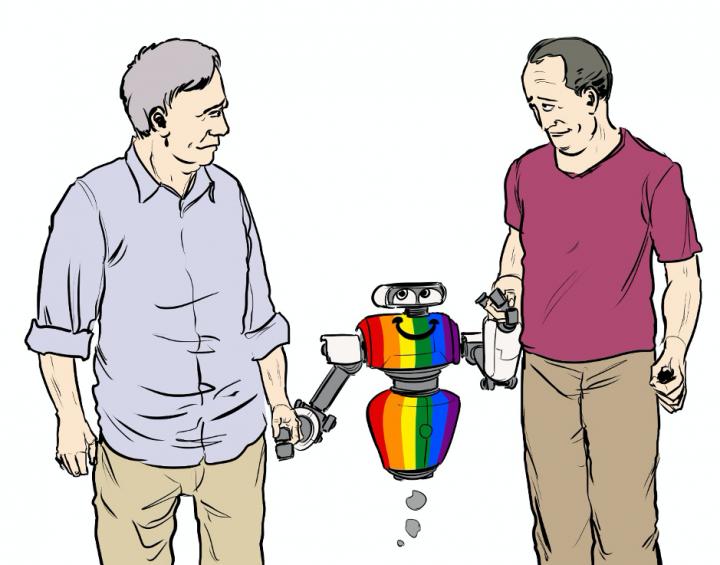
Developers need to be more inclusive with AI and robot design, researchers say
IMAGE

Credit: Adam Poulsen, https://sites.google.com/view/adampoulsen


In a new short paper in the journal Nature Machine Intelligence, Roger A. Søraa from Norwegian University of Science and Technology (NTNU) and co-authors Eduard Fosch-Villaronga from Leiden University in the Netherlands, and Adam Poulsen from Charles Sturt University in Australia discuss what a queering of robots might entail.

“It is imperative that we construct mechanisms and policies that acknowledge the importance of inclusivity, diversity, and non-discrimination, also for the LGBTQ+ community in the development and use of robots and AI,” the researchers wrote.

They point out that technology is not developed in a vacuum, but instead reflects biases and reproduces societal values and beliefs.

Søraa is active in robot and cyborg research through the newly started Immersive Technology and Social Robots Lab at NTNU, and has been active in queer and gender debates, including starting the NTNU LGBTQ+ networks for employees.

Søraa and his co-authors highlight the lack in the inclusion of queer perspectives on robots and machines. This, they argue, should be better recognized in both the research and design of the robots of the future, and should prod developers and designers to be more inclusive in how they build and create the machines that increasingly walk, talk and act among us.

###

Media Contact
Roger Sørra
[email protected]

Related Journal Article

http://dx.doi.org/10.1038/s42256-020-0157-6

Tags: Computer ScienceMultimedia/Networking/Interface DesignRobotry/Artificial IntelligenceSexual OrientationTechnology/Engineering/Computer Science
Share12Tweet8Share2ShareShareShare2

Related Posts

Epiblast Diversification Fuels Early Blood Formation

June 24, 2026

Neutrophil S100A8/A9 Hinders Megakaryocyte Maturation

June 24, 2026

Unfinished Care, Burnout, and Managerial Support in Nursing Homes

June 24, 2026

Yeast Enables Precise Megabase Human DNA Transfer

June 24, 2026
Please login to join discussion

POPULAR NEWS

  • Saying Goodbye to PGY-6: Pediatric Fellowship Realities

    103 shares
    Share 41 Tweet 26
  • Multi-Hospital Study Reveals Long Covid Burden Is Twice as High as Current Estimates

    92 shares
    Share 36 Tweet 23
  • Detection of EDCs in Breast Milk and Infant Urine Up to Six Months Highlights Early Exposure Risks

    77 shares
    Share 31 Tweet 19
  • New Drug Candidate Developed at McMaster Shows Potential for Treating Brain Cancer

    58 shares
    Share 23 Tweet 15

About

We bring you the latest biotechnology news from best research centers and universities around the world. Check our website.

Follow us

Recent News

Epiblast Diversification Fuels Early Blood Formation

Neutrophil S100A8/A9 Hinders Megakaryocyte Maturation

Robotic Hand That “Feels” Motion: International Study Uncovers How the Brain Detects Movement

Subscribe to Blog via Email

Enter your email address to subscribe to this blog and receive notifications of new posts by email.

Join 82 other subscribers
  • Contact Us

Bioengineer.org © Copyright 2023 All Rights Reserved.

Welcome Back!

Login to your account below

Forgotten Password?

Retrieve your password

Please enter your username or email address to reset your password.

Log In
No Result
View All Result
  • Homepages
    • Home Page 1
    • Home Page 2
  • News
  • National
  • Business
  • Health
  • Lifestyle
  • Science

Bioengineer.org © Copyright 2023 All Rights Reserved.