Credit: SUTD
Fluorescence activated cell sorting (FACS) is a modern cell analysis technique for quantitative detection of physiological, biochemical, immunological, and molecular biological traits of cells – it can further separate a specific subset of cell populations from complex biological samples. Though current commercial FACS has quite an accurate cell sorting capability, it still suffers some inherent limitations. First, current commercial FACS is bulky in size and extremely expensive, and can usually only be afforded by shared user facilities. Second, the current sorting mechanism requires generation of cell-contained aerosols through a small nozzle, which can induce large shear stress, causing damage to cells. Hence, there is a great need to develop a simple and biocompatible approach to sort biological cells not only with high purity, but also maintaining high cell viability and functionality.
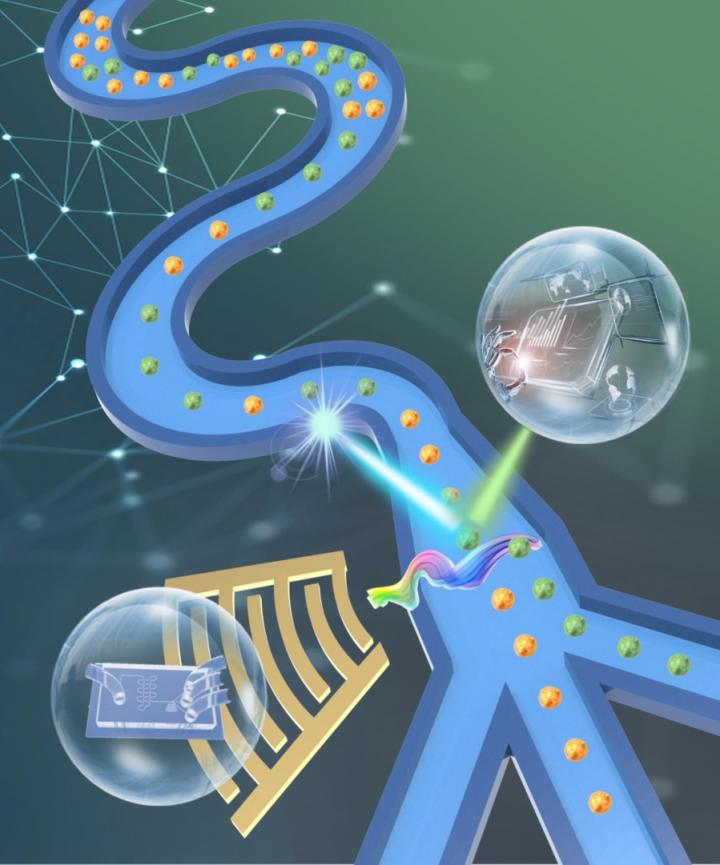
In this study, a Singapore University of Technology and Design (SUTD) research team led by Associate Professor Dr Ye Ai, in collaboration with Assistant Professor Chrishan Ramachandra from National Heart Centre Singapore (NHCS), developed a sheathless acoustic fluorescence activated cell sorting (aFACS) system for single-cell level fluorescence detection and isolation. The microfluidic sorting device uses elasto-inertial particle focusing to align cells in a single file for improving sorting accuracy and efficiency without sample dilution. The developed sorting device can effectively focus 1 μm particles which represents the general minimum size for a majority of cell sorting applications. Upon the fluorescence interrogation at the single-cell level, individual cells are deflected to the target outlet by a ?50 μm wide highly focused acoustic field. The use of gentle acoustic force in the developed aFACS provides a more biocompatible sorting solution to help researchers isolate their target cells, while maintaining high cell viability.
Clinical principal investigator Dr Chrishan said: “Human cardiomyocytes (CMs) derived from induced pluripotent stem cells (iPSCs) have shown tremendous potential for understanding the mechanisms of various cardiac diseases. Since these iPSC-CMs are generated on an individual basis, they comprise that particular individual’s genetic makeup and with it, any predisposition toward cardiac disease. These iPSC-CMs could therefore be used to model inherent cardiac diseases in a petri-dish and also serve as a drug screening platform to identify novel, patient-specific therapies. However, the ability to purify these iPSC-CMs is a major limitation in the field. Existing techniques used for purification result in substantial cell death. Having a technology that can purify iPSC-CMs, while maintaining their viability is highly advantageous to the field of cardiac research.”
Technical principal investigator Dr Ai said: “Compared to commercial FACS systems, our aFACS demonstrates excellent biocompatibility in sorting fragile biological cells such as iPSC-CMs. In addition, the sheathless acoustic sorting device is able to prevent sample dilution and cross-contamination using a single inlet without aerosol generation. It is able to achieve sorting purity and recovery rate higher than 90%, and cause only a very minor drop in cell viability within the range of 3?4%. With the same testing cell samples, the cell viability after a commercial FACS sorting drops by 35-45%.”
###
This work has been published in Analytical Chemistry, a top-tier journal focused on research in developing original application of analytical methods and results on an important analyte in analytical chemistry. SUTD graduate students, including Peixian Li, Minhui Liang, and Xiaoguang Lu, participated in this research project. This work was supported by Singapore-MIT alliance for Research and Technology Innovation Centre and National Health Innovation Centre Singapore.
Media Contact
Melissa Koh
[email protected]
65-649-98742
Related Journal Article
http://dx.