• HOME
  • NEWS
  • EXPLORE
    • CAREER
      • Companies
      • Jobs
    • EVENTS
    • iGEM
      • News
      • Team
    • PHOTOS
    • VIDEO
    • WIKI
  • BLOG
  • COMMUNITY
    • FACEBOOK
    • INSTAGRAM
    • TWITTER
Thursday, May 14, 2026
BIOENGINEER.ORG
No Result
View All Result
  • Login
  • HOME
  • NEWS
  • EXPLORE
    • CAREER
      • Companies
      • Jobs
        • Lecturer
        • PhD Studentship
        • Postdoc
        • Research Assistant
    • EVENTS
    • iGEM
      • News
      • Team
    • PHOTOS
    • VIDEO
    • WIKI
  • BLOG
  • COMMUNITY
    • FACEBOOK
    • INSTAGRAM
    • TWITTER
  • HOME
  • NEWS
  • EXPLORE
    • CAREER
      • Companies
      • Jobs
        • Lecturer
        • PhD Studentship
        • Postdoc
        • Research Assistant
    • EVENTS
    • iGEM
      • News
      • Team
    • PHOTOS
    • VIDEO
    • WIKI
  • BLOG
  • COMMUNITY
    • FACEBOOK
    • INSTAGRAM
    • TWITTER
No Result
View All Result
Bioengineer.org
No Result
View All Result
Home NEWS Science News

The fast dance of electron spins

Bioengineer by Bioengineer
October 4, 2019
in Science News
Reading Time: 2 mins read
0
IMAGE
Share on FacebookShare on TwitterShare on LinkedinShare on RedditShare on Telegram

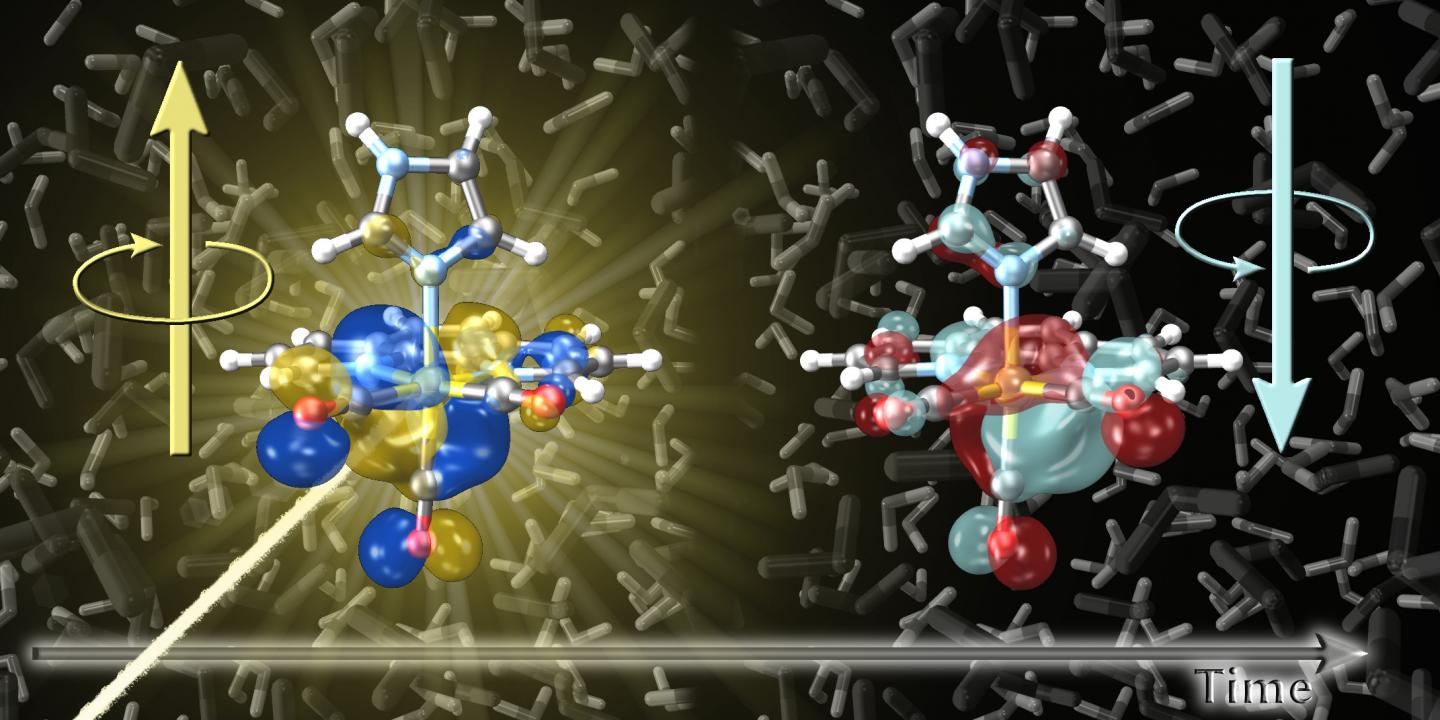
Chemists investigate the interactions of metal complexes and light
IMAGE

Credit: © Sebastian Mai

When a molecule is hit by light, in many cases a so-called “photoinduced” reaction is initiated. This can be thought of as the interplay of electron motion and nuclear motion. First, the absorption of light energetically “excites” the electrons, which for instance can weaken some of the bonds. Subsequently, the much heavier nuclei start moving. If at a later point in time the nuclei assume a favorable constellation with respect to each other, the electrons can switch from one orbit to another one. Controlled by the physical effect of “spin-orbit coupling” the electron spin can flip in the same moment.

This interplay of motion is the reason why spin-flip processes in molecules typically take quite long. However, computer simulations have shown that this is not the case in some metal complexes. For example, in the examined rhenium complex the spin-flip process already takes place within ten femtoseconds, even though in this short time the nuclei are virtually stationary–even light moves only three thousandths of a millimeter within this time. This knowledge is particularly useful for the precise control of electron spins, as, e.g., in quantum computers.

Investigation is based on enormous computer power

One of the biggest difficulties during the investigation was the huge amount of computer power that was required for the simulations. Although for small organic molecules one can nowadays carry out very accurate simulations already with a modest amount of computational effort, metal complexes present a much bigger challenge. Among other reasons, this is due to the large number of atoms, electrons, and solvent molecules that need to be included in the simulations, but also because the electron spin can only be accurately described with equations from relativity theory. Altogether, the scientists from the Institute of Theoretical Chemistry spent almost one million computer hours at the Austrian super computer “Vienna Scientific Cluster” in the course of their study. This is equivalent to about 100 years of computer time on a typical personal computer.

###

Publication in Chemical Science: Mai, Sebastian; González, Leticia. Unconventional two-step spin relaxation dynamics of
[Re(CO)3(im)(phen)]+ in aqueous solution. Chemical Science 2019.
DOI: 10.1039/C9SC03671G

Media Contact
Leticia González
[email protected]

Related Journal Article

http://dx.doi.org/10.1039/C9SC03671G

Tags: BiochemistryBiologyBiomedical/Environmental/Chemical EngineeringChemistry/Physics/Materials SciencesMolecular PhysicsNanotechnology/MicromachinesResearch/DevelopmentTechnology/Engineering/Computer Science
Share12Tweet8Share2ShareShareShare2

Related Posts

Rare Case of Extraluminal Esophageal Cancer Invading Spine Detected Despite Normal Endoscopy

May 14, 2026

Nanotechnology Special Issue Highlights Smart Platforms Driving Advances in Precision Cancer Therapy

May 14, 2026

Novel Biomarker Enhances Detection of Aggressive Prostate Cancer

May 14, 2026

Chemical Mixtures During Pregnancy Could Impact Fetal Growth via the Placenta

May 14, 2026
Please login to join discussion

POPULAR NEWS

  • Research Indicates Potential Connection Between Prenatal Medication Exposure and Elevated Autism Risk

    842 shares
    Share 337 Tweet 211
  • New Study Reveals Plants Can Detect the Sound of Rain

    729 shares
    Share 291 Tweet 182
  • Salmonella Haem Blocks Macrophages, Boosts Infection

    62 shares
    Share 25 Tweet 16
  • Breastmilk Balances E. coli and Beneficial Bacteria in Infant Gut Microbiomes

    57 shares
    Share 23 Tweet 14

About

We bring you the latest biotechnology news from best research centers and universities around the world. Check our website.

Follow us

Recent News

Rare Case of Extraluminal Esophageal Cancer Invading Spine Detected Despite Normal Endoscopy

Nanotechnology Special Issue Highlights Smart Platforms Driving Advances in Precision Cancer Therapy

Novel Biomarker Enhances Detection of Aggressive Prostate Cancer

Subscribe to Blog via Email

Enter your email address to subscribe to this blog and receive notifications of new posts by email.

Join 82 other subscribers
  • Contact Us

Bioengineer.org © Copyright 2023 All Rights Reserved.

Welcome Back!

Login to your account below

Forgotten Password?

Retrieve your password

Please enter your username or email address to reset your password.

Log In
No Result
View All Result
  • Homepages
    • Home Page 1
    • Home Page 2
  • News
  • National
  • Business
  • Health
  • Lifestyle
  • Science

Bioengineer.org © Copyright 2023 All Rights Reserved.