• HOME
  • NEWS
  • EXPLORE
    • CAREER
      • Companies
      • Jobs
    • EVENTS
    • iGEM
      • News
      • Team
    • PHOTOS
    • VIDEO
    • WIKI
  • BLOG
  • COMMUNITY
    • FACEBOOK
    • INSTAGRAM
    • TWITTER
Thursday, November 12, 2026
BIOENGINEER.ORG
No Result
View All Result
  • Login
  • HOME
  • NEWS
  • EXPLORE
    • CAREER
      • Companies
      • Jobs
        • Lecturer
        • PhD Studentship
        • Postdoc
        • Research Assistant
    • EVENTS
    • iGEM
      • News
      • Team
    • PHOTOS
    • VIDEO
    • WIKI
  • BLOG
  • COMMUNITY
    • FACEBOOK
    • INSTAGRAM
    • TWITTER
No Result
View All Result
Bioengineer.org
No Result
View All Result
Home NEWS Science News

Engineers produce water-saving crop irrigation sensor

Bioengineer by Bioengineer
September 26, 2019
in Science News
Reading Time: 2 mins read
0
IMAGE
Share on FacebookShare on TwitterShare on LinkedinShare on RedditShare on Telegram

New technology responds to the global need to regulate water consumption in agriculture
IMAGE

Credit: UConn Engineering

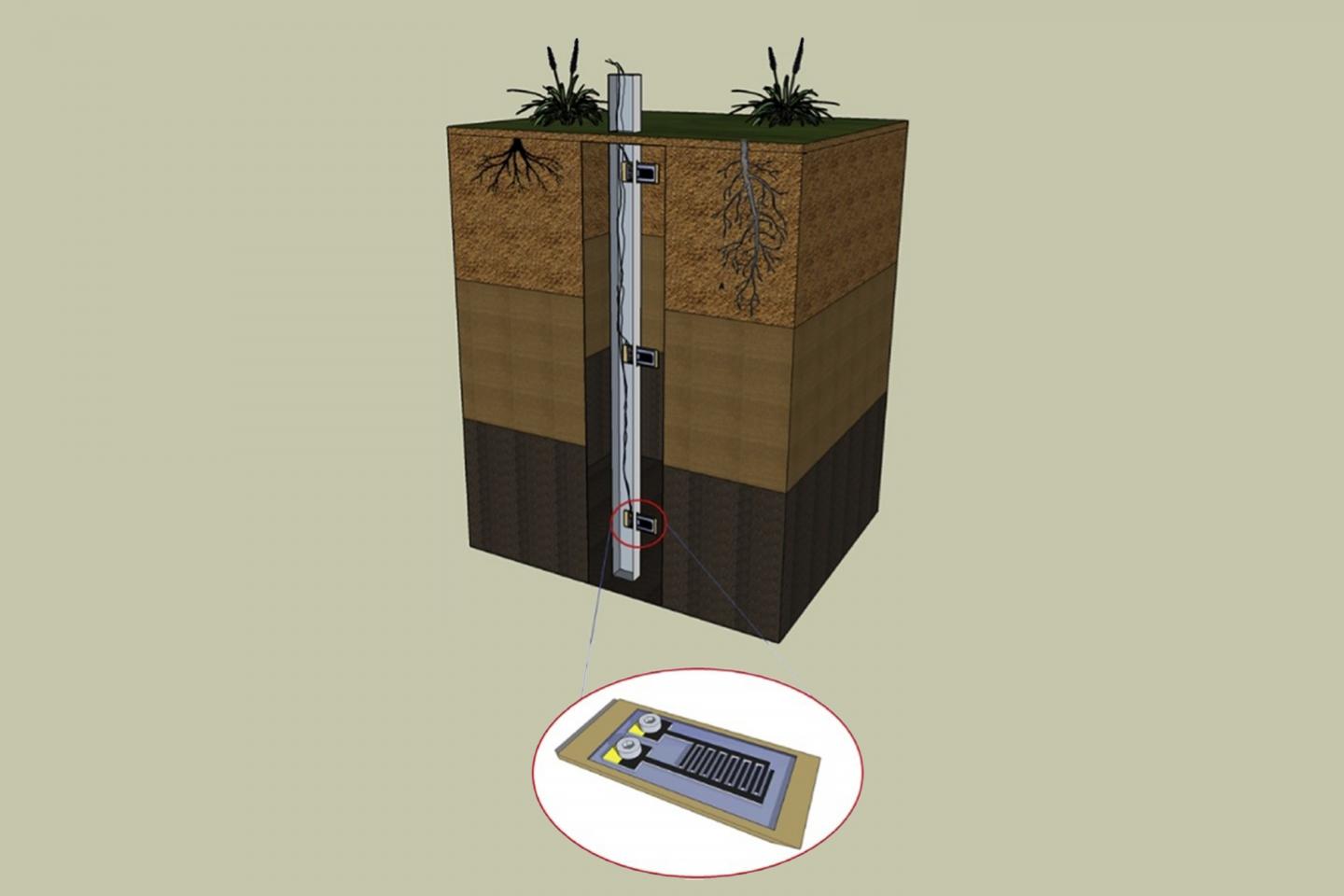
A team of University of Connecticut researchers engineered a soil moisture sensor that is more cost effective than anything currently available and responds to the global need to regulate water consumption in agriculture.

Designed and tested on the university’s farm, the sensors are small enough to insert into the soil with ease and less expensive to manufacture than current technology, the researchers write in the Journal of Sensors and Actuators.

“Advances in hydrological science are hampered by the lack of on site soil moisture data,” said Guiling Wang, study author and professor of civil and environmental engineering at UConn. “It’s really hard to monitor and measure things underground. The challenge is that the existing sensors are very expensive and the installation process is very labor intensive.”

The sensors developed by the team of UConn engineers — environmental, mechanical, and chemical — are expected to save nearly 35% of water consumption and cost far less than what exists. Current sensors that are used in a similar way range from $100 to $1,000 each, while the one developed at UConn cost $2, according to the researchers.

An alternate monitoring option, soil moisture data collected from remote sensing technology such as radars and radiometers on board satellites, have suffered from low resolution. But the new technology developed by UConn Professor Baikun Li’s group can provide high spatio-temporal resolution data needed for hydrology model development in Wang’s group.

In the UConn prototype, wires are connected from the sensors to an instrument that logs data. Researchers conducted field tests of the sensors — performing side-by-side tests with commercial sensors under various environmental conditions throughout a 10-month period. The effects of the environmental variations on soil moisture throughout the period were clearly reflected.

Critically, the small sensors can also be easily sent around he world given the fact that soil moisture plays a fundamental role in agricultural decision-making globally.

Accurate soil moisture sensing is essential to ensure a water level that produces the most robust crops while not wasting the natural resource. In some states in the U.S. — Florida and California, for example — irrigation water usage has become tightly restricted.

The UConn researchers are also working on a nitrogen sensor that is the same model of the water sensors. These would help provide farmers with information on when fields need fertilizing. Currently, nitrogen sensors are not available using this type of technology.

“This is really an exciting start to a much larger scope of things we have in mind,” says Li, a study author and professor of civil and environmental engineering.

###

Media Contact
Kristen Cole
kristen.cole@uconn.edu

Original Source

https://today.uconn.edu/2019/09/engineers-produce-water-saving-crop-irrigation-sensor/

Related Journal Article

http://dx.doi.org/10.1016/j.snb.2019.126857

Tags: Agricultural Production/EconomicsAgricultureElectrical Engineering/ElectronicsHardwareTechnology TransferTechnology/Engineering/Computer Science
Share12Tweet8Share2ShareShareShare2

Related Posts

Dispersal Delay Drives Periodic Population Oscillations Across Coupled Habitat Patches

Dispersal Delay Drives Periodic Population Oscillations Across Coupled Habitat Patches

November 12, 2026
Research report: Exploring the behaviours and responses of older adults to hot weather in Queensland, Australia: a mixed-methods study

Exploring the behaviours and responses of older adults to hot weather in Queensland, Australia: a mixed-methods study

November 12, 2026

Study Links Colorectal Cancer Screening Uptake to Self-Efficacy in Quito, Ecuador

November 12, 2026

Genome Study Identifies Canine Chromosome Regions Linked to Havanese Eye Cataracts

November 12, 2026
Please login to join discussion

POPULAR NEWS

  • Drone-Based IoT Platform Maps Micro-Gradients in Campus Air Quality

    Drone-Based IoT Platform Maps Micro-Gradients in Campus Air Quality

    29 shares
    Share 12 Tweet 7
  • Self-Care Outweighs Marital Status in Explaining Older Greek Adults’ Health Quality

    29 shares
    Share 12 Tweet 7
  • Cardiovascular-Kidney-Metabolic Syndrome Progression Far Exceeds Regression in Older Adults

    29 shares
    Share 12 Tweet 7
  • Respiratory Rate Features Add Modest Exercise Context Beyond Wearable Heart Rate Metrics

    29 shares
    Share 12 Tweet 7

About

We bring you the latest biotechnology news from best research centers and universities around the world. Check our website.

Follow us

Recent News

Dispersal Delay Drives Periodic Population Oscillations Across Coupled Habitat Patches

Exploring the behaviours and responses of older adults to hot weather in Queensland, Australia: a mixed-methods study

Study Links Colorectal Cancer Screening Uptake to Self-Efficacy in Quito, Ecuador

Subscribe to Blog via Email

Enter your email address to subscribe to this blog and receive notifications of new posts by email.

Join 86 other subscribers
  • Contact Us

Bioengineer.org © Copyright 2023 All Rights Reserved.

Welcome Back!

Login to your account below

Forgotten Password?

Retrieve your password

Please enter your username or email address to reset your password.

Log In
No Result
View All Result
  • Homepages
    • Home Page 1
    • Home Page 2
  • News
  • National
  • Business
  • Health
  • Lifestyle
  • Science

Bioengineer.org © Copyright 2023 All Rights Reserved.