• HOME
  • NEWS
  • EXPLORE
    • CAREER
      • Companies
      • Jobs
    • EVENTS
    • iGEM
      • News
      • Team
    • PHOTOS
    • VIDEO
    • WIKI
  • BLOG
  • COMMUNITY
    • FACEBOOK
    • INSTAGRAM
    • TWITTER
Friday, November 27, 2026
BIOENGINEER.ORG
No Result
View All Result
  • Login
  • HOME
  • NEWS
  • EXPLORE
    • CAREER
      • Companies
      • Jobs
        • Lecturer
        • PhD Studentship
        • Postdoc
        • Research Assistant
    • EVENTS
    • iGEM
      • News
      • Team
    • PHOTOS
    • VIDEO
    • WIKI
  • BLOG
  • COMMUNITY
    • FACEBOOK
    • INSTAGRAM
    • TWITTER
No Result
View All Result
Bioengineer.org
No Result
View All Result
Home NEWS Science News

Electric tech could help reverse baldness

Bioengineer by Bioengineer
September 19, 2019
in Science News
Reading Time: 2 mins read
0
IMAGE
Share on FacebookShare on TwitterShare on LinkedinShare on RedditShare on Telegram

IMAGE

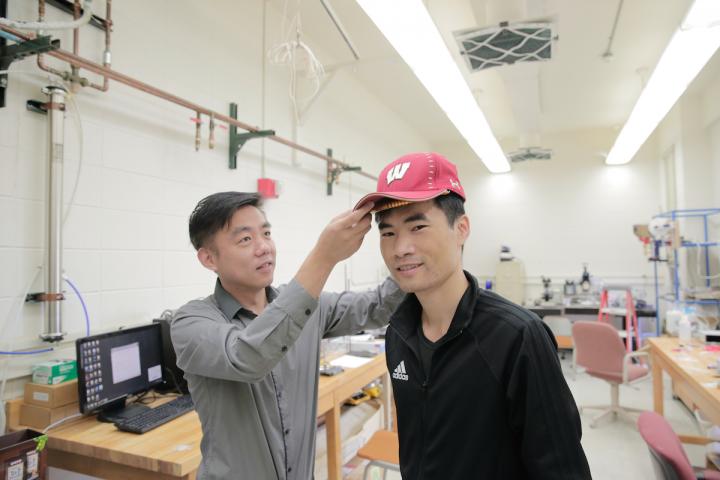
Credit: UW-Madison photo by Sam Million-Weaver.

MADISON — Few things on earth strike fear into the hearts of men more profoundly than hair loss. But reversing baldness could someday be as easy as wearing a hat, thanks to a noninvasive, low-cost hair-growth-stimulating technology developed by engineers at the University of Wisconsin-Madison.

“I think this will be a very practical solution to hair regeneration,” says Xudong Wang, a professor of materials science and engineering at UW-Madison.

Wang and colleagues published a description of the technology in the journal ACS Nano.

Based on devices that gather energy from a body’s day-to-day motion, the hair-growth technology stimulates the skin with gentle, low-frequency electric pulses, which coax dormant follicles to reactivate hair production.

The devices don’t cause hair follicles to sprout anew in smooth skin. Instead they reactivate hair-producing structures that have gone dormant. That means they could be used as an intervention for people in the early stages of pattern baldness, but they wouldn’t bestow cascading tresses to someone who has been as bald as a billiard ball for several years.

Because the devices are powered by the movement of the wearer, they don’t require a bulky battery pack or complicated electronics. In fact, they’re so low-profile that they could be discreetly worn underneath the crown of an everyday baseball cap.

Wang is a world expert in the design and creation of energy-harvesting devices. He has pioneered electric bandages that stimulate wound-healing and a weight-loss implant that uses gentle electricity to trick the stomach into feeling full.

The hair-growth technology is based on a similar premise: Small devices called nanogenerators passively gather energy from day-to-day movements and then transmit low-frequency pulses of electricity to the skin. That gentle electric stimulation causes dormant follicles to “wake up.”

“Electric stimulations can help many different body functions,” says Wang. “But before our work there was no really good solution for low-profile devices that provide gentle but effective stimulations.”

Because the electric pulses are incredibly gentle and don’t penetrate any deeper than the very outermost layers of the scalp, the devices don’t seem to cause any unpleasant side effects. That’s a marked advantage over other baldness treatments, like the medicine Propecia, which carries risks of sexual dysfunction, depression and anxiety.

What’s more, in side-by-side tests on hairless mice, the devices stimulated hair growth just as effectively as two different compounds found in baldness medicines.

“It’s a self-activated system, very simple and easy to use,” says Wang. “The energy is very low so it will cause minimal side effects.”

###

The researchers have patented the concept with the Wisconsin Alumni Research Foundation, and they hope to move forward with human testing soon.

— Sam Million-Weaver, perspective@engr.wisc.edu

Media Contact
Xudong Wang
xudong@engr.wisc.edu

Original Source

https://news.wisc.edu/electric-tech-could-help-reverse-baldness/http://

Related Journal Article

http://dx.doi.org/10.1021/acsnano.9b03912

Tags: Biomedical/Environmental/Chemical EngineeringResearch/DevelopmentTechnology/Engineering/Computer Science
Share13Tweet8Share2ShareShareShare2

Related Posts

Early Uric Acid Reductions Do Not Lower Clinical Risks in Asymptomatic Patients

Early Uric Acid Reductions Do Not Lower Clinical Risks in Asymptomatic Patients

November 27, 2026
Case Study Links Underlying Thyrotoxicosis to Severe Metabolic Decompensation in Classic MSUD

Case Study Links Underlying Thyrotoxicosis to Severe Metabolic Decompensation in Classic MSUD

November 27, 2026

Multimodal Drone Sensor Fusion Accurately Estimates Maize Leaf Area Index Across Fields

November 27, 2026

Deposition Temperature Boosts Solar Photocatalytic Breakdown of Dye by Manganese Oxide Films

November 27, 2026
Please login to join discussion

POPULAR NEWS

  • Researchers Identify Microglial and Cytoskeletal Targets Across Preclinical Neurodegeneration Models

    Researchers Identify Microglial and Cytoskeletal Targets Across Preclinical Neurodegeneration Models

    29 shares
    Share 12 Tweet 7
  • Longitudinal MRI Radiomics Adds Little Value Beyond Glioblastoma Tumor Volumetry

    29 shares
    Share 12 Tweet 7
  • Lake Productivity Shows Minor Influence on Roach Growth Across Polish Waters

    29 shares
    Share 12 Tweet 7
  • EPHA-Related Gene Signature Predicts Patient Survival in Lung Adenocarcinoma Progression

    29 shares
    Share 12 Tweet 7

About

We bring you the latest biotechnology news from best research centers and universities around the world. Check our website.

Follow us

Recent News

Early Uric Acid Reductions Do Not Lower Clinical Risks in Asymptomatic Patients

Case Study Links Underlying Thyrotoxicosis to Severe Metabolic Decompensation in Classic MSUD

Multimodal Drone Sensor Fusion Accurately Estimates Maize Leaf Area Index Across Fields

Subscribe to Blog via Email

Enter your email address to subscribe to this blog and receive notifications of new posts by email.

Join 89 other subscribers
  • Contact Us

Bioengineer.org © Copyright 2023 All Rights Reserved.

Welcome Back!

Login to your account below

Forgotten Password?

Retrieve your password

Please enter your username or email address to reset your password.

Log In
No Result
View All Result
  • Homepages
    • Home Page 1
    • Home Page 2
  • News
  • National
  • Business
  • Health
  • Lifestyle
  • Science

Bioengineer.org © Copyright 2023 All Rights Reserved.