A study led by Hiroshima University finds that nuclear membrane protein Lem2 acts as a valve to control the size of the nucleus, keeping it in proportion to the size of the cell
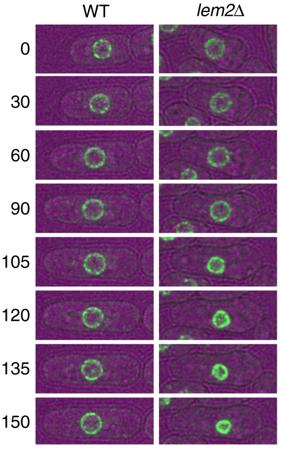
Credit: From the paper: Nuclear membrane protein Lem2 regulates nuclear size through membrane flow
Hiroshima, Japan – The size of the nucleus, often described as the command center of a cell, is proportional to cellular size, resulting in a constant ratio of nuclear and cellular volumes throughout the cell cycle. Using a deceptively simple system, multinucleate cells rely on the relative amount of cytoplasm to govern nucleus size, causing the nuclear volume to change in concert with cell growth.
The nucleus is surrounded by an envelope that is part of a subcellular membrane network, with the nuclear membrane being continuous with the endoplasmic reticulum. It stands to reason then that as the nucleus increases or decreases in size, so too does the nuclear membrane. Yet the mechanisms controlling nuclear size and the contribution of the membrane to this process are largely unknown.
In a study published this week in Nature Communications, a multinational research team from Hiroshima University and The Francis Crick Institute show that inner nuclear membrane protein Lem2 is key to nuclear size control in model eukaryotic organism Schizosaccharomyces pombe.
As lead author of the study, Dr Kazunori Kume of Hiroshima University explains how the team zeroed in on Lem2 and confirmed its role in nuclear size control.
“We created deletion mutants of various inner nuclear membrane proteins in S. pombe and assessed any resulting changes in the nuclear volume/cytoplasmic volume ratio. While no aberrations were detected in the single-mutant cells, deletion of Lem2 augmented the previously-documented nuclear enlargement of a rae1-167 mutant strain.”
Because the nuclear membrane is connected to the subcellular membrane network, it can flow between the nucleus and other parts of the cell. By alternately blocking membrane synthesis and nucleocytoplasmic transport in normal and lem2 mutant cells, the researchers discovered that Lem2 controls the flow of the membrane between the nuclear envelope and the rest of the cellular membrane system. Further, by expressing excess Lem2 in rae1-167 mutants, they could prevent the nuclear enlargement normally seen in these cells.
Interestingly, the team also found that endoplasmic reticulum protein Lnp1 could compensate for the lack of Lem2, effectively acting as a secondary barrier to membrane flow. The presence of a back-up system highlights the importance of nuclear scaling to the physiology of the cell.
“We propose that Lem2 acts as a valve to control membrane flow into and out of the nuclear envelope, forming part of a nuclear size control mechanism,” says Dr Kume. “It is likely that similar mechanisms may regulate the sizes of other organelles in the eukaryotic subcellular membrane network, helping to keep these organelles in proportion to the rest of the cell.”
###
Since its foundation in 1949, Hiroshima University has strived to become one of the most prominent and comprehensive universities in Japan for the promotion and development of scholarship and education. Consisting of 12 schools and 11 graduate schools, ranging from International Development and Cooperation to Integrated Arts and Sciences, the university has grown into one of the most distinguished research universities in Japan. English website: https:/
Media Contact
Norifumi Miyokawa
[email protected]
Related Journal Article
http://dx.