Community-developed blueprint of worm metabolism holds promise for greater understanding of aging
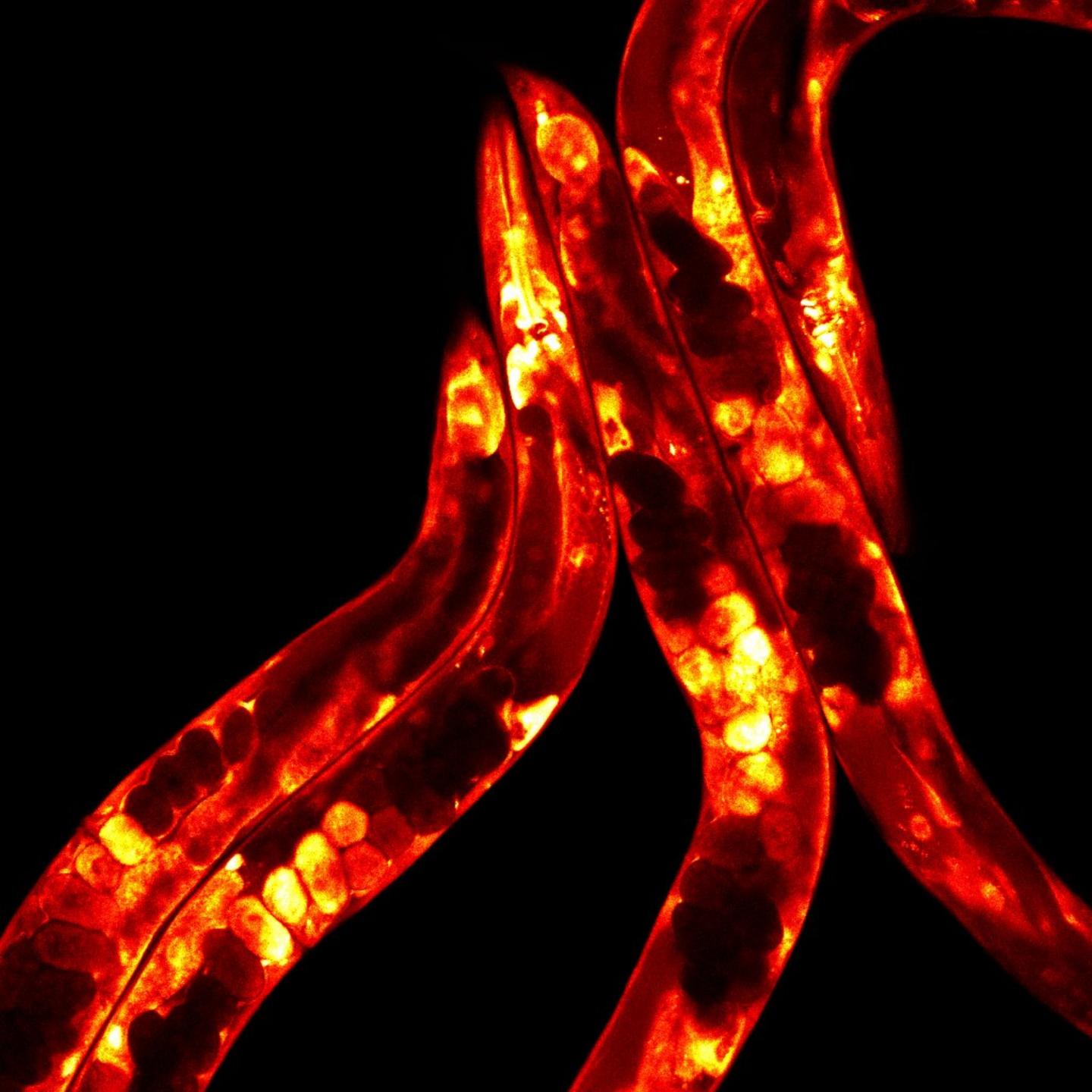
Credit: Credit: Dr. Laetitia Chauve, Babraham Institute.
Key points:
- Multi-disciplinary collaboration and community effort has produced a consensus blueprint of worm metabolism and associated research tools
- Latest research has re-optimised the model for relevance to metabolic changes during ageing
- Model validated with research case study in ageing C. elegans worms
What can worms tell us about human ageing? A lot more than you’d think; as research led by the Babraham Institute but involving researchers from multiple disciplines drawn together from across the world has shown. In a cluster of papers, the latest of which is published today in Frontiers in Molecular Biosciences, the researchers describe how a collaborative effort has developed a single agreed model of metabolic flux in a tiny worm called C. elegans, and how Babraham Institute researchers have used this model to understand more about the link between metabolism and ageing.
Metabolism fuels life; converting food to energy for cellular processes and ensuring a supply of building blocks to meet the organism’s needs. Importantly, metabolism plays a key role in modulating longevity, as many of the genes that are known to extend lifespan do so by altering the flow of energy and signals in cells and across tissues. There is demonstration of this relationship shown by the influence of diet and severe calorie restriction on lifespan in many organisms, including humans.
C. elegans is one of the best model organisms to investigate the process of ageing because of its short lifespan (2-3 weeks) and readily available genetic tools. It also shares many of its core metabolic pathways with humans and many of the key genetic players in determining the lifespan of worms have been found to do the same in humans.
“One major barrier for fully exploiting the potential of C. elegans as a research tool was the lack of a model uniting everything that was known about C. elegans metabolism,” says Janna Hastings, a PhD student in the Casanueva lab at the Babraham Institute. “To overcome this, we initiated a global team effort to reconcile existing and conflicting information on metabolic pathways in C. elegans into a single community-agreed model and launched the resulting WormJam resource in 2017.”
The Casanueva lab at the Babraham Institute use C. elegans to understand how metabolism changes during the normal course of ageing and how a variety of interventions that change metabolic fluxes can extend the length and quality of life. Physical changes evident in ageing worms point towards the loss of central metabolic capabilities as the worms age. The developed metabolic model was valuable to their research but had one key limitation; it best reflected what was happening during the growing phase of C.elegans, not the ageing phase.
“One of the key challenges that we face when studying ageing is that the modelling tools available are optimised for animals or cells that are in the process of growing, which is not happening in aged animals,” explains Dr Olivia Casanueva, group leader in the Epigenetics programme at the Babraham Institute.
Confronted with this challenge, the researchers re-optimised the modelling tool using data from multi-omic sources (both transcriptomics and metabolomics) and were able to adapt the tool to study metabolic fluxes during ageing.
The relevance of the model to understanding the metabolic changes that occur during ageing was validated in the lab by studying ageing worms. The research identified a number of metabolites that significantly change with age and revealed a drop in mitochondrial function with age.
Mitochondria are the powerhouse of energy production in the cell and their declining function in older humans may be central to ageing and many age-related diseases such as Alzheimer’s. The researchers asked whether the new optimised tools could predict which metabolites produced by the mitochondria might be most affected by age.
“The model prediction was quite accurate, as it predicted that Oxaloacetate, a key resource for the production of energy, was becoming limiting in aged worms,” said Dr Casanueva. “We know that of all metabolites that can be supplemented to the food source for ageing worms, Oxaloacetate is the one metabolite that produces the most robust effect – extending lifespan by up to 20%.”
So, what can worms tell us about human ageing? A lot more now, thanks to the WormJam model and the subsequent development to adapt this for ageing studies.
“This re-optimisation of the model for ageing animals represents a significant technical advance for the field and will allow more accurate predictions of metabolic fluxes during the course of ageing,” concludes Dr Casanueva. “By developing our understanding of the experimental model of ageing, we can gain valuable insight into what’s happening in humans – taking a step towards achieving healthier ageing.”
###
Media Contact
Louisa Wood
[email protected]
44-012-234-96230
Original Source
https:/
Related Journal Article
http://dx.